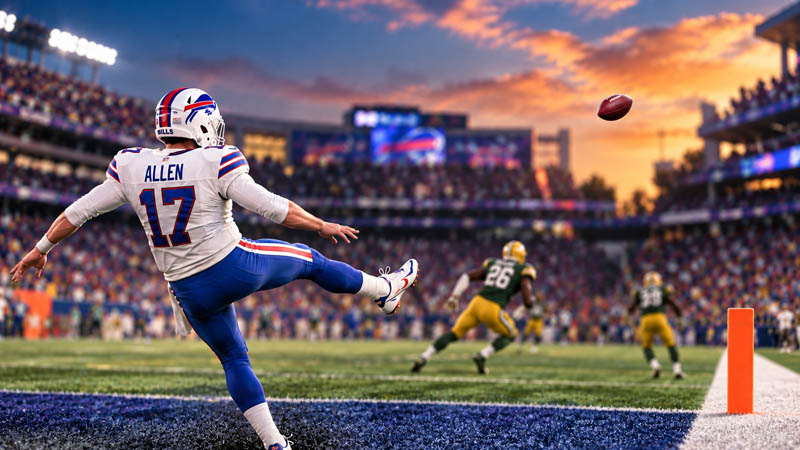
In professional football, field position can dramatically influence a team’s chances of winning. One classic strategy designed to control field position is the coffin-corner punt.
However, a common misconception is that NFL quarterbacks perform these punts. They do not. Coffin-corner punts are executed by specialized punters, who aim to kick the ball out of bounds near the opponent’s goal line.
This precise technique limits return opportunities and forces the opposing offense to begin its drive deep in its own territory.
Although rule changes and modern kicking techniques have reduced its frequency, the coffin-corner punt remains an important special-teams strategy.
Quarterbacks vs. Punters on Fourth Down
To understand why the public occasionally associates quarterbacks with punting, we must look at the history of football strategy.
Decades ago, during the single-wing era of football, players were generalists. The “quick kick”—a surprise punt executed by a tailback or quarterback on third down to catch the defense off guard—was a viable weapon.
In today’s highly specialized professional landscape, however, every roster spot is optimized. A starting quarterback’s physical training focuses entirely on pocket movement, throwing mechanics, and defensive coverage recognition.
Asking a franchise quarterback to perform a high-precision directional kick is not only an unnecessary injury risk, but it also ignores the extreme physical specialization required to punt at the professional level.
While a quarterback might line up as a punter or holder during a highly calculated trick play on fourth-and-short, these are emergency exceptions rather than standard strategies.
The true masters of the boundary line are the punters, who treat the field as a geometric plane to be carved up with mathematical precision.
Anatomy of the Coffin-Corner: What Is It?
In the official rulebook, there is no separate category labeled “coffin-corner”. The play is, by all legal definitions, a standard scrimmage kick.
The term itself is football shorthand used by broadcasters, coaches, and players to describe a specific target zone and strategic intent.
A coffin-corner punt is a highly directional kick aimed at the narrow, high-stress area where the sideline meets the receiving team’s goal line.
The ultimate goal is simple yet incredibly difficult to achieve: make the football travel out of bounds or allow the coverage unit to secure it as close to the opponent’s goal line as possible, without letting the ball break the plane of the end zone.
By successfully placing the ball in this microscopic corridor, the kicking team accomplishes three primary objectives:
- Chokes Opposing Field Position: It forces the opposing offense to start their next possession backed up against their own goal line, severely limiting their offensive playbook and execution room.
- Denies the Return: By angling the ball sharply out of bounds, the kicking team eliminates any opportunity for a dynamic return specialist to gain yardage.
- Prevents Touchbacks: It keeps the ball from entering the end zone, avoiding a costly touchback that would hand the opponent free yards.
The Strategic Math: Precision Over Power
When a punter drops back to execute a standard kick from deep in their own territory, the objective is sheer power: maximize distance and hang time to flip the field. However, once an offense stalls near midfield—often referred to as “plus territory”—the strategic paradigm shifts entirely.
In plus territory, a massive, booming kick becomes a liability because any ball that rolls into or crosses the end zone results in a touchback. In these scenarios, precision completely overrides power.
A 40-yard kick that is downed at the 3-yard line is infinitely more valuable to a coaching staff than a 52-yard kick that slides into the end zone for a touchback.
The Three-Variable Equation
Every directional kick requires the punter to solve a complex, real-time equation involving three competing variables:
                  [ 1. Distance ]
                         ^
                         |
                         v
  [ 2. Hang Time ] <----------> [ 3. Directional Control ]
- Distance: The kick must have enough depth to push the opponent deep, but not so much that it enters the end zone.
- Hang Time: The ball must stay in the air long enough to allow the coverage unit to run down the field and position themselves around the landing zone.
- Directional Control: The trajectory must be angled sharply toward the sideline to minimize the returner’s field of play.
If the punter misses too far inside, the returner gains open space in the middle of the field. If they kick too far outside, the ball may travel out of bounds too quickly, sacrificing massive chunks of potential field position. If the kick has too much forward energy, it breaks the goal line, resulting in a self-inflicted strategic error.
The 2026 Rule Change: Why Touchbacks Are More Dangerous Than Ever
The strategic value of the directional kick has skyrocketed due to modern updates to the league’s rulebook. Under the NFL’s 2026 rulebook, a scrimmage-kick touchback places the ball at the receiving team’s 20-yard line.
+--------------------------------------------------------+
|                      END ZONE                          |
+--------------------------------------------------------+
| [Goal Line]                                            |
|                                                        |
|   * * * TOUCHBACK ZONE (Accidental End Zone Entry)     |
|   Result: Ball placed at the 20-Yard Line              |
|                                                        |
|------------------------------------ [20-Yard Line] ----|
|                                                        |
+--------------------------------------------------------+
This ruleset creates a massive strategic penalty for kicking teams that fail to control their distance. For a special teams unit working from plus territory, allowing a ball to barely break the goal-line plane immediately erases the spatial advantage the drive was intended to secure.
Giving a professional offense a starting point at the 20-yard line, free of charge, represents a massive failure in field-position management.
Because of this rule, punters must show extreme restraint and pinpoint control, ensuring the ball lands or exits the field of play well short of the goal line.
Execution: The Team Behind the Kick
One of the greatest misconceptions among casual viewers is that a coffin-corner kick is a one-man show. In reality, special teams coordinators view this play as a synchronized, eleven-man operation that requires flawless execution across three distinct phases:
1. Protection and the Snap
Before the punter can even analyze the wind or calculate the kick angle, the offensive line must establish a solid wall of protection. Chasing perfect sideline placement becomes completely irrelevant if the defensive rush disrupts the punter’s rhythm or blocks the kick entirely.
The long snapper must deliver a fast, accurate ball to the punter’s hip, allowing the specialist to keep their eyes on the oncoming rush and the downfield wind patterns.
2. Trajectory Control
Once the ball is secured, the punter adjusts their body alignment to face the target boundary. They launch the ball on a calculated, angled trajectory designed to carry it toward the sideline.
The punter hopes that either the flight of the ball will take it directly out of bounds inside the 5-yard line, or its spin will cause it to check up and bounce laterally toward the boundary rather than forward into the end zone.
3. The Gunner’s Box-Out
The coverage unit, led by lightning-fast gunners on the outside, is responsible for completing the play. Gunners sprint down the field, matching the flight of the ball. Their job is to position themselves between the returner and the sideline, effectively boxing the returner in.
If the ball lands in bounds short of the goal line, the gunners must legally down the ball before its forward momentum carries it into the end zone.
This is why a successful directional kick does not actually have to travel out of bounds in the air; a ball downed by a diving gunner at the 1-yard line is an absolute home run for the special teams unit.
The Returner’s Nightmare: Split-Second Calculations
For a punt returner standing inside their own 10-yard line, a perfectly placed directional kick creates an immediate psychological crisis. The returner must process the ball’s flight, their proximity to the boundary, and the oncoming coverage unit in a fraction of a second.
                          [Sideline Boundary]
                     ----------------------------
                     \                          /
                      \   [Returner Squeezed]  /  <-- Sideline cuts off
                       \           x          /      50% of escape routes
                        \         / \        /       and reduces vision
                         \   [Gunners Closing]
                          \       o   o     /
                           \               /
They are faced with a series of high-risk decisions:
- The Fair Catch Dilemma: Catching the ball guarantees possession and prevents a chaotic bounce, but it also traps their offense at that exact, deep location.
- The Let-It-Bounce Gamble: Choosing to let the ball drop in hopes of a touchback is highly risky. The oblong shape of a football makes its bounce notoriously unpredictable. Instead of rolling forward into the end zone, it can easily spin sideways, die on the turf, or be saved by a diving coverage player.
- The Sideline Trap: Attempting to field the ball and launch a return in the corner is incredibly dangerous. The sideline acts as an extra defender, instantly removing half of the returner’s potential escape paths. A returner moving laterally has almost no space to turn upfield, leaving them highly vulnerable to hard contact that can trap them even deeper. Furthermore, fielding a high-velocity kick next to the boundary increases the risk of a muffed punt—a live-ball scramble that can easily result in a defensive touchdown.
The Modern Shift: Aussie-Style vs. Traditional Corners
If the coffin-corner kick is so strategically effective, why do modern NFL viewers see it used less frequently than in previous decades? The answer lies in a specialized kicking revolution.
The Rise of Australian-Style Punting
In the modern NFL, the traditional, low-trajectory spiral aimed at the sideline has largely been replaced by “Aussie-style” punting.
Popularized by collegiate and professional specialists from Australia, this technique involves dropping the football end-over-end rather than in a tight spiral.
As former Green Bay Packers specialist Tim Masthay has pointed out, end-over-end kicks offer vastly superior distance control compared to traditional low-trajectory sideline kicks.
When an end-over-end kick hits the turf, its backward spin naturally causes the ball to check up or bounce backward, significantly reducing the risk of an accidental touchback.
Trusting the Coverage Athletes
Additionally, today’s NFL players are faster and more athletic than ever. Modern special teams coordinators prefer to rely on high, hanging, directional kicks down the numbers.
By prioritizing maximum hang time over a sharp sideline angle, coaches allow their elite gunners to sprint downfield, surround the returner, and down the ball inside the 10-yard line with a much lower margin of error.
Aiming for a sharp, lateral angle out of bounds carries a much higher risk of a shanked kick or a ball that goes out of bounds too early, wasting valuable field-position opportunities.
Debunking the Top 3 Misconceptions
To round out your understanding of this historic football concept, let’s clear up three of the most common myths associated with the play:
1. The Punter Must Hit the Literal Corner Pylon
False. The orange corner pylon is a visual marker for the goal line, not a realistic target for a punter. Special teams coaches target a landing zone, not a pinpoint coordinate. The ideal target is a wide, comfortable corridor near the boundary, several yards short of the goal line, which accounts for natural wind drift and rush pressure.
2. The Kick Is Only Successful If It Goes Out of Bounds
False. While a ball flying out of bounds is highly effective because it guarantees zero return yards, an in-bounds kick that is downed by the coverage unit at the 2-yard line is just as successful. The primary metric of success is where the opposing offense is forced to take their first snap, not whether the ball crossed the sideline in the air.
3. Quarterbacks Use This Technique on Trick Plays
False. While quarterbacks can technically execute a “quick kick,” they do not possess the specialized training to hit a coffin-corner target under pressure. If a team runs a fourth-down trick play involving a quarterback, the goal is typically to convert the first down through the air or on the ground, rather than executing a highly complex directional kick.
The Ultimate Field-Position Chess Game
Ultimately, the coffin-corner concept is a beautiful demonstration of field-position geometry. It is a play where a special teams unit uses the boundary of the field as an extra defender, squeezes the returner’s options, and attempts to stop the ball just inches before the end zone.
The next time you watch a professional broadcast, ignore the ball for a moment after a punt from midfield. Watch the leverage of the outside gunners and the positioning of the returner.
If the punter has executed their job correctly, you will see a returner trapped against the sideline, surrounded by coverage players, with their back literally inches from their own goal line. It is a play of microscopic margins, executed not by quarterbacks, but by the most precise specialists on the roster.