
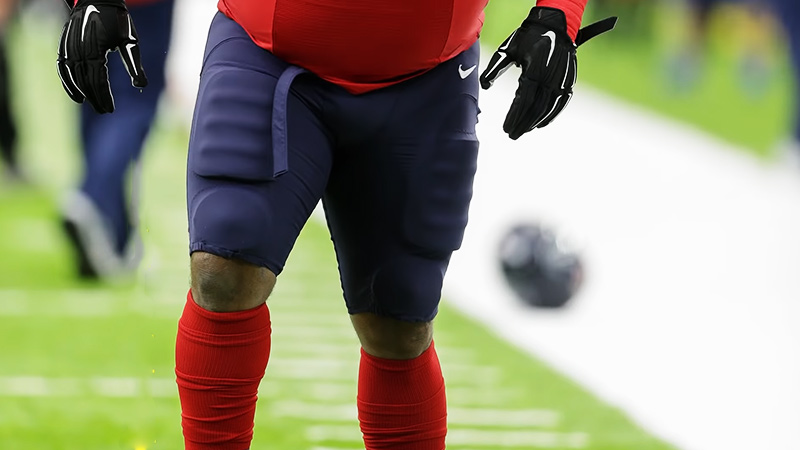
On any given Saturday, a casual observer of college football will notice a striking uniform trend among the “big men” in the trenches.
Nearly every offensive lineman is outfitted with heavy-duty, dual-hinged prophylactic knee braces.
These metallic contraptions, designed to prevent the devastating lateral impacts common in pileups, seem like a logical necessity for athletes of that size. However, when the clock strikes Sunday and the NFL takes the field, those braces largely disappear.
The absence of this protective gear at the professional level is not an oversight, nor is it a sign of decreased risk. Instead, it is a calculated decision rooted in the high-stakes trade-offs between physical protection and the elite-level biomechanics required to survive in the most competitive league on earth.
For an NFL lineman, the choice to go “bare-kneed” is a choice to prioritize the split-second mobility that often separates a starter from a backup.
The Biomechanical Cost of Protection
The primary reason NFL linemen avoid prophylactic knee braces is the inherent restriction they place on natural movement. In the professional game, where every player is a world-class athlete, the margins for error are microscopic.
A defensive end’s “get-off” speed is measured in fractions of a second, and an offensive lineman must mirror that movement with absolute precision.
The rigid metal or plastic hinges found in standard prophylactic braces are designed to stabilize the joint against lateral forces, but this stability comes at a cost.
These hinges inevitably restrict the fluidity of the knee’s range of motion during complex, multi-planar movements.
While a brace might allow for basic flexion and extension, it often fights against the subtle rotational and lateral shifts required when a lineman is pulling on a sweep or adjusting to a sudden “stunt” by the defensive line.
For these professionals, even a lightweight brace creates what coaches call “mechanical drag”. In high-tempo environments, this drag hinders the ability to shift weight and react instantly to a defender’s move.
At the NFL level, losing even 1% of your agility can be the difference between making a block and allowing a sack that changes the course of a season.
The Loss of Proprioception and Ground-Connection
Beyond the physical weight and mechanical resistance of a brace, there is a deeper, more neurological reason for the NFL’s aversion to bracing: the loss of proprioception. Proprioception is the body’s internal “GPS”—the ability of the brain to sense the position and movement of limbs without looking at them.
Linemen spend decades honing their footwork mechanics to a level of unconscious mastery. Every step, slide, and kick-back is calibrated based on the sensory feedback coming from their feet and joints.
When a rigid frame is strapped to the knee, it alters this natural sense of movement. The compression of the sleeve and the pressure of the straps send “noise” to the nervous system, which can muffle the precise signals the athlete relies on to maintain balance.
Many professional players report feeling less “connected” to the turf when wearing braces. In a position where “winning the ground” is the ultimate objective, this sensory disconnect is a significant disadvantage.
To an NFL lineman, being able to feel the subtle shifts in their own weight and the tension in the grass is more valuable than the insurance policy of a metal hinge.
The Precision of Professional Footwork
It is a common misconception that offensive line play is merely a contest of brute strength. In reality, it is a dance of extreme precision.
The “kick-slide” used by left tackles to protect the quarterback’s blind side is a finely tuned mechanical pattern that requires perfect hip-to-knee-to-ankle alignment.
Adding a rigid external frame to this kinetic chain can disrupt these mechanics. Because the brace dictates a specific path of motion, it may force the athlete into a movement pattern that is slightly “off” from their natural gait.
Over the course of a 17-game season—and the thousands of snaps taken in practice—these tiny deviations can lead to compensatory injuries elsewhere in the body, such as the hips or the ankles.
Professional linemen prioritize their ability to execute these movement patterns with 100% efficiency. They find that the minor protection offered by a prophylactic brace is offset by the tangible loss in the speed and agility required to maintain their technique against elite pass-rushers.
Mandates vs. Autonomy: The Collegiate Divide
One of the most frequent questions from fans is why the rules seem so different between the NCAA and the NFL. The discrepancy is largely a matter of institutional policy and liability management rather than a difference in medical opinion.
In many college and high school programs, prophylactic knee braces are mandated for all offensive linemen.
These programs view the braces as a necessary precaution to guard against the chaotic nature of “pileups” and to lower the program’s liability in the event of a catastrophic injury.
In the developmental stages of a player’s career, the focus is often on keeping them on the field at all costs, even if it means sacrificing a small degree of performance.
However, once a player reaches the NFL, the environment shifts toward individual autonomy. Unless a player is actively rehabbing a specific, diagnosed knee injury, the decision to wear a brace is almost entirely up to them.
At this level, players are considered the masters of their own bodies. Most choose to prioritize comfort and maximum mobility over the “preventive restriction” that defined their college years.
They have reached a level where their career longevity depends more on their ability to outmaneuver their opponent than on their ability to withstand a freak lateral impact.
The Economics of the Trench
There is also an undeniable economic factor at play. An NFL lineman’s value is tied directly to their performance on tape.
If a player looks “heavy-footed” or “slow in the hips” because of a brace, it can impact their contract negotiations and their longevity in the league.
In the pros, the game is faster, the athletes are stronger, and the consequences of a missed block are more severe.
When faced with the choice between a 5% reduction in injury risk (the “protection”) and a 5% reduction in lateral quickness (the “performance hit”), the vast majority of NFL players will bet on their quickness every time.
They understand that the best way to prevent an injury is often to be fast enough to avoid the compromising position in the first place.
Conclusion: The Elite Standard
The decision to forgo knee braces in the NFL is a testament to the extreme level of athleticism required in modern professional football.
While youth and collegiate programs emphasize a “safety first” approach through mandates, the NFL operates on a “performance first” philosophy.
For the men who inhabit the trenches, the knee brace represents a paradox: it offers protection from the outside world while simultaneously stripping away the internal mechanics that allow them to excel.
By choosing bare knees and unencumbered joints, NFL linemen are choosing to trust their training, their footwork, and their natural agility.
In the high-velocity world of professional sports, the ability to move without restriction is the ultimate form of protection.






