
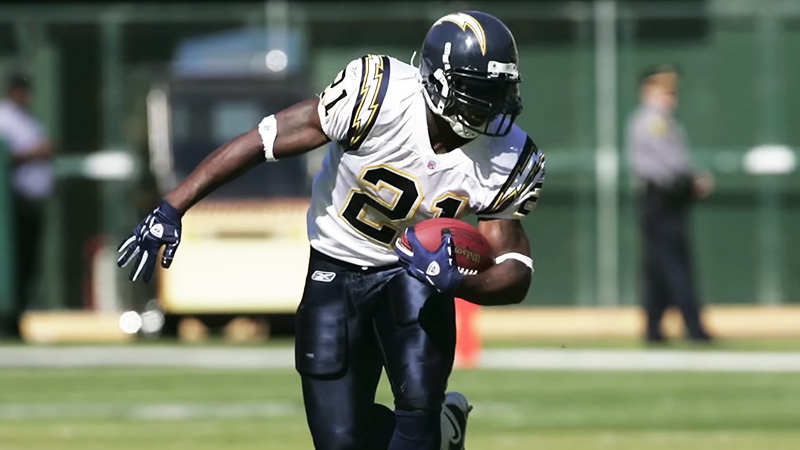
When observing a modern professional or collegiate football game, one of the most striking visual shifts from decades past is the silhouette of the athletes.
The baggy, billowing jerseys of the 1980s and 90s have been replaced by what appears to be a “shrink-wrapped” aesthetic.
To the casual observer, this might seem like a stylistic choice or a display of physical fitness. However, in the high-stakes environment of elite athletics, every millimeter of fabric is engineered with a specific purpose.
The transition to tight, small-looking jerseys is a response to the evolving physics of the game. It is a calculated convergence of tactical advantage, injury mitigation, and ball security.
For organizations operating at the highest levels of the sport, these uniforms are not merely clothing—they are a critical component of a player’s armor.
I. The Tactical Imperative: Eliminating the Defender’s Handle
The primary driver behind the “small shirt” phenomenon is the elimination of grasping points. In a sport where a single yard can determine the outcome of a multi-million dollar season, any physical advantage is exploited.
Removing the Leverage Points
In the past, loose jerseys acted as inadvertent handles for defensive players. A trailing defender could grab a handful of fabric to slow down a breakaway runner or redirect a wide receiver during a route.
By adopting a “second-skin” fit, players significantly reduce the surface area available for an opponent to grip.
This design choice forces defenders to make contact with the player’s body or pads rather than relying on the leverage provided by excess cloth.
The Role of Tailoring and Adhesives
To achieve this near-seamless fit, professional equipment managers utilize advanced tailoring techniques. Jerseys are often custom-fitted to the specific dimensions of a player’s shoulder pads, leaving zero “slack” in the material.
In many elite locker rooms, it is common practice to use heavy-duty double-sided tape to bond the jersey directly to the plastic shell of the shoulder pads.
This ensures that even during high-velocity collisions, the jersey remains anchored, denying opponents a clear grip and simultaneously reducing the likelihood of illegal holding penalties that can stall an offensive drive.
II. Enhancing Ball Security: The Physics of the Grip
For “skill position” players—running backs, wide receivers, and tight ends—the tightness of the uniform is directly linked to the security of the football.
The “Slippery Sleeve” Problem
Modern athletic fabrics are designed to be moisture-wicking and durable, but these synthetic polyesters can be significantly slicker than human skin or the leather of a football.
A loose sleeve resting between a player’s forearm and the ball creates a “slip zone,” increasing the risk of a fumble during a tackle.
By wearing tight sleeves or opting for sleeveless compression layers, players ensure that the football remains in direct contact with the “grippier” surface of their skin or the high-friction gloves they wear.
Unrestricted Biomechanics
Precision is the hallmark of the modern passing game. A quarterback’s throwing motion or a receiver’s reach for a high pass requires a total range of motion.
Excess fabric can bunch at the shoulders or under the arms, creating mechanical resistance.
Form-fitting gear ensures that the athlete’s movement remains fluid and uninterrupted, allowing for the maximum extension required to make game-changing plays.
III. The Foundation of Safety: Pad Anchoring and Compression
While the jersey is the most visible layer, the “small shirts” worn underneath—the compression base layers—are arguably more vital for the athlete’s physical longevity.
Stabilizing the Armor
Football is a game of repeated, high-impact collisions. If a player’s shoulder pads or rib protectors are allowed to shift upon impact, they can fail to protect the very areas they were designed to shield.
Tight compression layers act as a stabilizing foundation, keeping heavy protective padding snug against high-impact zones.
This ensures that the energy of a hit is distributed across the pad as intended, rather than the pad sliding and exposing a joint or bone to direct force.
Dermal Protection and Temperature Regulation
The environment inside a football uniform is punishing. The friction between heavy plastic pads and the skin can cause severe chafing and “turf burns” during a slide.
Tight compression shirts sit directly against the skin to act as a protective barrier, absorbing sweat and preventing the painful abrasions that can distract a player during competition.
Furthermore, these layers assist in thermoregulation, move moisture away from the body, and maintain muscle warmth during periods of inactivity on the sidelines.
IV. Audience Profiling: Who Benefits from the “Small Fit”?
To understand the universal adoption of this trend, we must look at the various personas on the field and how the equipment addresses their specific pain points.
- The Power Back (The “Bruiser”): His primary pain point is being tackled by his jersey in the backfield. The tight fit ensures he can “squirt” through narrow gaps without fabric getting caught on a lineman’s fingers.
- The Perimeter Speedster (The “Deep Threat”): His challenge is maintaining top speed while fighting through “press coverage.” A form-fitting jersey prevents a defensive back from impeding his progress at the line of scrimmage.
- The Interior Lineman (The “Trench Warrior”): For these players, the tight fit is about safety and preventing “fingers in the jersey,” which frequently leads to broken digits and hand injuries for their opponents and themselves.
V. Technical Specifications: The Fabric of the Modern Game
The “small” appearance of these shirts is made possible by breakthroughs in textile engineering. Modern jerseys are typically constructed from a blend of high-denier polyester and elastane (Spandex).
- Four-Way Stretch: This allows the garment to expand over bulky padding while immediately snapping back to its original shape, maintaining the “no-grip” integrity.
- Hydrophobic Coating: Many jerseys are treated to shed water and sweat, ensuring the garment doesn’t become heavy or “stretchy” when wet, which would re-introduce the grabbing hazard.
- Reinforced Stitching: Because these jerseys are worn under extreme tension, the seams are often double or triple-reinforced to prevent blowouts during a tackle.
Frequently Asked Questions (FAQ)
Q: Does the tightness of the jersey make it harder for players to breathe?
A: No. Modern compression gear and jerseys are designed with “zonal stretch.” While the sleeves and torso are tight to prevent grabbing, the rib area often utilizes a more breathable, flexible weave that allows for full lung expansion during heavy exertion.
Q: Do players need help getting into these jerseys?
A: Yes, absolutely. In professional locker rooms, it often takes two equipment managers to “thread” a player into a jersey that has been taped and tailored to their pads. It is a process that can take several minutes.
Q: Are the jerseys actually smaller sizes (e.g., a Large wearing a Small)?
A: Not necessarily. While the jersey may look like a small, it is usually a custom-cut “pro-fit” that is designed with a shorter torso and narrower sleeves than a standard retail jersey, specifically to accommodate the pads underneath.
Q: Is this trend seen in other sports?
A: Yes. Rugby and elite-level soccer have adopted similar “slim-fit” or compression technologies to reduce jersey pulling and improve aerodynamics, though football remains the most extreme example due to the presence of hard armor.
Conclusion: A Triumph of Function Over Fashion
The “small shirt” aesthetic in American football is a perfect case study in functional design. What began as a way to stop defensive holding has evolved into a comprehensive system for enhancing ball security, stabilizing protective equipment, and ensuring an athlete’s range of motion is never compromised.
As the game continues to get faster and the hits become more explosive, the engineering of the uniform will only become more precise. The “shrink-wrapped” look is not a trend—it is a tactical necessity.
For the athletes on the field, these tight-fitting layers are the difference between a fumbled ball and a secured catch, or between a season-ending injury and a successful play.






