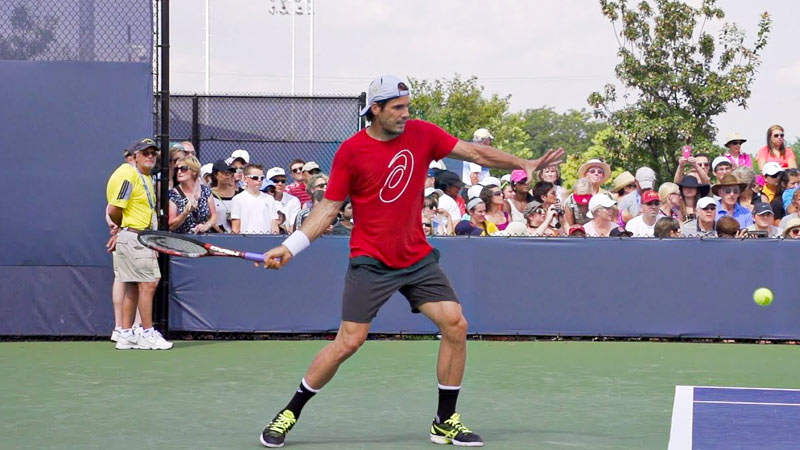
Tommy Haas officially retired on March 15, 2018, primarily due to the cumulative physical toll of a career-long battle with chronic injuries.
Despite reaching World No. 2 and securing 15 ATP titles, Haas endured nine major surgeries, including four on his right shoulder alone.
By age 39, the physical demands of elite professional tennis became unsustainable, manifesting as shortness of breath and fitness struggles during his 2017 farewell tour.
Choosing to exit on his own terms, Haas transitioned into a prestigious leadership role as the Tournament Director at Indian Wells, a position he had remarkably balanced since 2016.
The Physical Reality: Why Did Tommy Haas Retire?
The decision to walk away from professional tennis was not an overnight realization but the culmination of a “snake-bitten” career defined as much by rehabilitation as by match wins.
For Haas, the transition from the court to retirement was a necessary response to a body that had been pushed to its absolute limits over twenty-two years of high-intensity competition.
While many athletes retire due to a loss of passion or a decline in skill, Haas’s primary obstacle was a physical framework that required constant surgical intervention to remain functional at the professional level.
A Career Interrupted by Nine Major Surgeries
The sheer volume of medical procedures Haas underwent is nearly unparalleled in the history of the sport. His medical history includes four separate surgeries on his right shoulder, alongside major operations on his hip, foot, elbow, and ankle.
Each of these procedures required grueling months of recovery, yet Haas consistently found the strength to return to the top tier of the ATP Tour.
However, by the time he reached his late thirties, the “unbreakable” spirit that had driven his multiple comebacks began to clash with the reality of a body that could no longer recover at the speed required for the modern game.
The Psychological Toll of Four Years in Rehabilitation
It is important to recognize that Haas did not just lose matches to injury; he lost significant time. Over the course of his career, Haas spent a total of four full years in rehabilitation rather than on the court.
These “hidden years” represent a massive portion of an athlete’s prime that was spent in gymnasiums and doctor’s offices instead of competing for Grand Slam titles.
The mental fortitude required to return from a major surgery once is immense; to do so nine times is a testament to his character, but it also explains why retirement became the only logical conclusion once the physical discomfort began to outweigh the joy of the grind.
Defying the Odds: The Final Season of a Warrior
Before his official announcement in 2018, Haas embarked on a final tour in 2017 that allowed him to say goodbye to the fans and cities that had supported him for decades.
This period was crucial for his legacy, as it proved that even at the end of his career, his technical skill remained world-class.
He refused to let his career fizzle out in a doctor’s office, choosing instead to test himself one last time against the best in the world, providing a sense of closure that few “snake-bitten” athletes ever achieve.
The Stunning Victory Over Roger Federer
One of the most remarkable chapters of his final year was his victory over his close friend and tennis icon Roger Federer. In June 2017, playing on the grass courts of Stuttgart, Haas managed to upset Federer in a match that shocked the tennis world.
This victory was particularly significant because Federer would go on to win Wimbledon just weeks later.
For Haas, beating the greatest grass-court player in history during his final season served as a powerful reminder of the “World No. 2” caliber talent he possessed, even as his physical health was declining.
Recognizing the Signs of Physical Decline
Despite the high of the Federer victory, the 2017 season also brought the sobering reality that his time was up.
Haas began to experience what he described as a “horrible situation” during matches, where he felt physically unfit and suffered from shortness of breath.
The technical skill was there, and the competitive fire remained, but the biological engine was failing.
These symptoms made it clear that he could no longer compete safely or effectively at the ATP level, leading to the emotional retirement ceremony held under the desert sun in Indian Wells.
A Masterclass in Career Transitioning
One of the reasons Tommy Haas’s retirement is studied as a model for professional athletes is the seamless way he transitioned into a second career.
Unlike many players who struggle to find their identity after leaving the tour, Haas had already laid the groundwork for his future.
By the time he officially hung up his rackets, he was already an established figure in the business and management side of the sport, which provided a soft landing for his post-playing days.
Balancing the Dual Role at Indian Wells
In a move that is almost unheard of in professional sports, Haas was appointed the Tournament Director of the BNP Paribas Open in Indian Wells in 2016—while he was still an active player on the tour.
This dual role allowed him to view the sport from a management perspective while still understanding the needs of the competitors.
By the time he retired in 2018, he had already gained two years of executive experience, making the official end of his playing career feel less like a loss and more like a promotion into a full-time leadership role.
Shaping the Future of the ATP Tour
As Tournament Director, Haas has used his extensive experience to maintain Indian Wells’ reputation as one of the premier events on the tennis calendar.
His deep connections with players like Roger Federer and his understanding of the physical demands of the tour have allowed him to advocate for player-friendly conditions and world-class facilities.
This transition has ensured that while he no longer hits a ball for ranking points, his influence on the game remains as strong as ever, bridging the gap between the legends of the past and the stars of the future.
Statistical Legacy of a German Icon
To truly understand why Tommy Haas is held in such high regard, one must look at the consistency of his performance despite the interruptions caused by his health. The following data highlights the milestones of a career that spanned more than two decades.
| Career Metric | Achievement |
|---|---|
| Career-High Ranking | World No. 2 |
| Total ATP Singles Titles | 15 |
| Total Match Wins | 569 |
| Grand Slam Performance | 4-time Semifinalist (Australian Open, Wimbledon) |
| Olympic Achievement | Silver Medal (2000 Sydney) |
| Comeback Awards | 2-time ATP Comeback Player of the Year (2004, 2012) |
Haas’s 569 match wins place him among the elite in German tennis history, a feat made even more impressive when considering the four years he lost to surgery and rehabilitation.
His versatility was his greatest strength, allowing him to win titles on every major surface and remain competitive against multiple generations of champions, from the era of Sampras and Agassi to the dominance of the Big Three.
Frequently Asked Questions About Tommy Haas
Why did Tommy Haas wait until 2018 to officially retire?
Haas wanted to ensure he retired on his own terms rather than being forced out by a specific injury.
His 2017 tour allowed him to play his final matches in front of his fans, and his victory over Federer in Stuttgart proved he could still compete at a high level before he finally listened to his body’s signals for rest.
What is Tommy Haas doing now?
He currently serves as the Tournament Director for the BNP Paribas Open in Indian Wells, California. He has been in this role since 2016 and is responsible for overseeing one of the largest and most prestigious tennis tournaments outside of the four Grand Slams.
How many surgeries did Tommy Haas have?
Over the course of his career, Haas underwent nine major surgeries. These included four operations on his right shoulder, as well as procedures on his hip, foot, elbow, and ankle.
Did Tommy Haas ever win a Grand Slam?
While he never won a Grand Slam title, he reached the semifinals on four occasions: three times at the Australian Open and once at Wimbledon. He also earned an Olympic silver medal for Germany in 2000.
Conclusion: A Legacy of Fortitude
Tommy Haas’s retirement marked the end of an era for a player who embodied the spirit of persistence. His story is not just one of ranking points and trophies, but of a man who refused to be defined by his limitations.
By the time he stood on the court at Indian Wells in 2018 to say his final goodbye, surrounded by legends like Rod Laver and Pete Sampras, it was clear that he had earned the respect of the entire sporting world.
His transition into tournament management serves as a professional blueprint for modern athletes, demonstrating that a career-ending injury does not have to be the end of a professional journey.
Haas remains a central figure in tennis, ensuring that the grit and elegance he displayed on the court continue to influence the sport from the boardroom.
For fans and aspiring players, the message of his career is clear: success is not just about how high you climb, but how many times you are willing to get back up.