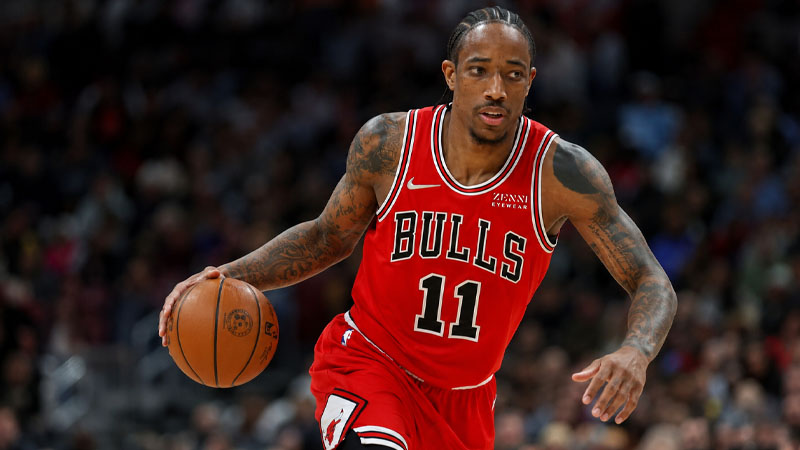
DeMar DeRozan changed his number to 11 upon joining the Chicago Bulls in 2021 because the franchise had retired his signature number 10 to honor legend Bob Love.
This transition marked a rare departure for the star, who has worn number 10 at every other stage of his career, from Compton High School to the USC Trojans, and throughout his tenures with the Toronto Raptors and San Antonio Spurs.
After three seasons in Chicago, DeRozan reclaimed his original number 10 following a 2024 move to the Sacramento Kings, where the digit was available.
Why Did DeMar DeRozan Change His Number in Chicago?
The decision to switch jersey numbers is rarely taken lightly by elite athletes, as a specific digit often becomes synonymous with their personal brand and professional identity.
When DeMar DeRozan entered the free agency market in 2021 and eventually landed with the Chicago Bulls, he faced a unique hurdle: the weight of history in one of the NBA’s most storied organizations.
Because the Bulls have a rigorous standard for jersey retirements, DeRozan had to pivot his aesthetic approach to accommodate the legends who came before him.
The Legacy of Bob Love’s Number 10
The primary reason DeRozan could not wear his preferred number in Chicago was the retirement of No. 10 in honor of Bob Love.
Love was a cornerstone of the Bulls during the late 1960s and 1970s, earning three All-Star nods and becoming one of the most prolific scorers in the team’s early history.
Out of respect for Love’s contribution to the city and the franchise, the number was taken out of circulation decades ago.
DeRozan, known for his deep respect for the history of the game, understood that certain numbers are sacred in specific arenas, leading him to seek a new numerical identity for his time in the Eastern Conference.
Embracing Number 11 as a Competitive Fresh Start
Faced with the unavailability of his usual digit, DeRozan selected No. 11 as a symbolic gesture of a “fresh chapter”.
This choice was not merely random; it represented a new competitive challenge as he joined a veteran-heavy Bulls roster looking to return to playoff relevance.
During his tenure in Chicago, the number 11 became a symbol of mid-range mastery and elite clutch performance.
While it was a temporary departure from his lifelong connection to number 10, the shift allowed him to create a distinct era in his career that fans would easily recognize as his “Chicago years”.
The Significance of Number 10: From Compton to Kobe
To understand why DeRozan’s return to number 10 in 2024 was so significant for both the player and the fans, one must analyze the deep-rooted personal and cultural ties he has to those specific digits.
For DeRozan, number 10 is not just a kit assignment; it is a direct link to his upbringing and the basketball idols who shaped his game. This connection spans from the streets of Southern California to the highest levels of international competition.
The “COMP10” Hometown Connection
DeRozan’s affinity for the number 10 began long before he reached the NBA. He wore the number at Compton High School, where his dominance on the court eventually led the school to retire the jersey in his honor.
Local fans and community members often refer to the player and the number through the moniker “COMP10,” a play on his hometown’s name that highlights his enduring loyalty to his roots.
This branding is similar to other NBA stars who use jersey numbers to represent their geographic origins, serving as a constant reminder of where his journey started.
Channeling the Greatness of Olympic Kobe Bryant
Beyond his personal history, DeRozan’s choice of number 10 is a tribute to his mentor and idol, Kobe Bryant. While Bryant famously wore 8 and 24 for the Los Angeles Lakers, he donned the number 10 while playing for Team USA in the Olympics.
DeRozan, who possesses one of the world’s most extensive collections of Kobe Bryant’s signature sneakers, viewed wearing number 10 as a way to channel “Olympic Kobe”.
This homage is a cornerstone of DeRozan’s professional philosophy, as he continues to uphold the “Mamba Mentality” through his work ethic and specialized footwork on the court.
Tracking DeMar DeRozan’s Jersey Numbers Through the Years
Throughout his professional and amateur career, DeRozan has demonstrated a remarkable level of consistency regarding his jersey choice. Aside from the three-year stint in Chicago, his career has been a steady showcase of the number 10.
The following table outlines the progression of his jersey numbers and the specific context behind each era of his career.
| Career Stage | Team/Affiliation | Jersey Number | Reason for Number Selection |
|---|---|---|---|
| High School | Compton High School | 10 | Local identity; now a retired jersey |
| College | USC Trojans | 10 | Continued his amateur legacy |
| NBA (2009–2018) | Toronto Raptors | 10 | Primary professional identity |
| NBA (2018–2021) | San Antonio Spurs | 10 | Maintained brand after trade |
| NBA (2021–2024) | Chicago Bulls | 11 | Number 10 retired for Bob Love |
| NBA (2024–Present) | Sacramento Kings | 10 | Reclamation of original identity |
How Does DeRozan’s Return to Number 10 Impact His Legacy?
In 2024, DeRozan joined the Sacramento Kings via a sign-and-trade deal, a move that allowed him to return to his preferred number 10 because it was active and available on the Kings’ roster.
Reclaiming this number is more than just a logistical change; it signifies the veteran’s return to the identity that defined his most iconic seasons in Toronto and San Antonio.
As he enters this new phase in Sacramento, the number 10 serves as a badge of his longevity and his status as one of the league’s premier scoring threats.
Climbing the All-Time NBA Scoring Leaderboard
The return to number 10 coincides with DeRozan reaching historic milestones in the NBA record books.
He recently surpassed basketball legends such as Paul Pierce and John Havlicek on the all-time scoring list, moving into the top 20 of the league’s most prolific scorers.
Achieving these feats while wearing his signature number adds a layer of narrative symmetry to his career.
For statisticians and historians, the bulk of his thousands of points have been scored with a “10” on his back, cementing that specific digit’s association with his elite mid-range efficiency.
Professional Consistency and Player Identity
In the modern NBA, where player movement is frequent, maintaining a consistent jersey number helps in building a lasting brand that resonates with global audiences.
By switching back to 10 in Sacramento, DeRozan reinforces the “COMP10” brand and his connection to the Kobe Bryant legacy. This consistency is highly valued by fans who have followed him since his early days in Toronto.
It also signals to the Sacramento fan base—often referred to through slogans like “Thy Kingdom Come”—that they are getting the classic, peak version of DeMar DeRozan.
Frequently Asked Questions About DeMar DeRozan’s Jersey
Is DeRozan’s High School Jersey Retired?
Yes, DeMar DeRozan’s connection to the number 10 is so significant that his high school, Compton High, officially retired the jersey. This honor was bestowed upon him to celebrate his transition from a local standout to a global NBA star.
The retirement of his high school number served as the foundation for his professional identity, ensuring that wherever he went—from the University of Southern California to the NBA—he would seek to carry that legacy with him.
What Number Did DeRozan Wear for the Spurs?
During his three seasons with the San Antonio Spurs (2018–2021), DeRozan wore his traditional number 10.
Unlike the situation he would later face in Chicago, the Spurs’ storied list of retired jerseys did not include the number 10, allowing him to maintain his primary identity following the high-profile trade from the Toronto Raptors.
His time in San Antonio further solidified the association between his name and the number 10, as he adapted his game to become an elite playmaker while wearing the familiar digits.
The Cultural Power of the Number Ten
The story of DeMar DeRozan’s jersey is a masterclass in how an athlete can use a simple digit to weave a narrative of loyalty, respect, and inspiration.
While the move to number 11 in Chicago was a necessary detour to honor a past legend, his immediate return to number 10 with the Sacramento Kings proves that his identity is firmly rooted in his origins.
Whether he is climbing the all-time scoring ranks or mentoring the next generation of players, the “10” on his jersey remains a powerful symbol of his journey from the courts of Compton to the pinnacle of professional basketball.
As he continues his career in California, the reclamation of his number marks a full-circle moment for one of the game’s most respected veterans.