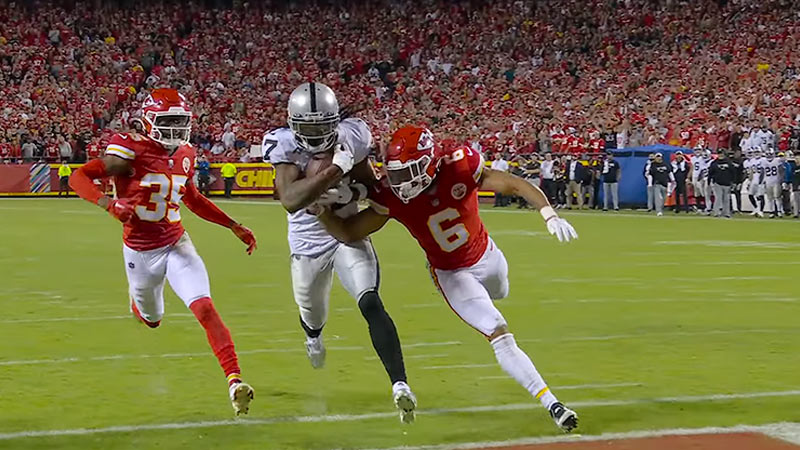
In March 2022, the NFL landscape was irrevocably altered when the Green Bay Packers traded arguably the league’s best wide receiver to the Las Vegas Raiders.
While initial headlines focused on a singular “lowball” offer, the reality was a multifaceted breakdown involving financial benchmarks, market timing, and personal career goals.
1. The Financial Disconnect: Dissecting the “Lowball” Narrative
The central friction in the Adams-Packers relationship began at the negotiation table. Early reports suggested that the Packers’ initial offer was significantly below Adams’ perceived value, a sentiment that the player later confirmed.
The Benchmark Conflict
Negotiations often rely on “comparable” assets. In 2020, the highest-paid wide receivers included Amari Cooper at $20 million per year, Julio Jones at $22.2 million, and DeAndre Hopkins at a staggering $29 million on paper.
- The Packers’ Stance: The organization reportedly viewed the $20 million mark (the Amari Cooper benchmark) as a fair starting point for negotiations. To the front office, starting at the third-highest salary in the league was a standard, respectful business tactic.
- The Adams Perspective: Adams viewed himself as the league’s premier talent, seeing the Hopkins deal as the true market ceiling. When the Packers opened in the high teens or low $20 million range, it was perceived not as a starting point, but as a lack of appreciation for his historic production.
Paper Value vs. Actual Cash Flow
A critical nuance in these discussions is the difference between “Average Per Year” (APY) and actual guaranteed money. Many high-end NFL contracts are backloaded with non-guaranteed sums to inflate the APY for public relations purposes.
- Analysts noted that while Hopkins’ deal was cited at $29 million, the actual cash flow was often lower when adjusted for previous obligations.
- In Adams’ eventual Raiders deal, the $28 million APY was heavily bolstered by cap hits of $44 million in the final two years—years he was unlikely to play at ages 33 and 34.
2. The Market Explosion: A Case of Bad Timing
The timing of the negotiation was perhaps the Packers’ greatest obstacle. While Green Bay played a conservative hand, the wider NFL market underwent a radical shift.
The Christian Kirk Catalyst
In the 2022 offseason, the Jacksonville Jaguars signed Christian Kirk to a deal that significantly inflated the middle-tier market. This “market explosion” effectively validated Adams’ demand for higher compensation.
The Packers, who had likely anticipated a deal in the $24–$25 million range based on historical data, suddenly found themselves “holding the bag” as the floor for elite receivers jumped to $28 million.
The Delayed Match
By the time the Packers realized the market had shifted, the emotional damage was largely done.
Though Green Bay eventually offered to match the $28 million per year proposed by the Raiders, Adams felt the gesture was too little, too late. The initial hesitation from the front office had already created a “fractured relationship”.
3. The Aaron Rodgers Factor: Quarterback Uncertainty
In the NFL, a wide receiver’s success is inextricably linked to the stability of the quarterback position. For Adams, the year-to-year uncertainty surrounding Aaron Rodgers’ future in Green Bay was a primary deterrent to a long-term commitment.
Adams noted that Rodgers’ refusal to commit to the franchise beyond a one-year horizon made it difficult for him to sign a five-year deal.
If Rodgers were to retire or be traded, Adams would have been left in a rebuilding situation during the prime of his career—a risk he was ultimately unwilling to take.
4. The Human Element: Roots and Reunion
Beyond the spreadsheets and cap hits, personal motivations played a decisive role.
- West Coast Roots: Having grown up in Northern California, Adams harbored a long-standing desire to play closer to home.
- The Carr Connection: The opportunity to reunite with his college quarterback and close friend, Derek Carr, was a significant draw. This move allowed Adams to “prove that his career didn’t rely on Aaron Rodgers,” establishing his individual legacy outside of the Rodgers-led offense.
5. The Franchise Tag Stalemate
In a final attempt to retain control, the Packers placed the franchise tag on Adams. However, Adams took a firm stance, informing the organization that he would not play under the tag.
This move effectively forced Green Bay’s hand; they either had to trade him for value or risk a season of holdouts and locker-room tension.
The trade ultimately yielded the Packers a first-round and a second-round pick, which were utilized to acquire Quay Walker and Christian Watson.
While the front office was criticized for the “process” that led to the exit, some fans viewed the return for a player essentially on the verge of free agency as a high-value recovery.
Conclusion
Davante Adams’ departure from the Green Bay Packers was not the result of a single disagreement, but a convergence of financial friction and personal ambition.
While initial negotiations stalled over a perceived lowball offer compared to the surging wide receiver market, the conflict deepened due to uncertainty regarding Aaron Rodgers’ future.
Although the Packers eventually matched the Raiders’ financial terms, the emotional bridge had been burned by the initial stalemate and Adams’ refusal to play under the franchise tag.
Ultimately, the trade allowed Adams to reunite with Derek Carr and fulfill his lifelong goal of playing on the West Coast. This transition provided Green Bay with the vital draft capital needed to begin a new era.