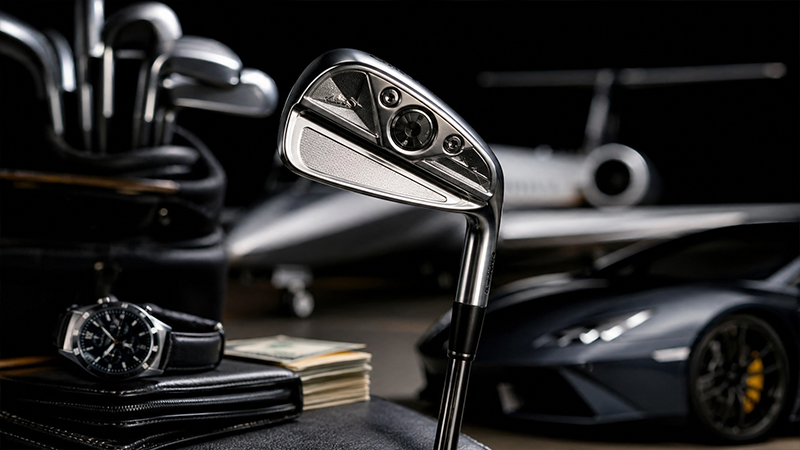
In the modern landscape of high-performance sports equipment, few topics ignite as much debate as the pricing strategy of boutique manufacturers.
While golf has always been perceived as a “premium” pastime, the entry of brands like Parsons Xtreme Golf (PXG) shifted the conversation from “expensive” to “ultra-luxury.”
When a single iron can retail for $850, compared to a full set of top-tier Mizuno MP-20s for roughly $1,400, golfers and analysts alike are forced to ask: What are we actually paying for?.
Explores the complex interplay of manufacturing overhead, psychological pricing models, and strategic market segmentation that defines the luxury golf sector.
The Sticker Shock of Elite Golf — More Than Just Metal
For the average amateur, the price tag of a premium iron set can be a barrier to entry. However, in the luxury segment, the high price is not a barrier; it is the value proposition.
The initial reaction to PXG’s pricing was one of collective “sticker shock” within the golf community. This was not accidental.
By positioning their clubs at a price point significantly higher than mainstream offerings from TaylorMade or Callaway, PXG immediately signaled that they were not competing for the mass market.
The “Ferrari of Golf” Ambition
Founder Bob Parsons famously marketed the brand as the “Ferrari of Golf”. This comparison is instructive for understanding the brand’s identity.
A Ferrari is not merely a vehicle for transportation; it is a statement of engineering prowess and social status. Similarly, PXG irons were launched with the promise of “secret sauce” engineering that justified their exorbitant cost.
However, as many enthusiasts have noted, the “secret sauce” is often a blend of high-end marketing and specialized production rather than a mystical performance advantage that fundamentally alters the laws of physics.
For many, the high cost is simply because the company “can” charge it, knowing a specific market exists that is ready to be captured.
The “Chivas Regal Effect” — The Psychology of Premium Pricing
To understand why a golfer would spend $850 on a single club, one must look beyond the technical specifications and into the realm of behavioral economics.
Perception as Reality
The “Chivas Regal Effect” is a well-documented psychological phenomenon where consumers associate a higher price with higher quality.
In the case of Chivas Regal Scotch, sales reportedly increased after the price was raised, despite no change to the product itself. In the golf industry, PXG utilized this effect to carve out a niche where they are the primary player.
The Ego and the Logo
For a significant portion of the luxury market, the price is the point. High-net-worth individuals often view high prices as a sign of exclusivity and a way to signal their financial status to peers.
In this context, owning a set of PXG irons serves a dual purpose: it provides a high-quality tool for the game and acts as a status symbol that “puffs up” the ego of the owner.
This is synonymous with the designer fashion industry, where a brand can charge $300 for a standard t-shirt simply because the label carries a specific social weight.
The Realities of Manufacturing — R&D and Fixed Costs
While the psychological aspect is undeniable, there are legitimate economic reasons why luxury irons carry a higher MSRP than mass-produced sets.
High Fixed Costs and Low Volume
Mainstream manufacturers like Callaway or TaylorMade benefit from massive economies of scale. They produce hundreds of thousands of units, allowing them to spread their research and development (R&D) and tooling costs across a vast number of sales.
In contrast, luxury brands often operate on a lower-volume model. When a company is not a “high volume seller,” the cost per unit must increase significantly to cover the following:
- Intensive R&D: Developing new materials and internal structures requires significant investment before a single club is sold.
- Complex Tooling: Premium clubs often utilize a larger number of molds per club head to achieve precise weighting and aesthetics, which adds substantial fixed costs to the production line.
- Material Quality: While the performance gap may be marginal for some, the use of specialized alloys and multi-material constructions contributes to the baseline manufacturing cost.
The Japanese Comparison
It is worth noting that PXG was not the first to explore this pricing tier. Japanese “boutique” offerings, such as Honma (which offers gold-plated sets) and other high-end forged irons, have occupied this space for decades.
PXG was simply the first brand to bring this ultra-premium pricing model to the mainstream Western market with aggressive, high-visibility marketing.
The “Veteran Factor” and Strategic Market Segmentation
One of the most fascinating aspects of the PXG business model is their approach to market segmentation, specifically their “Hero” program.
Catering to the Military Community
There is a prevailing sentiment among some golfers that PXG primarily caters to active military and veterans. By offering substantial discounts to this demographic, PXG makes their “insanely expensive” clubs affordable and competitive with traditional brands.
This serves two strategic purposes:
- Brand Loyalty: It builds an incredibly loyal customer base within a specific, highly-connected community.
- Market Feasibility: Some analysts suggest the high MSRP for civilian customers actually helps subsidize the lower price points offered to veterans, making the business model more sustainable than it would be if they only targeted the ultra-wealthy.
The Multi-Tiered Product Line
As the brand has matured, PXG has introduced more “affordable” options, such as the 0211 series, which has been seen for as low as $125 per club.
This suggests a “trickle-down” strategy where the prestige of the flagship luxury models (like the 0311) elevates the perceived value of the entry-level clubs, allowing the brand to capture a wider range of the market without losing its premium luster.
Performance vs. Perception — Does Price Equal Progress?
Ultimately, the value of a golf club is measured on the scorecard. This is where the debate becomes most subjective.
The “Feel” Factor
Performance in golf is often tied to “feel”—a subjective quality that varies from player to player.
While some golfers report that PXG irons brought back their “passion for the game,” others find they prefer the feel of traditional blades from Mizuno or TaylorMade.
For instance, a player might choose TaylorMade P770s over PXG because the feedback at impact aligns better with their personal preference, regardless of the price tag.
The Custom Fitting Experience
A significant part of the premium price includes the service. Luxury brands often emphasize a white-glove custom fitting experience.
For some, a $25 or $50 fitting session that results in a perfectly tuned set of clubs is where the true value lies.
The “Black Ops” driver and other high-end offerings are often praised for the customer service and specialized fitting that accompanies the purchase.
Enhanced FAQ — Navigating the World of Luxury Golf Clubs
1. Are PXG irons really worth $850 a club?
From a pure performance standpoint, many golfers find that mainstream clubs (like Mizuno MP-20 or TaylorMade blades) provide equal or better results for a lower price.
However, “worth” is subjective; if a golfer values the exclusivity, the R&D story, and the status of the brand, the price may be justified in their eyes.
2. Why do people “hate” on PXG?
The polarizing nature of the brand often stems from its aggressive marketing and its overt appeal to wealth and ego.
Some golfers feel that the high price is “insanely expensive for the sake of being expensive,” leading to a backlash from more practical-minded players.
3. Is there a way to get these luxury clubs for less?
Yes. PXG frequently offers significant discounts to military personnel and veterans, bringing the price down to levels competitive with traditional manufacturers. Additionally, their 0211 series offers a more budget-friendly entry point into the brand.
4. What is the “Chivas Regal Effect” in golf?
It is the strategy of pricing a product high to create a perception of superior quality and exclusivity. In golf, this attracts buyers who equate high cost with better performance or higher social standing.
5. How do luxury irons compare to Japanese clubs?
Luxury brands like PXG share the premium price space with Japanese manufacturers like Honma. These clubs often use specialized forging processes and materials that appeal to a “boutique” sensibility rather than the mass-market approach of major US brands.
Conclusion: Making the Luxury Choice
The decision to invest in luxury golf irons is rarely a purely logical one based on a cost-to-performance ratio. Instead, it is a choice made at the intersection of technical appreciation, financial capability, and personal identity.
As we have seen, the high price of clubs like PXG is driven by a combination of high R&D and tooling costs for low-volume production, a strategic appeal to status-conscious consumers, and a unique market segmentation that rewards specific communities like veterans.
For the golfer who views their equipment as an extension of their lifestyle—much like a $2,500 watch or a designer handbag—the high entry price is simply the “cost of admission” to an exclusive club.
For the practical golfer looking for the best “bang for their buck,” traditional powerhouses like Mizuno and TaylorMade continue to offer world-class performance without the ultra-luxury markup.
In the end, whether you are hitting a $125 iron or an $850 iron, the game remains the same. But for those who choose the luxury path, the “passion for the game” often comes with a very specific, and very expensive, logo.