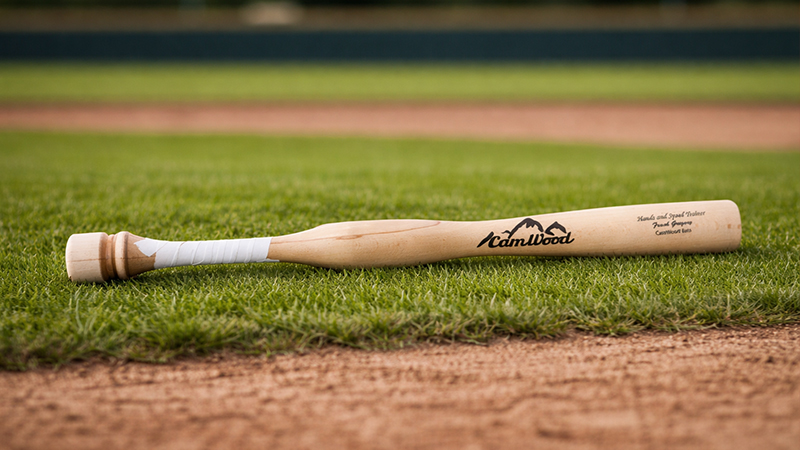
The search for the perfect swing is a journey every baseball player, parent, and coach understands. In the modern era of training, the Camwood Training Bat has emerged as one of the most discussed tools for developing elite hand speed and proper swing paths.
Unlike traditional weighted bats that simply add mass to the barrel, the Camwood bat utilizes a unique design philosophy centered on weight distribution to transform how a hitter interacts with the ball.
This post dives deep into the mechanics, benefits, and practical application of the Camwood bat to explain exactly how it works and whether it is the right fit for your training regimen.
The Fundamental Philosophy: Barrel-Loaded vs. Hand-Loaded
To understand how the Camwood bat works, one must first look at its physical construction. Traditional training bats often place extra weight in the barrel, which can inadvertently lead to “barrel dragging” or “casting” as the hitter struggles to move the heavy end through the zone.
The Camwood bat flips this design on its head by placing the added weight directly above the handle and the hitter’s hands.
By concentrating the mass near the hands, the bat functions as an “overload” trainer. This specific weight placement ensures that the added resistance does not disrupt the natural mechanics of the swing.
Instead, it forces the muscles in the hands and forearms to work significantly harder during the initial phase of the swing, which ultimately builds the specific functional strength required for high-level hitting.
The Mechanics of the Swing: Eliminating the “Casting” Flaw
One of the most common mechanical errors in youth and amateur baseball is “casting,” where a hitter extends their hands away from their body too early in the swing.
This flaw results in a long, loopy swing path that is easy for pitchers to beat with velocity or inside pitches.
The Camwood bat is engineered to solve this problem through its hand-weighted design. Here is a breakdown of the mechanical corrections it facilitates:
- Encouraging a “Hands First” Approach: Because the weight is located at the handle, the hitter is physically prompted to lead with their hands into the hitting zone. This prevents the barrel from lagging behind or being dragged through the zone.
- Promoting an Inside-Out Swing Path: By keeping the weight closer to the body’s center of gravity during the turn, the bat helps the hitter stay “inside” the ball. This creates a more direct and efficient path to contact.
- Improving Extension: While it keeps the hands tight early in the swing, the design also encourages proper hand extension through the point of contact, leading to more powerful and efficient hits.
Building Functional Strength and Bat Speed
While mechanics are crucial, the Camwood bat also serves as a potent strength-building tool. Regular use of the bat is designed to increase both bat speed and exit velocity.
This is achieved by strengthening the key muscle groups used during the swing without the negative side effects of swinging a bat that is simply too heavy in the barrel.
Users in the baseball community have reported that consistent training with the bat helps players stay “way ahead” of their peers in terms of physical development and swing maturity.
For younger players, the extra weight provides the resistance needed to develop a “grown man” swing as they mature.
However, it is important to note that some of these gains also come from the general discipline of a heavy-swing routine; as some users point out, swinging any heavy implement repeatedly will likely result in strength gains.
Practical Training: The “Bucket a Day” Routine
The effectiveness of the Camwood bat is largely dependent on how it is integrated into a player’s practice schedule. It is not a “magic wand” but a tool that requires disciplined use. A common recommendation from experienced users is the “bucket a day” method.
Training Volume
Hitters are encouraged to take approximately 25 to 30 swings (one bucket of balls) per day using the Camwood bat before switching to their regular game bat.
Drill Selection
The bat is highly versatile and can be used for tee work and soft toss to build muscle memory.
Progressive Loading
New users should be prepared to start in stages, beginning with 10 swings and gradually increasing to 20 or more as their strength improves, as the bat can feel quite heavy at first.
Integration with Weighted Balls
Some players find success using the Camwood bat specifically for batting practice with weighted balls to further intensify the strength-building aspect of the workout.
Key Benefits of Using a Hand-Weighted Trainer
Beyond just speed and strength, the Camwood bat offers several qualitative improvements to a hitter’s profile:
- Improved Bat Path: The bat helps eliminate “long” swings, creating a direct path to the ball that reduces weak pop-ups and grounders.
- Enhanced Barrel Control: The unique weight distribution allows hitters to stay “on the ball” longer, providing better control over where the barrel goes in the zone.
- Muscle Memory: Through high-repetition tee work, the bat’s design reinforces the feeling of a compact swing, which then transfers to the player’s standard game bat.
Potential Risks and Technical Considerations
While the Camwood bat is widely praised, there are technical habits players must be careful to avoid. A primary concern is the “front shoulder flying open”. Because of the weight, some hitters may try to “yank” the bat through the zone, causing their lead shoulder to pull away from the plate.
To counter this, coaches recommend that hitters using the Camwood bat focus on trying to hit the outside pitch. This focus forces the hitter to stay closed and drive through the ball, ensuring that the strength gains do not come at the expense of proper shoulder alignment.
Additionally, parents should be aware of sizing. For younger players, finding the right length is critical; for instance, some alternatives like Victus may not offer certain sizes like a 30-inch model, making the Camwood a necessary choice for players who need specific dimensions.
Community Insights: Is It Worth the Investment?
The consensus among the baseball community, particularly on platforms like r/Homeplate, is that the Camwood bat is a beneficial training tool but not necessarily “life-changing” on its own. It is viewed as a worthwhile purchase for those who are committed to a daily routine.
For those on a strict budget, there are alternatives to consider. Some users suggest using a “hitting knob” which can be attached to any existing bat to mimic the hand-weighted feel of the Camwood more practically.
Others note that similar trainers from brands like Victus can sometimes be found for a lower price, though they may lack the specific size range of the Camwood.
Conclusion: Transforming Your Swing with Purpose
The Camwood Training Bat works by utilizing the science of hand-loaded resistance to correct the most common flaws in a baseball swing. By forcing a “hands-first” approach and building forearm and hand strength, it helps players develop a more compact, powerful, and controlled swing path.
Whether you are a parent looking to help your son gain an edge or a player seeking to increase your exit velocity, the Camwood bat offers a mechanically sound way to train.
When combined with a disciplined “bucket a day” routine and a focus on staying closed through the swing, it stands as a proven tool for taking a hitter’s game to the next level.