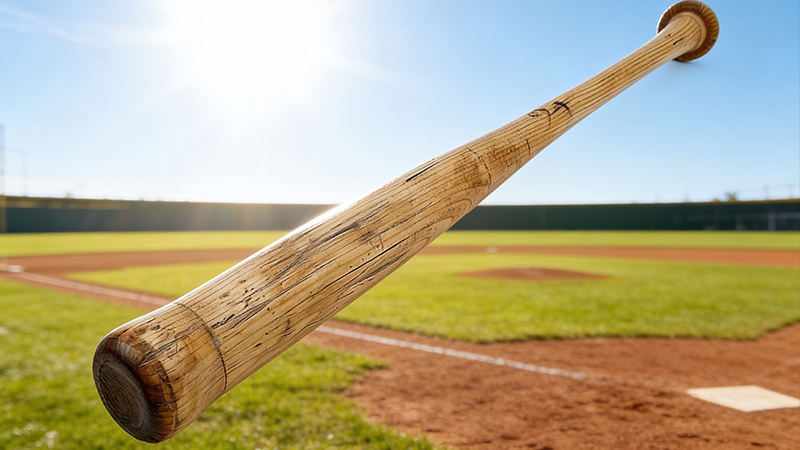
In the world of Major League Baseball (MLB), the crack of a bat is a sound synonymous with American tradition. However, that sound is strictly regulated by a set of rules that dictate exactly what a player can—and cannot—bring to the plate.
While you might see bamboo bats for sale at your local sporting goods store or used in amateur wood-bat leagues, they are strictly prohibited in the Big Leagues.
This article explores the botanical, structural, and regulatory reasons why bamboo remains on the sidelines of professional baseball.
The Evolution of the Baseball Bat: A History of Material Change
To understand why bamboo is illegal, we must first look at the history of what is legal. Professional baseball has seen a constant evolution of wood species used for manufacturing bats.
From Hickory to Ash
In the early days of the sport, hickory was the preferred material. It was incredibly dense and durable, but its extreme weight made it difficult for players to achieve the high swing speeds required as the game modernized.
By the mid-20th century, Northern White Ash became the industry standard. Ash offered a unique combination of strength and flexibility, allowing for a “trampoline effect” that drove the ball deep into the outfield.
The Maple Revolution and the Rise of Birch
Around the dawn of the 21st century, maple took over the league, popularized by home-run kings who preferred its harder surface and lack of flaking compared to ash.
Today, however, North American ash faces an existential threat from invasive species like the Emerald Ash Borer. This ecological crisis has forced players to look for alternatives, leading to the current rise of the yellow birch as a viable professional option.
Despite this history of adaptation, one material has consistently been left out of the rotation: bamboo.
The Botanical Debate: Is Bamboo Actually Wood?
The primary reason bamboo faces a legal hurdle in the MLB starts with its biological classification. The formal rules of baseball are surprisingly vague about wood species, but they are very specific about the definition of wood.
Tree vs. Grass
While bamboo is often marketed as “wood” because of its hardness and durability, most botanists—and MLB officials—would classify it as a grass.
From a biological standpoint, bamboo contains lignin and cellulose, which are the building blocks of tree wood, but it lacks the internal architecture of a tree.
Structural Differences
Trees possess a complex system of xylem and phloem to transport water and nutrients, which creates the “rings” we see in a standard wood bat.
Bamboo does not have this structure. Furthermore, trees die once they are harvested for timber, whereas bamboo is a colony-based plant that does not die when you cut it down.
Because it does not meet the traditional botanical definition of “timber,” a legal argument for bamboo being “wood” is likely a losing battle in a professional setting.
Analyzing MLB Rule 1.10(a): The “One Piece” Standard
Even if the league were to concede that bamboo is “wood,” it would immediately run into the most significant regulatory barrier: Rule 1.10(a). This rule provides the exact physical specifications for a legal bat:
- Dimensions: The bat must be a smooth, round stick, no more than 2.61 inches in diameter at the thickest part and no more than 42 inches in length.
- Composition: Most importantly, the rule states that the bat “shall be one piece of solid wood”.
The Hollow Nature of Bamboo
The “one piece” requirement is the death knell for bamboo in the MLB. Unlike maple or ash trees, which provide a solid trunk from which a bat can be turned on a lathe, bamboo is naturally hollow. There is no such thing as a “solid” piece of bamboo large enough to carve into a full-sized baseball bat.
The Lamination Problem: Why Glue Changes the Game
Because bamboo is hollow, manufacturers must engage in a complex engineering process to create a bat-shaped object. This involves cutting the bamboo into “a zillion little strips” and then pressurized-gluing them back together into a solid block.
Prohibition of Laminates and Plywood
The MLB rulebook is very clear: you are not allowed to make a bat from laminates or plywood. A bamboo bat is, by definition, a laminated product. This process introduces foreign substances—specifically industrial adhesives—into the composition of the bat.
The Adhesive Weight (The Yamaha Analogy)
To illustrate the sheer volume of glue required to make bamboo structurally sound, consider the music industry.
When Yamaha produced an acoustic guitar (the FGX-B1) made entirely of bamboo, it reportedly required more than two pounds of glue to hold the instrument together.
If a baseball bat were constructed using the same methods, it would technically be made of as much adhesive as it would be bamboo. This violates the spirit and the letter of the law requiring a “solid wood” instrument.
The Exception to the Rule: The Bamboo Fungo Bat
If bamboo is illegal for gameplay, why do we see it so often in professional fields? The answer lies in the “fungo bat”.
Practice vs. Performance
Coaches frequently use bamboo fungo bats during pre-game infield and outfield practice. These bats are prized because they are:
- Lightweight: Allowing coaches to hit hundreds of balls without fatigue.
- Easy to swing: Offering better control for hitting specific spots on the field.
However, there is a massive difference between hitting a ball tossed in the air by a coach and hitting a 100-mph fastball. No MLB player would ever use a fungo bat in a game when they have unlimited access to “the real thing”—solid, single-piece wood bats that are designed to withstand the forces of professional pitching.
Conclusion: Why Tradition and Science Keep Bamboo Banned
The prohibition of bamboo in Major League Baseball is a combination of botanical reality and strict regulatory standards. Because bamboo is a grass and not a tree, it cannot be harvested as a single, solid block.
The necessity of using massive amounts of glue to laminate bamboo strips together directly violates Rule 1.10(a), which demands a “one piece of solid wood” construction.
While bamboo is an incredible, sustainable material for practice tools like fungo bats, its status as a “laminate” means it will likely never see the inside of a Major League batter’s box.
For now, the future of the game remains rooted in the traditional—and solid—trunks of maple, ash, and birch trees.