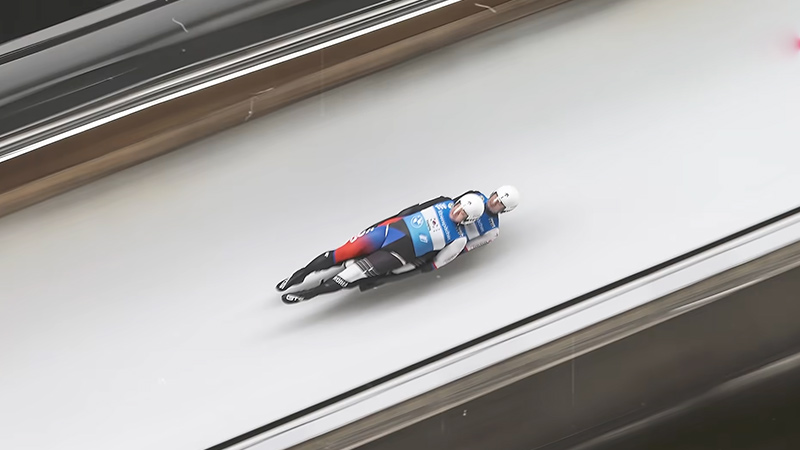
Doubles luge is one of the most thrilling and misunderstood events in the Winter Olympics. At first glance, it may look like two athletes simply lying on a sled and racing down an icy track together.
But in reality, doubles luge is a carefully choreographed partnership that requires precise coordination, trust, and technical mastery.
One of the most common questions people ask is: Who steers in doubles luge? The answer may surprise you.
Let’s break it down.
Understanding Luge Basics
Before diving into the doubles format, it helps to understand luge itself.
Luge is a winter sliding sport governed internationally by the International Luge Federation (FIL). Athletes race down a frozen track on a small sled while lying on their backs, feet first. Speeds can exceed 140 km/h (87 mph), making it one of the fastest and most dangerous winter sports.
Luge is featured in the Winter Olympic Games, alongside bobsleigh and skeleton. Events typically include:
- Men’s singles
- Women’s singles
- Doubles
- Team relay
While singles luge is relatively straightforward in structure—one athlete, one sled—doubles introduces a unique dynamic.
What Is Doubles Luge?
Doubles luge features two athletes riding on the same sled. Traditionally, doubles teams were composed of two men, but mixed-gender doubles are increasingly common in international competition.
In doubles:
- Both athletes lie on the same sled.
- The athlete in front lies slightly lower.
- The second athlete lies on top and slightly behind.
- Both athletes contribute to balance and aerodynamics.
Unlike in bobsleigh, where a pilot clearly steers, doubles luge has a more subtle steering system.
So, Who Steers in Doubles Luge?
The Front Athlete Is the Primary Steering Force
In doubles luge, the front athlete is responsible for steering the sled.
The front athlete:
- Controls direction using leg and shoulder movements.
- Applies pressure to the sled’s runners.
- Makes small, precise corrections throughout the run.
The rear athlete plays a crucial support role but does not act as the primary steering force.
How Steering Actually Works?
Steering in luge is far from obvious. There is no steering wheel, no handlebars, and no large body movements.
Instead, athletes steer by:
1. Leg Pressure
The front athlete uses calf and foot pressure against the sled’s runners. Small movements change how the sled edges into the ice.
2. Shoulder and Upper Body Shifts
Subtle shoulder rotations help guide the sled through curves.
3. Weight Distribution
Shifting body weight changes how the sled interacts with the track surface.
Because luge sleds are extremely sensitive, even a tiny movement can alter direction dramatically.
What Does the Rear Athlete Do?
If the front athlete steers, what’s the rear athlete’s job?
The rear athlete:
- Provides additional power at the start.
- Maintains aerodynamic positioning.
- Assists with balance and stability.
- Synchronizes movements with the front athlete.
At the start, both athletes paddle aggressively with spiked gloves to generate momentum. The rear athlete typically has longer reach and often provides significant starting force.
Once on the course, the rear athlete must remain incredibly still and aligned with the front athlete. Any unsynchronized movement can destabilize the sled.
Why the Front Athlete Steers?
There are several practical reasons why the front athlete controls steering:
1. Positioning Advantage
The front athlete has the clearest path and direct connection to the sled’s steering mechanics.
2. Reaction Time
Being in front allows quicker anticipation of curves and transitions.
3. Mechanical Design
Doubles sleds are built so that the front athlete’s leg movements most effectively influence the runners.
Communication Between Teammates
At speeds exceeding 130 km/h, there’s no time for verbal communication.
Instead, doubles teams rely on:
- Years of training together
- Muscle memory
- Pre-planned timing
- Sensory feedback through body contact
The rear athlete can feel the front athlete’s micro-movements and must adapt instantly.
This level of coordination is why many successful teams have trained together for years.
Famous Doubles Luge Teams
Several legendary doubles teams have demonstrated extraordinary coordination and steering mastery.
Tobias Wendl & Tobias Arlt
This German duo dominated the sport, winning multiple Olympic gold medals and setting high standards for synchronization and steering precision.
Georg Hackl (Singles Legend)
While primarily known for singles luge, Hackl’s influence on German training systems helped shape the country’s doubles success as well.
Germany remains one of the strongest nations in luge, frequently topping medal tables at the Winter Olympics.
The Physics Behind Steering
Steering a luge sled is about managing friction, centrifugal force, and gravity.
As the sled enters a curve:
- Centrifugal force pushes it outward.
- The front athlete adjusts runner pressure.
- Proper angling reduces friction and maintains speed.
Too much correction slows the sled.
Too little correction leads to crashing into the wall.
The goal is to find the perfect line—known as the “ideal racing line”—through every turn.
Start Technique in Doubles
The start is critical in luge, especially doubles.
Both athletes:
- Sit on the sled handles.
- Rock forward and backward to build momentum.
- Explode forward using spiked gloves.
- Paddle rapidly against the ice.
- Transition smoothly into a lying position.
The rear athlete’s power significantly impacts early acceleration. However, once settled into position, steering responsibility transfers fully to the front athlete.
Differences Between Singles and Doubles Steering
While steering mechanics are similar, doubles introduces additional complexity:
| Aspect | Singles | Doubles |
|---|---|---|
| Weight | One athlete | Two athletes |
| Steering | One athlete | Front athlete |
| Stability | Easier to balance | Requires coordination |
| Speed | Slightly slower | Often faster due to weight |
Interestingly, doubles sleds can sometimes reach higher speeds due to increased mass and momentum.
Risk and Precision
Doubles luge is considered one of the most technically demanding winter sports.
Tracks like those used in the Beijing 2022 Winter Olympics featured steep drops and tight curves that demanded near-perfect steering control.
Because both athletes are on one sled:
- Mistakes are shared.
- Balance errors are amplified.
- Trust is non-negotiable.
Mixed Doubles in Modern Luge
In recent years, the sport has evolved to include more mixed-gender doubles teams.
The steering dynamic remains the same:
- The front athlete steers.
- The rear athlete supports.
The determining factor isn’t gender—it’s skill set, body position, and training specialization.
Training to Become a Doubles Luge Steerer
Becoming the front athlete (primary steerer) requires:
- Exceptional body awareness
- Lightning-fast reflexes
- Strong lower-body control
- Deep track familiarity
- Mental composure under pressure
Many athletes begin in singles before transitioning into doubles.
Steering skill often determines team formation. Coaches assign the more technically precise athlete to the front position.
Why People Get Confused?
From a spectator’s perspective:
- Both athletes appear to lie still.
- Movements are nearly invisible.
- Steering adjustments are extremely subtle.
This leads many viewers to assume both athletes steer equally.
In reality, while both influence stability, the front athlete is the primary steering authority.
Key Takeaway
So, who steers in doubles luge?
The front athlete steers the sled.
They control direction using subtle leg and shoulder movements, while the rear athlete provides power, balance, and aerodynamic stability.
Doubles luge is less about two athletes steering and more about one steering with total support from a perfectly synchronized partner.
Final Thoughts
Doubles luge is a remarkable blend of physics, partnership, and precision. At speeds that rival highway traffic, two athletes trust each other completely as they navigate one of the fastest sports on ice.
The next time you watch doubles luge at the Winter Olympics, pay attention to the front athlete. The movements may be invisible to the naked eye—but they are guiding every curve, every straight, and every split-second decision down the track.
Behind every smooth, record-breaking run is a master steerer lying just inches above the ice, making microscopic adjustments at breathtaking speed.
And that’s who truly steers in doubles luge.