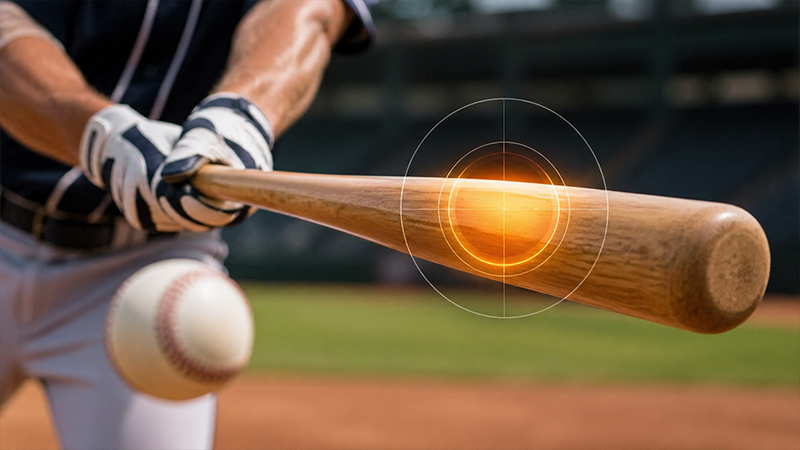
For any hitter, there is no sensation more rewarding than the “buttery soft feel” of a perfectly timed swing. It is that magical moment where the ball seems to jump off the barrel with effortless power, leaving the hitter with zero “sting” in their hands.
This is the elusive sweet spot—the “holy grail” of hitting where physics and technique align perfectly.
Understanding where this spot is, how it works, and how to find it on your specific bat can transform you from an average hitter into a formidable presence at the plate.
This guide dives deep into the science, location, and practical methods for mastering the heart of your barrel.
Defining the Sweet Spot: Beyond the Hype
While many manufacturers use the term “sweet spot” as a marketing tool, it has a rigorous scientific foundation.
From a player’s perspective, it is simply the place on the barrel where contact results in the best hit: maximum ball speed and minimal hand vibration.
However, scientists and acoustic experts generally define the sweet spot through two primary lenses:
- The Center of Percussion (COP): The point on the barrel that minimises the “jar” or kickback to the hitter’s hands upon impact.
- The Vibrational Node: The specific location on the bat that does not move when the bat vibrates after an impact.
When you hit the ball in this “sweet zone,” you aren’t just hitting it hard; you are ensuring that the maximum amount of energy is transferred to the ball rather than being wasted in the form of bat vibration.
The Physics of Precision: Vibrational Bending Modes
To truly understand the sweet spot, one must understand how a bat behaves when it strikes a ball. Every bat has vibrational bending modes. When a ball hits the bat, it causes the bat to oscillate at different frequencies.
The Fundamental Bending Mode
The first bending mode (measured at approximately 215 Hz in some wood bats) has two nodes, which are positions of zero displacement.
- One node is located about 6.5 inches from the barrel end.
- The second node is located near the handle, roughly where a hitter’s hands grip the bat.
The Second Bending Mode
The second bending mode vibrates at a higher frequency (around 670 Hz) and introduces a third node, located approximately 4.5 inches from the barrel end.
The “Sweet Zone”
Expert research suggests that the true “sweet spot” is actually a sweet zone—the region located between the nodes of the first and second vibrational modes.
On a standard 30-inch Little League bat, this zone typically spans the area between 4 and 7 inches from the barrel end.
Because the bat’s physical motion is nearly zero in this specific region, the hitter feels no painful sting, and the ball receives the highest energy transfer.
Location: Where Is the Spot Exactly?
While the general rule of thumb is the 4-to-7-inch range, several factors can shift this location.
Common Misconceptions
A common mistake among players—especially in slowpitch and youth leagues—is assuming the sweet spot is closer to the end of the bat than it actually is.
Scientific analysis shows the sweet spot is usually higher on the barrel (closer to the end cap) than many hitters realise, but it is rarely right at the very tip.
Variables that Shift the Spot
The exact mathematical “perfect spot” can vary based on:
- Bat Length and Weight: Changes in geometry shift the vibrational nodes.
- End Loading: A bat with more weight in the tip (end-loaded) may have a slightly different sweet spot compared to a balanced bat.
- Barrel Length: Longer barrels may offer a slightly wider zone of performance.
Material Matters: Wood vs Aluminium vs Composite
Not all bats are created equal when it comes to their “sweetness.” The material of the bat dictates both the size of the sweet spot and the feedback the hitter receives.
Wood Bats: The Ultimate Teacher
Wood bats (like Ash, Maple, or Birch) provide the most immediate and honest feedback. If you miss the sweet spot on a wood bat, the ball will not carry, and the resulting vibrations will “ring” your hands painfully.
- Ash and Birch: These are softer woods that tend to vibrate the hands less than Maple, making them better for those new to wood.
- Coaching Insight: Many coaches insist that players use wood bats during practice because it forces them to refine their swing and consistently find the sweet spot.
Aluminium (Alloy) Bats: The Wider Zone
Single-walled aluminium bats often have a wider sweet zone (the distance between vibrational nodes) than wood bats.
However, there is a trade-off: because aluminium has low natural damping, it vibrates much longer than wood—sometimes 10 times longer. If you miss the sweet spot on an older aluminium bat, the sting can actually be worse than wood.
Composite Bats: Maximising Performance
Generally, composite bats feature the largest sweet spots in the industry. Manufacturers use advanced technologies like nitrogen gas bladders and active damping to minimise vibrations, allowing the “sweet” feel to extend further across the barrel.
Practical Methods to Find Your Sweet Spot
Since bats do not come with a “X marks the spot” label, you must use physical and acoustic tests to find your barrel’s heart.
The Hanging/Tapping Method
This is the most scientifically accurate manual test.
- Hold the bat loosely between your thumb and index finger, about 6 inches below the knob (or where the handle node is located).
- Have a partner tap the barrel with a hard object, like a hammer or another bat, starting from the end cap and moving toward the handle.
- Feel for the “Dead” Spot: As the tapping moves, you will feel vibrations in your hand. When the tapping hits the sweet spot, the vibrations will disappear.
- Listen for the Sound: The sweet spot will produce a distinct “ping” or “clink” sound, whereas other areas will sound like a dull “thud”.
The One-Handed Bounce
A popular method in the slowpitch community involves holding the bat in one hand and bouncing a ball off different parts of the barrel. You can visually see and hear where the ball “comes off hardest”. The sound will be noticeably different when you hit the high-performance zone.
The Front Toss Experiment
The best way to feel the spot in a “live” scenario is through front toss in a tunnel. Unlike hitting off a tee (which provides little feedback) or a high-velocity cage (which can damage the bat), front toss provides low-velocity impacts that allow you to experiment with different contact points across the barrel and feel the “buttery” response of the sweet spot.
Maintenance and Longevity: Protecting the Spot
Finding the sweet spot is only half the battle; you must also maintain the bat to ensure that spot stays “hot.”
Rotating the Barrel
To prevent “dead spots” and ensure even wear, especially on composite bats, it is crucial to rotate the bat slightly (about a quarter turn) after every hit.
This prevents one side of the barrel from becoming overly fatigued or damaged, which can happen if you always hold the bat with the graphics facing the same way.
Understanding “Break-in”
Some composite bats actually improve over time as the fibres in the sweet spot break down and become more flexible, increasing the “trampoline effect”. However, consistently hitting outside the sweet spot can lead to premature cracking or loss of performance.
Conclusion: The Edge of Every At-Bat
Mastering the sweet spot is about more than just avoiding a sting in your hands; it is about energy efficiency.
When you connect with the 4-to-7-inch zone of your bat, you are utilizing the full technological and physical potential of your equipment.
Whether you are swinging a traditional wood bat to sharpen your skills or a high-tech composite model to maximise your power, locating that heart of the barrel is the key to unlocking your true potential. Step up to the plate, listen for the “clink,” feel for the “butter,” and swing for the fences.