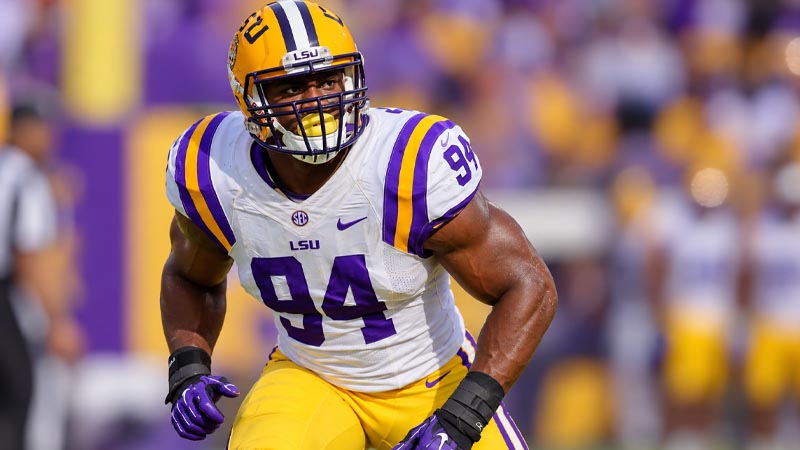
The trajectory of an elite professional athlete often reveals its most critical data points during the formative years of collegiate competition.
For Danielle Hunter, these data points were recorded in the highly competitive environment of the Southeastern Conference (SEC) at Louisiana State University (LSU).
Analyzing Hunter’s tenure from 2012 to 2014 provides a comprehensive understanding of how a prospect with atypical production metrics can transition into a premier professional defender.
The LSU Foundation: Institutional Context
Louisiana State University has long been recognized as a primary exporter of defensive talent to the professional ranks.
When Hunter arrived in Baton Rouge in 2012, he entered a system designed to maximize physical traits and tactical discipline.
His decision to join the Tigers placed him in a “pro-style” defensive environment that prioritized gap integrity and physical dominance at the point of attack.
Hunter’s time at LSU was characterized by steady progression and remarkable reliability. Over the course of three seasons, he participated in a total of 38 games. This volume of experience in the SEC is a critical indicator of a player’s readiness for the physical rigors of the next level.
Quantitative Analysis of Collegiate Performance
A data-driven examination of Hunter’s statistics reveals a profile that favored consistency and high-volume activity over traditional “splash” plays like sacks.
While many elite defensive ends are judged solely on their ability to reach the quarterback, Hunter’s value at LSU was found in his total defensive impact.
Collegiate Statistical Summary (2012–2014)
| Category | Statistical Value |
|---|---|
| Total Games Played | 38 |
| Total Tackles | 142 |
| Career Sacks | 4.5 |
| Consecutive Starts | 23 |
| Draft Declaration Year | Junior (2014) |
| NFL Entry Year | 2015 |
The most striking figure in this dataset is the 142 total tackles. For a defensive end, this reflects an extraordinary level of involvement in run defense and short-area pursuit.
In an analytical context, this suggests that Hunter was not merely a situational pass-rusher but a foundational piece of the LSU defensive front who was trusted to remain on the field across all three downs.
The Reliability Factor: 23 Consecutive Starts
In the evaluation of collegiate prospects, durability is often weighted as heavily as raw athleticism. Hunter’s record at LSU is punctuated by 23 consecutive starts.
- Physical Resilience: Maintaining a starting role for nearly two full seasons in the SEC requires a high threshold for physical punishment and a disciplined approach to recovery.
- Tactical Consistency: Coaches in high-stakes programs like LSU rarely permit a player to start 23 straight games unless they demonstrate a mastery of the defensive scheme and a low frequency of mental errors.
- System Integration: This streak of starts provided the continuity necessary for Hunter to refine his technique against various offensive line configurations, ranging from spread-option attacks to traditional power-running games.
The Paradox of the “Low” Sack Count
An analytical challenge often cited regarding Hunter’s college career was his 4.5 career sacks. On the surface, this number appears modest for a player who would eventually become a prolific sack specialist in the professional ranks. However, deeper analysis suggests several factors were at play:
- Role Specification: The LSU defensive scheme during Hunter’s tenure often tasked defensive ends with “setting the edge,” a role that prioritizes containing the runner and forcing plays back toward the linebackers rather than selling out for a sack.
- Tackle Volume as an Alternative Metric: The high tackle count (142) indicates that Hunter was frequently the first defender to reach the ball carrier. This displacement of production from “sacks” to “total tackles” highlights his efficiency in space and his ability to shed blocks.
- Pressure vs. Finishing: Professional evaluators often look beyond the sack column to find “pressures” or “hurries.” Hunter’s physical profile at LSU allowed him to disrupt the pocket even when the final statistical credit did not result in a sack.
The Decision to Declare: Evaluating the Junior Exit
After his junior season in 2014, Hunter made the strategic decision to declare for the 2015 NFL Draft.
This move is statistically common among players whose physical development and “game film” suggest they have maximized their collegiate learning curve.
- Market Timing: By leaving after three years and 38 games, Hunter entered the draft with relatively low “mileage” while still possessing nearly two years of starting experience.
- Trait-Based Evaluation: While his sack numbers were low, his 142 tackles and 23 consecutive starts signaled to professional teams that he possessed the work capacity and reliability of a veteran.
- The LSU Pipeline: Entering the draft as an LSU product carries an inherent “brand value,” as the university’s reputation for producing defensive starters acts as a trust signal for professional front offices.
Conclusion: A Legacy of Durability
Danielle Hunter’s time at LSU serves as a case study in the importance of foundational reliability.
While his 4.5 sacks may not have captured national headlines at the time, his 142 tackles and 23 consecutive starts provided a much more accurate forecast of his professional longevity and work ethic.
By the time he departed Baton Rouge after 38 games, he had established himself as a durable, high-volume defender capable of meeting the demands of the most rigorous competition in college football.
The transition from LSU to the professional ranks in 2015 was not merely a change in uniform, but the culmination of a three-year intensive development program that prioritized consistency above all else.
For any analysis of Hunter’s career, the data remains clear: his time at LSU was the essential catalyst for his future success.