In the high-stakes world of elite baseball, timing is everything. Whether it’s a hitter timing a 98-mph fastball or a manufacturer timing the release of a disruptive technology, the calendar often dictates the trajectory of the game.
For many players and coaches, one year stands out as a pivotal moment in equipment history: 2017. This was the year Marucci launched the CAT7 and CAT7 Connect, a release that didn’t just iterate on previous designs but fundamentally doubled the performance expectations of the “sweet spot” in aluminum bats.
Understanding when the CAT7 came out requires looking at a timeline of relentless innovation that began in 2009.
As a world-class SEO content strategist, I have analyzed the development cycles and engineering breakthroughs of the Marucci CAT line to provide this comprehensive deep dive into the 2017 launch and its lasting impact on the sport.
The Launch Date: 2017 and the Two-Year R&D Cycle
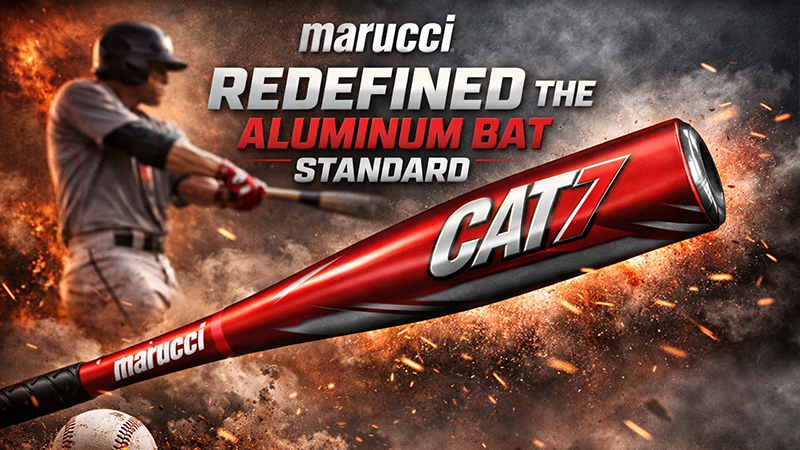
The Marucci CAT7 and CAT7 Connect were officially released in 2017. To understand why this date matters, one must look at Marucci’s disciplined approach to product development.
Unlike many competitors who might “re-paint” a bat and release it as a new model annually, Marucci has historically adhered to a two-year research and development cycle for every model in the CAT series.
By the time 2017 arrived, the CAT line had already established a formidable reputation. Starting with the original CAT5 in 2009, the series had survived the tumultuous transition from BESR to BBCOR standards without resorting to the “short-cut” engineering that plagued other brands.
The 2017 launch represented the fourth major generation of the alloy line, following the CAT5 (2009), the CAT5² (the first ring-free BBCOR model), and the CAT6 (2014).
The Pre-History: Building the Foundation for 2017
To appreciate why the 2017 release was so significant, we must examine the “Innovation Gap” Marucci filled in the years leading up to it.
The 2009 Inception (CAT5)
In 2009, the amateur baseball landscape was thriving under BESR certification. Marucci entered the metal bat market with the CAT5, utilizing AX05 alloy and an original anti-vibration knob.
The bat was named after a “Category 5” storm—the strongest classification possible—foreshadowing the impact the line would have on the industry.
The BBCOR Pivot (CAT5²)
When the BBCOR era began, most manufacturers faced a crisis: how to meet stricter performance standards without losing money on old inventory.
Many chose to retrofit old bats with internal rings or governors. These rings limited the trampoline effect but created “dead spots” in the barrel.
Marucci, however, utilized the AZ3000 alloy to create the first ring-free BBCOR barrel, ensuring consistent performance across the entire hitting surface.
The 2014 Refinement (CAT6)
In 2014, Marucci released the CAT6. This model focused on balance and swing speed, with the patented anti-vibration knob taking on two ounces of weight to move the balance point closer to the hitter’s hands.
While the CAT6 was a massive success, Marucci’s engineering team spent the next two years researching how to expand the “sweet spot” even further.
Why 2017 Was Different: The CAT7 Breakthroughs
When 2017 arrived, the CAT7 wasn’t just a slight improvement; it was an engineering overhaul. The sources highlight several key technological advancements that debuted with this model:
1. AZ4X Alloy: The Strength Factor
The 2017 CAT7 utilized AZ4X alloy, which was the strongest in the Marucci arsenal at the time. This alloy featured increased tensile strength and a higher response rate, providing the durability needed to push the limits of thin-wall construction.
2. Doubling the Sweet Spot
The most famous claim of the 2017 launch was that the CAT7 barrel featured a sweet spot double the size of the CAT6. This was achieved through the “Variables of Wall Thickness.”
Because the AZ4X alloy was so resilient, Marucci engineers could design a barrel with up to seven variables of wall thickness without needing internal rings or governors.
More variables allowed for a larger area of thin, responsive wall, giving hitters more surface area for maximum performance.
3. The AV2 Anti-Vibration Knob
The CAT7 introduced the 2nd Generation AV2 knob. This patented system featured a finely tuned harmonic dampening system designed to provide better feel and significantly less negative vibrational feedback on off-center hits.
4. The Introduction of the “Connect.”
Perhaps the biggest shift in 2017 was the expansion of the line. Marucci didn’t just release a one-piece alloy bat; they introduced the CAT7 Connect. This was a two-piece hybrid bat featuring:
- A carbon composite handle for reduced vibration.
- A power-balanced AZ4X alloy barrel.
- SDX (Shock Dissipation Connection) technology, which dismisses vibrations at the point of contact to provide a smooth, solid feel.
Market Impact: The Death of the “Dead Spot”
The 2017 release of the CAT7 solidified Marucci’s stance against internal rings. By 2017, many players had become frustrated with the “stiff” and “unresponsive” feel of competitors’ bats that used internal governors.
The CAT7’s ring-free design allowed the barrel to flex naturally, providing a “hot” sound and feel that became the gold standard for aluminum bats. This commitment to ring-free technology meant that every square inch of the CAT7 barrel was “active.”
For the hitter, this meant that a ball hit slightly toward the taper or the end cap still had a chance to carry, whereas a bat with internal rings would have produced a “dead” result in those same zones.
The Legacy: What Happened After 2017?
The success of the 2017 CAT7 set the stage for the biennial releases that followed, each building on the innovations of its predecessor:
2019 (CAT8)
Marucci upgraded to AZ105 alloy, allowing for even thinner walls and more forgiveness. They also introduced SDX EXT, which stiffened the connection in the hybrid models to eliminate the “lag” between the hands and the barrel.
2021 (CAT9)
This generation saw the introduction of AZR alloy with a more responsive microstructure. It also debuted the Outer-Locking System (OLS) on the Connect models, attaching the handle from the outside in for the stiffest connection in the industry.
2023 (CATX)
The most recent evolution moved the balance point closer to the hands and introduced Liquid-Gel anti-vibration technology, representing the “largest generational change” in the line’s history.
Enhanced FAQ: Navigating the CAT7 Era
Is the CAT7 still a viable bat today?
While newer models like the CATX offer more advanced vibration dampening and better balance, the CAT7 remains a legendary bat in the secondary market due to its “double sweet spot” and ring-free design. Many players still seek out the 2017 model for its distinct sound and responsiveness.
What is the difference between the 2017 CAT7 and the 2017 CAT7 Connect?
The standard CAT7 is a one-piece alloy bat, offering a traditional stiff feel and a balanced swing weight favored by contact hitters.
The CAT7 Connect is a two-piece hybrid (composite handle/alloy barrel) with a “power-balanced” feel, designed for hitters who want more mass behind the ball and less vibration.
How did the CAT7 achieve a “ring-free” barrel?
It came down to the metallurgy. The AZ4X alloy was strong enough to meet BBCOR performance limits without needing a physical ring inside the bat to stop the walls from flexing too much. This allowed Marucci to use seven different wall thicknesses to optimize the barrel naturally.
Did the CAT7 have an anti-vibration knob?
Yes, it featured the AV2 (2nd Generation) Anti-Vibration Knob. This was a major upgrade over the original knob found on the CAT5 and CAT6, offering better harmonic dampening to protect the hitter’s hands from “sting”.
Conclusion: Why 2017 Matters in the Marucci Timeline
If the CAT5 was the birth of the line and the CATX is its modern pinnacle, the 2017 CAT7 was the “breakout” moment that proved Marucci could dominate the metal bat market just as they had dominated wood bats.
By doubling the sweet spot of the CAT6 and introducing the “Connect” hybrid technology, Marucci gave hitters a level of choice and performance that was previously unavailable in the BBCOR era.
When you ask, “When did the Marucci CAT7 come out?” you aren’t just asking for a date on a calendar. You are asking for the moment the industry realized that “ring-free” technology was the future of the game.