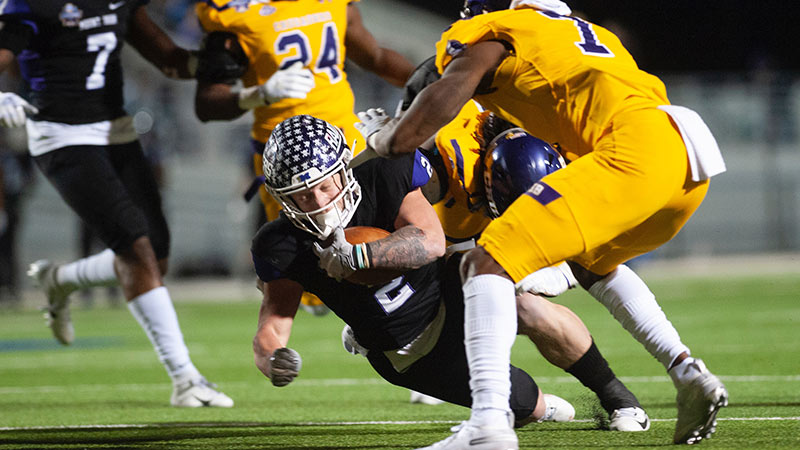
In the high-stakes theater of professional football, few moments command as much tension and strategic scrutiny as the post-touchdown decision.
After the end zone has been breached, a coach faces a binary choice that can redefine the trajectory of a season: the conservative extra point or the high-reward two-point conversion.
To understand the gravity of this choice, one must first master the physical parameters of the field. In the NFL, a two-point conversion attempt starts at the 2-yard line.
This specific distance—sixty inches of grass or turf—serves as the boundary between safe play and calculated risk. While it may seem like a negligible distance in a game played on a hundred-yard field, the two-yard line is the most contested real estate in the sport.
The Geography of the Conversion
The professional game is defined by its precision. When a team opts to “go for two,” the officials place the ball at the center of the 2-yard line.
From this position, the offense is granted one untimed play to run or pass the ball into the end zone. Because the play is untimed, it exists in a vacuum of sorts, occurring after the clock has stopped for the touchdown but before the subsequent kickoff.
Professional vs. Collegiate Standards
It is a common point of confusion for casual observers to conflate the rules of Saturday afternoon with those of Sunday. However, the governing bodies of football have established distinct thresholds for this play.
While the NFL utilizes the 2-yard line, the collegiate level demands a slightly longer path to the end zone. In college football, a two-point try starts at the 3-yard line.
This one-yard difference significantly alters the success probability, as it provides the defense more room to operate and forces the offense to execute more complex route distributions or more powerful blocking schemes.
The 2015 Rule Change: A Historical Pivot
To truly appreciate the current state of the two-point conversion, one must look back at the 2015 season, which fundamentally changed the “risk-reward” math for every head coach in the league.
Before this shift, both the two-point conversion and the extra-point kick were snapped from the 2-yard line. This made the extra point a near-certainty, essentially a “gimme” for professional kickers.
In an effort to add excitement and strategic depth to the game, the league moved the line of scrimmage for the kick back.
This is different from a standard extra point kick, which is now snapped from the 15-yard line. By moving the kick back 13 yards, the NFL turned a 20-yard chip shot into a 33-yard field goal.
While still highly successful, the increased distance introduced the elements of wind, snap consistency, and block potential into the equation, making the 2-yard line conversion attempt a much more attractive alternative.
The Analytics of the Two-Yard Line
Modern professional football is governed as much by data as it is by physical talent.
Analysts have spent thousands of hours dissecting the success rates of plays originating from the 2-yard line. Generally, NFL teams convert two-point attempts at a rate hovering between 48% and 52%.
The Mathematical Case for Going for Two
From a pure “expected value” standpoint, the math often favors the 2-yard line attempt.
- Extra Point (from the 15-yard line): With a success rate of approximately 94%, the “expected value” is 0.94 points per attempt.
- Two-Point Conversion (from the 2-yard line): With a success rate of roughly 50%, the “expected value” is 1.00 point per attempt.
Over a long enough timeline, the data suggests that a team that always goes for two will outscore a team that always kicks. However, football is not played in a laboratory.
Factors such as weather, defensive personnel, and the specific “game state” (the current score and time remaining) dictate when a coach deviates from the standard kick.
Strategic Personas: When to Attack the 2-Yard Line
Coaches typically fall into several categories when managing the 2-yard line:
- The Analytics Disciple: This coach relies on “The Chart”—a data-driven guide that dictates exactly when to go for two based on the score. For instance, if a team is down by 8 points and scores a touchdown, the math suggests going for two immediately to either tie the game or know exactly what is needed on the next possession.
- The Aggressor: This coach uses the 2-yard line to maintain momentum. If a defense is tired after a long touchdown drive, the offense may stay on the field to capitalize on that fatigue before the defense can regroup for a kickoff.
- The Underdog: When facing a statistically superior opponent, a coach may use the two-point conversion to shorten the game and reduce the number of possessions, looking for a high-variance play to tip the scales.
Personnel and Play-Calling at the Goal Line
The 2-yard line requires a specialized playbook. Because the field is compressed, the “vertical” passing game is eliminated, as the back of the end zone acts as a twelfth defender. This forces the offense to win in one of three ways:
- Power Run: Utilizing heavy offensive line sets and fullbacks to physically move the defensive front two yards forward.
- Rub Routes and Picks: Using receivers to create natural “traffic” in the secondary, allowing a teammate to break free for a quick completion.
- Quarterback Mobility: The 2-yard line is where mobile quarterbacks become most dangerous. The threat of a quarterback running for the corner of the end zone forces defenders to leave their assignments, opening up passing lanes.
The Defensive Perspective: Defending the 2-Yard Line
For a defense, the 2-yard line is a test of “gap integrity” and reactionary speed. There is no room for error.
Defenses must choose between “base” personnel (standard defenders) or “goal-line” packages (extra defensive linemen). The goal is to penetrate the backfield or “wall off” the goal line so the ball carrier cannot break the plane.
Interestingly, if the defense gains possession of the ball during a two-point try—via an interception or a fumble—they can return it to the opposite end zone for two points of their own. This adds an additional layer of risk to the offense’s decision-making process at the 2