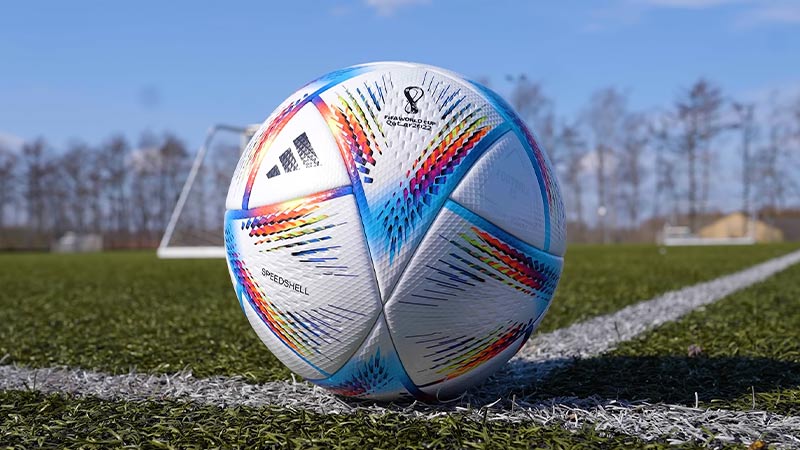
For decades, the question of what soccer ball FIFA uses has been answered by a single name: Adidas. As we look toward the 2026 FIFA World Cup, the official match ball is the Adidas Trionda, a technological marvel representing the fusion of three nations.
Since 1970, these balls have evolved from heavy, lace-up leather spheres to sensor-equipped instruments of precision.
Understanding the current choice requires examining a legacy of innovation, from the first black-and-white Telstar to the modern connected-ball era. This guide explores the engineering, history, and future of the world’s most scrutinized sports equipment.
The Official Match Ball for 2026: The Adidas Trionda
The Adidas Trionda was unveiled in October 2025 as the official match ball for the FIFA World Cup 2026, hosted jointly by Canada, Mexico, and the United States.
As the latest iteration in a long-standing partnership between FIFA and Adidas, the Trionda represents the pinnacle of sports science, incorporating advanced aerodynamics and real-time data tracking to meet the demands of the modern game.
Symbolism and Design Inspiration
The name “Trionda” is a linguistic blend of the English word “Tri” (three) and the Spanish/Portuguese word “Onda” (wave). This name celebrates the historic “triple wave” of the three host nations.
To further honor this partnership, the ball’s graphics incorporate national icons: the red maple leaf for Canada, the green eagle for Mexico, and the blue star for the United States.
Technical Construction and “La Ola” Geometry
The Trionda features a four-panel design, which is the fewest number of panels ever used for a World Cup match ball. This construction utilizes deep seams and “la ola” (the wave) inspired geometry to provide maximum in-flight stability.
By reducing the number of panels, engineers have minimized the “seam-drag” effect, allowing for a more predictable trajectory even at high speeds.
Connected Ball Technology and VAR Integration
Continuing the innovation started with the 2022 Al Rihla, the Trionda contains a 500Hz motion sensor chip. This chip sends real-time data to the Video Assistant Referee (VAR) system, assisting officials with precise offside calls and touch-detection.
This high-frequency sensor can detect the exact moment the ball is struck, providing data that is critical for making millisecond-accurate officiating decisions.
The Evolution of FIFA Match Balls: 1930 to 1966
Before the standardization brought by Adidas in 1970, the balls used in the FIFA World Cup were often a point of contention and varied significantly in design.
The Early Years: Tiento and T-Model
In the very first World Cup final in 1930, a dispute arose between finalists Argentina and Uruguay over which ball to use.
Consequently, two different balls were utilized: the Tiento (supplied by Argentina) was used in the first half, while the larger and heavier T-Model (supplied by Uruguay) was used in the second half.
These early balls were made of leather and typically featured heavy laces that could be painful for players when heading the ball.
Major Technical Breakthroughs (1950–1962)
The 1950 World Cup in Brazil introduced the Duplo T, which was the first ball to eliminate laces and introduce the syringe valve for inflation. By 1954, the Swiss World Champion became the first ball to feature 18 panels.
However, consistency remained an issue; during the 1962 World Cup in Chile, the official “Crack” ball was so poorly received by some teams that a European replacement ball had to be brought in mid-match during the opening game.
Complete List of Early FIFA World Cup Balls
| Year | Tournament Host | Match Ball Name | Key Feature |
|---|---|---|---|
| 1930 | Uruguay | Tiento / T-Model | Two different balls used in the final. |
| 1934 | Italy | Federale 102 | Produced by ECAS in Rome. |
| 1938 | France | Allen | 13-panel leather ball with white cotton laces. |
| 1950 | Brazil | Duplo T | First ball without laces; introduced syringe valve. |
| 1954 | Switzerland | Swiss World Champion | The first 18-panel ball. |
| 1958 | Sweden | Top Star | Selected from 102 candidates in a blind test. |
| 1962 | Chile | Crack | Controversial; replaced by European balls in some games. |
| 1966 | England | Challenge 4-Star | 18-panel ball in orange or yellow. |
The Adidas Revolution: Standardization Since 1970
In 1970, Adidas became the exclusive official match ball supplier for FIFA, a role it has maintained for over half a century. This partnership led to the creation of some of the most iconic sports equipment in history.
The Telstar and the Birth of a Legend
The 1970 Telstar was the first 32-panel black-and-white ball used in the FIFA World Cup. The contrasting colors were specifically chosen to improve the ball’s visibility on black-and-white television broadcasts, which gave it its distinctive “buckball” appearance that many still associate with the sport today. Interestingly, only 20 of these balls were supplied for the entire tournament.
The Shift to Synthetic Materials
For decades, match balls were made of leather, but this posed problems in wet conditions as the material would absorb water and become heavy. The 1974 Telstar Durlast addressed this by using a polyurethane coating, making the ball waterproof.
The 1982 Tango España was the last leather ball used in a World Cup, as it was succeeded by the 1986 Azteca, the first fully synthetic and hand-sewn match ball.
This transition allowed for better shape retention and more consistent performance across different weather conditions.
Multi-Color and Multi-Layer Innovation
The 1998 Tricolore marked another milestone as the first multi-colored ball used in a World Cup finals tournament. Following this, the 2002 Fevernova moved away from the traditional “Tango” design that had dominated since 1978, opting for a triangular graphic and a refined internal layer system to improve flight accuracy.
Modern Engineering: The Science of Flight (2010–Present)
In the 21st century, the focus of FIFA match balls has shifted toward aerodynamic perfection and sustainability.
The Jabulani and Aerodynamic Controversy
The 2010 Jabulani is perhaps the most famous ball for its controversy. Featuring only 8 panels, the ball was criticized by players and fans who claimed its flight was unusually unpredictable.
This led Adidas to further refine their designs, resulting in the six-panel Brazuca for the 2014 tournament, which utilized aerodynamic symmetry to restore stability.
Sustainability and the Al Rihla
The 2022 Al Rihla (meaning “The Journey”) set a new standard for environmental responsibility. It was the first official match ball created using water-based glues and inks, a practice that has been continued with the 2026 Trionda.
The Al Rihla also made history by traveling on a suborbital mission onboard a SpaceX Falcon 9 booster before being used in the tournament.
Comparison of Modern Adidas World Cup Balls
- 2014 Brazuca: First ball named by fans; featured 6 polyurethane panels thermally bonded for a seamless surface.
- 2018 Telstar 18: A tribute to the original 1970 design but with modern construction; featured a “glitch” graphic.
- 2022 Al Rihla: Introduced Connected Ball technology and used sustainable water-based materials.
- 2026 Trionda: Features the most advanced 4-panel geometry and 500Hz sensor data.
Match Balls of the FIFA Women’s World Cup
While the men’s tournament balls often get the most attention, FIFA and Adidas have also developed specialized balls for the Women’s World Cup, often mirroring the technology of the men’s ball with unique aesthetic identities.
From Icon to Oceaunz
The 1999 Icon was the first ball specifically created for a Women’s World Cup, though it was technically identical to the men’s Tricolore.
This trend continued with the 2003 Fevernova and 2007 Teamgeist, which shared performance specs with their male counterparts but featured different visual designs.
Connected Technology in the Women’s Game
The 2023 Oceaunz, used in Australia and New Zealand, featured the same connected ball technology seen in the 2022 Qatar World Cup. This allowed for real-time data to be provided to video match officials.
The graphics of the Oceaunz reflected the coastlines and waterways of the host nations, emphasizing the cultural connection between the sport and the environment.
FAQ: Common Questions About FIFA Match Balls
Why does the number of panels on the ball keep changing?
The reduction in panels—from 32 on the Telstar to just 4 on the Trionda—is driven by aerodynamic engineering. Fewer panels mean fewer seams, which reduces air resistance and allows for a smoother, more stable flight.
What is the “Connected Ball” technology used for?
The technology, including the 500Hz sensor in the Trionda, provides precise data on the ball’s movement. This helps the VAR system make accurate decisions regarding offsides and determining if a ball has crossed the goal line or been touched by a player.
Are World Cup balls waterproof?
Yes, since the 1974 Telstar Durlast, balls have featured coatings (like polyurethane) or thermal bonding (like the Brazuca) to prevent water absorption and ensure the ball does not gain weight during rainy matches.
Is the same ball used for the entire tournament?
Not exactly. While the design remains consistent, specific variants are often introduced for the knockout stages or the final. For example, the Al Hilm was used for the final four matches in 2022, and the gold-colored Teamgeist Berlin was used for the 2006 final.
The Future of the Beautiful Game
The evolution from the heavy, lace-up leather balls of 1930 to the sensor-equipped Adidas Trionda of 2026 tells the story of football’s modernization. As the game becomes faster and the margins for error smaller, the equipment must keep pace.
The Trionda is not just a tool for the sport; it is a data-gathering instrument designed to ensure fairness through VAR integration while honoring the cultural unity of North America.
Whether you are a professional player or a dedicated fan, the match ball remains the most vital piece of technology on the pitch.
As we move toward 2026, the Trionda stands as a symbol of how far the game has come—and how much further it can go through the intersection of tradition, sustainability, and cutting-edge science.