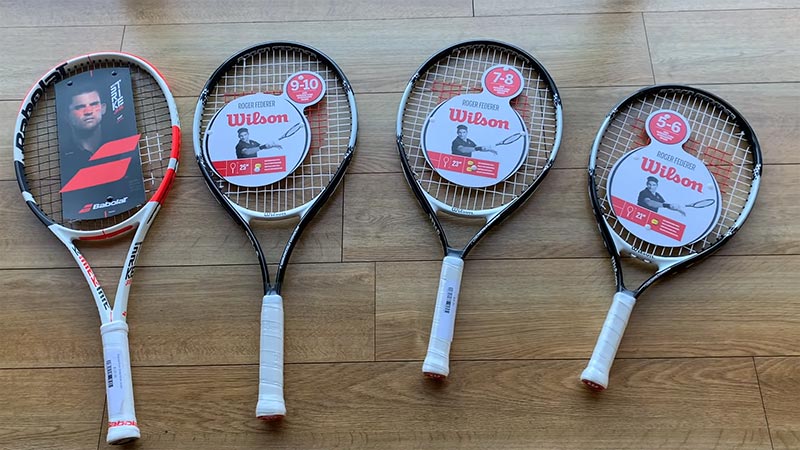
The transition into the teenage years is one of the most pivotal moments in a young tennis player’s development.
At 13, players are often caught between two worlds: the junior circuit, where they have honed their skills on shorter frames, and the adult game, which demands more power, reach, and technical precision.
Choosing the right racket size is not just about performance; it is a critical decision for physical safety and long-term athletic growth.
The 13-Year-Old Transition: Why Size Matters
For a 13-year-old, the choice typically falls between a 26-inch junior racket or a full-size 27-inch adult racket.
This decision is rarely based on age alone, as 13-year-olds can vary significantly in physical maturity. Instead, the selection should be driven by a combination of the player’s height, physical strength, and overall skill level.
Using a racket that is too large can lead to poor mechanics, as the player may struggle to swing the extra length and weight. Conversely, staying on a junior racket for too long when a player has outgrown it can limit their potential for power and spin.
The Height Factor: The Primary Metric
The most reliable starting point for selecting a racket size is the player’s height. A 26-inch racket is generally considered the standard for players who are approximately 55 inches (4’7″) to 5’3″.
This length allows the player to maintain control over the racket head without it dragging or feeling unwieldy during fast-paced rallies.
However, once a player exceeds 5’3″ (approximately 142–158 cm), they are often ready to transition to a full-size 27-inch adult frame.
This extra inch provides a significant advantage in terms of reach and leverage, which is essential as players move toward more competitive high school or club play.
Pro-Tip (External Information): To verify if a racket is the right length at home, have the player stand straight and hold the racket by their side pointing toward the ground.
The tip of the racket should ideally be about an inch above the ground; if it hits the ground or forces the shoulder to shrug, it is likely too long.
Skill Level and Material Construction
Beyond physical dimensions, the internal “DNA” of the racket—its material—plays a massive role in how it performs for a 13-year-old.
The Beginner’s Choice: Aluminum
For 13-year-olds who are just starting their tennis journey, a 26-inch aluminium racket is highly recommended.
Aluminum frames are lightweight and generally more affordable, making them an excellent entry point for learning the basics of the swing without the physical strain of a heavier professional frame.
The Advanced Player’s Choice: Graphite
For more experienced or physically strong players, the suggest moving toward a graphite construction. Graphite rackets are stiffer and more stable, which helps advanced players generate the power needed for competitive play.
If an experienced 13-year-old is moving up to a 27-inch frame, it is advised to select a lightweight model, specifically one that weighs under 285 grams.
This ensures that while the player gains the length of an adult racket, they are not overwhelmed by its mass, allowing them to maintain high swing speeds.
The Safety and Comfort Check
Safety is the most important consideration when moving a young teen into adult-sized equipment. A racket that is too heavy or long can place undue stress on the wrist, elbow, and shoulder, potentially leading to overuse injuries during a critical growth spurt.
The “Choke-Up” Test A clear indicator that a racket is too large is the player’s grip. If a 13-year-old finds themselves “choking up” on the handle—holding it higher than the base—it is a sign that the racket feels too heavy or long for them to control properly. In such cases, the emphasize that it is safer to size down to a 26-inch racket to prevent injury.
The Weight Test (External Information): A simple way to check weight is to have the player hold the racket straight out in front of them with their dominant hand for 20-30 seconds. If their wrist begins to wobble or drop, the racket is likely too heavy for their current strength level.
Fine-Tuning the Grip Size
Even if you find the perfect frame length, an incorrect grip size can compromise a player’s performance. Most junior rackets are manufactured with a standard 4-inch grip.
While 13-year-olds are growing, their hand size may not yet match the larger grip sizes found on adult rackets (which typically range from 4 1/8 to 4 1/2 inches).
If a 4-inch grip feels slightly too small, a simple and effective solution is to add an overgrip. This adds a small amount of thickness and increases the “tackiness” of the handle, ensuring the racket doesn’t twist in the hand during heavy hits.
Conclusion: Making the Right Call
Selecting a tennis racket for a 13-year-old requires balancing physical metrics with on-court experience.
While a 26-inch racquet is appropriate for many in this age bracket, those with the height (over 5’3″) and the skill to handle a 27-inch frame will find that the transition helps take their game to the next level.
Always prioritize maneuverability and comfort over the prestige of using an “adult” racket. By choosing a frame that matches their current physical state, you ensure that the 13-year-old player continues to develop their technique with confidence and, most importantly, remains injury-free.