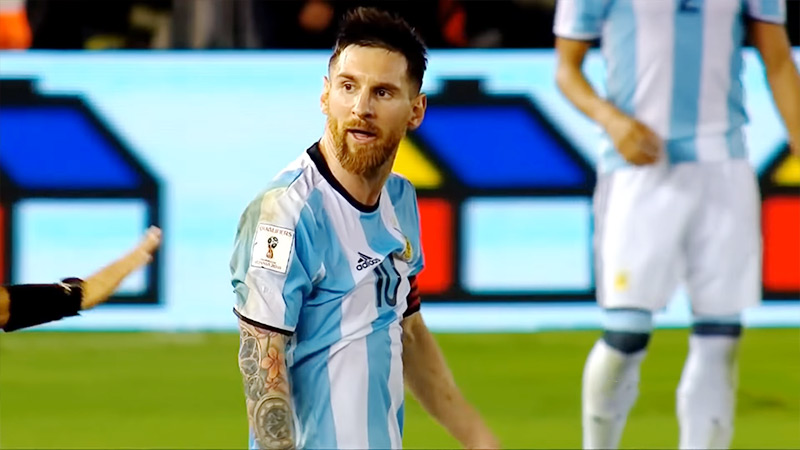
Lionel Messi is frequently hailed as the most complete footballer to ever grace the pitch, a player who seems to have perfected every offensive facet of the game, from vision and passing to dribbling and free-kicks.
However, even a player often described as “perfect” has specific areas where his game is less dominant. To understand the full scope of his career, one must look beyond the highlight reels to the physical and tactical limitations that have shaped his journey.
By examining his career through the lens of performance data and expert analysis, we can identify several key areas—physical, defensive, and psychological—that constitute the “weaknesses” of Lionel Messi.
The Physical Hurdle: Height and Aerial Dominance
Perhaps the most obvious physical limitation in Messi’s game is his stature. Standing at 169 cm (approximately 5’6″), Messi faces a natural disadvantage in a sport that often rewards height in specific tactical situations.
The Data Behind the Header
Statistically, Messi is not a primary target for high crosses. Data suggests he wins only roughly 36.7% of his aerial duels.
This lack of aerial presence makes him significantly less effective when positioned in a packed penalty area where teams rely on lofted balls to break a deadlock.
While he famously beat Rio Ferdinand with a header in a Champions League final, such moments are exceptions rather than the rule.
Physical Strength and Being Outmuscled
While Messi’s low center of gravity is one of his greatest assets for balance and dribbling, it comes with a trade-off in raw physical power.
Against taller, more physically imposing defenders, he can occasionally be outmuscled in tight situations. Although he compensates for this with exceptional ball-shielding techniques, he lacks the pure brute force seen in other world-class forwards.
Defensive Work Rate: The “Walking” Phenomenon
One of the most frequent criticisms of Messi, particularly in the later stages of his career, is his low defensive contribution. Tactical analysis often highlights a “weak” rating for Messi when it comes to tracking back or engaging in high-intensity pressing.
Scanning vs. Sprinting
Messi is often observed “walking” during play rather than sprinting to close down opponents.
While some analysts argue this is a tactical choice to scan defenses and preserve energy for offensive bursts, it undeniably places a heavier defensive burden on his teammates.
In modern systems that rely on a “front-to-back” press, Messi’s lack of immediate tracking back is a notable tactical limitation.
Minimal Pressing
His defensive output was minimal, noting a lack of consistent pressing. While he has shown he can be decent at dispossessing opponents when he chooses to engage, those instances are rare compared to traditional defensive forwards.
The Penalty Paradox: Consistency Under Pressure
For a player who has mastered the art of the free-kick, Messi’s record from the penalty spot has been a surprising point of contention throughout his career.
Statistical Inconsistency
Despite his legendary finishing ability, Messi has historically faced criticism regarding his consistency in taking penalties during high-stakes games.
Some data points suggest a significant miss rate; at one stage in his career, he was noted for missing roughly 25% of the penalties he took.
Comparison to Averages
While some fans point out that his career conversion rate of approximately 77% is slightly above the general average of 75%, it remains one of the few areas where he does not vastly outperform the rest of the elite footballing world.
For many spectators, a Messi penalty is met with more anxiety than one might expect for a player of his caliber.
Left-Foot Dependency and the “Weak” Right Foot
It is often said that Messi’s left foot is so extraordinary that he doesn’t truly “need” his right. However, from a purely technical standpoint, his reliance on his dominant side can be seen as a limitation that savvy defenders attempt to exploit.
The Cut-Back Tendency
Observers have noted that Messi will frequently miss chances by trying to cut back onto his left foot rather than taking a direct shot with his right. This split-second hesitation to use his “weaker” foot can allow defenders time to close the gap.
A “Relative” Weakness
It is important to qualify this: Messi has scored over 100 goals with his right foot, meaning his “weak” foot is still more effective than the primary foot of many professional players. Yet, when compared to the absolute perfection of his left, the right foot is undeniably a secondary tool.
Leadership Style: Inspiration vs. Vocal Command
Messi’s leadership has often been compared—sometimes unfavorably—to more vocal or aggressive captains like Carles Puyol or Paolo Maldini.
Leading by Example
Messi is not a naturally vocal or charismatic “shouter” on the pitch. Instead, he is described as a leader by inspiration and example.
While his legendary status and on-field aura command immense devotion from his teammates, he lacks the traditional, talkative leadership style that some tactical setups require to organize a team under duress.
Internal Processing
Messi has admitted to being a very structured person who can “shut down” when things don’t go according to plan.
He has noted that if his day is disorganized or an unplanned event occurs, he tends to process the frustration internally rather than communicating it immediately, which can impact his outward leadership dynamic.
Tactical Camouflage: How the “Weaknesses” Were Hidden
The reason these weaknesses are often overlooked is that the tactical systems Messi played in were frequently designed to mask them.
- The False 9: Under managers like Pep Guardiola, the “False 9” role allowed Messi to stay in central areas where his lack of defensive tracking was less damaging and his creative vision was maximized.
- Shielding for Strength: To counter his lack of raw physical power, Messi developed world-class shielding skills, using his body to keep the ball away from stronger defenders.
- Energy Preservation: His “walking” is often viewed not just as a weakness but as a calculated trade-off to ensure he is the most dangerous player on the pitch during the final 20 minutes of a match.
Conclusion: The Human Behind the GOAT
Lionel Messi’s weaknesses are largely “relative.” He is “weak” in the air compared to a target man, “weak” defensively compared to a box-to-box midfielder, and “weak” on his right foot only when compared to the greatest left foot in the history of the sport.
His primary limitations—height, defensive work rate, and penalty consistency—are the small cracks in an otherwise impenetrable armor.
They serve as a reminder that even the most legendary figures in sports are bound by physical and human constraints, and it is perhaps Messi’s ability to dominate despite these limitations that truly cements his status as the greatest of all time.