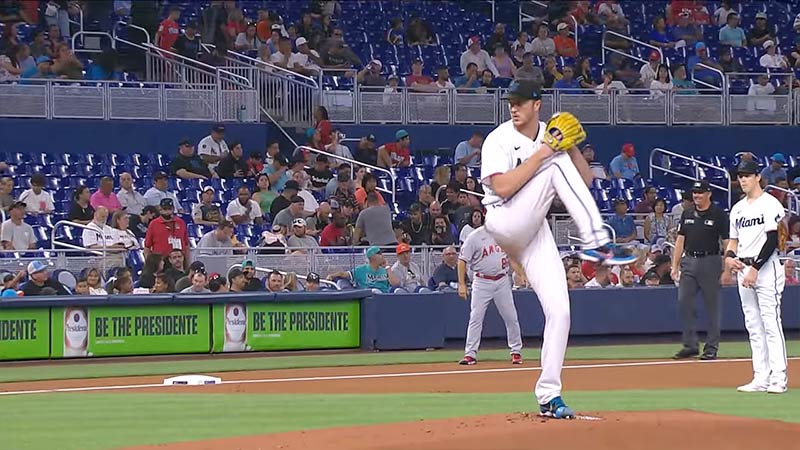
The crack of the bat, the roar of the crowd, and the lightning-fast chess match between the pitcher and the baserunner define America’s pastime.
While casual fans often focus on the dramatic home runs or high-velocity fastballs, the game’s true tactical battles happen in fractions of a second.
At the center of this defensive chess match is one fundamental pitching delivery: the stretch.
Whether you are an aspiring youth coach, a player looking to refine your mechanics, or a dedicated fan wanting to deepen your appreciation of the game, understanding the stretch is essential.
This comprehensive guide explores what the stretch is, why it is necessary, how it compares to the traditional windup, and how pitchers master this critical skill to shut down the running game.
What Is the Stretch in Baseball?
At its core, the stretch is a compact, abbreviated pitching delivery used primarily when there are baserunners on base. Unlike the sweeping, high-energy windup designed purely for maximum velocity with empty basepaths, the stretch is engineered for efficiency, deception, and control.
The Primary Objectives of the Stretch
- Reducing Delivery Time: By eliminating unnecessary body movements and extended leg kicks, the stretch shortens the time it takes for the ball to travel from the pitcher’s hand to the catcher’s mitt. This gives base stealers less time to advance.
- Controlling the Running Game: Because the pitcher starts from a sideways position facing home plate with their body already pre-set, they can execute a swift pickoff throw to any base without altering their stance or violating balk rules.
- Consistency and Repeatability: The smaller range of motion makes it easier for pitchers to repeat their mechanics pitch after pitch, maintaining superior control under high-pressure game situations.
How the Stretch Works: Step-by-Step Mechanics
Executing a proper stretch requires precise body control, adherence to strict official baseball rules, and seamless coordination. The delivery is broken down into distinct phases:Ste
Step 1: The Stance
The pitcher stands with their body positioned sideways relative to home plate.
- Their back foot (the right foot for a right-handed pitcher, or the left foot for a left-handed pitcher) must either touch or be completely parallel to the pitching rubber.
- The front foot is placed comfortably toward home plate, establishing a solid, balanced foundation.
Step 2: The Motion and Set Position
- The pitcher brings their hands together near their body—typically around the belt or chest area.
- Once the hands are joined, the pitcher enters the set position, looking toward the catcher for the sign and surveying any runners on base.
- Before initiating the forward delivery to the plate or making a move toward a base, the pitcher must come to a complete, discernible stop.
The Rule of the Stop: According to official baseball regulations, the pitcher must demonstrate a distinct, unmistakable pause in the set position.
Failing to come to a complete stop before throwing home or attempting a pickoff results in a balk, instantly advancing all baserunners one base.
Stretch vs. Windup: Understanding the Differences
To fully appreciate why pitchers use the stretch, it helps to compare it directly with its counterpart: the windup.
| Feature | The Windup | The Stretch |
| Primary Use | Bases empty | Runners on base (or anytime preference dictates) |
| Movement Style | Large, complex, flowing motion | Compact, concise, and quick |
| Leg Kick | High leg lift to build momentum | Minimal leg lift or a direct step |
| Primary Goal | Maximum velocity and power generation | Speed to home plate and baserunner containment |
| Pickoff Capability | Limited; requires stepping off the rubber first | Immediate and fluid |
Why Not Use the Stretch All the Time?
While the stretch is faster and safer with runners on base, many pitchers prefer the windup when the bases are empty because the larger momentum-building motion allows them to generate extra torque, resulting in higher pitch velocity and less physical strain over the course of a long game.
Advanced Strategic Elements of the Stretch
Mastering the stretch goes far beyond simply shortening your delivery. Elite pitchers utilize nuanced strategies to keep opposing base stealers completely off balance.
Holding the Ball and Varying Timing
Base runners study a pitcher’s timing religiously. If a pitcher adopts a predictable rhythm—for example, always delivering the pitch exactly two seconds after coming to the set position—fast runners will time their jumps and steal second base with ease.
The Variable Hold: Elite pitchers alter the duration of their pause in the set position. They might hold for one second on the first pitch, three seconds on the second, and execute a quick pitch on the third. This unpredictability paralyzes the runner’s jump.
The Slide Step
When facing an exceptionally fast baserunner or a crucial game-tying run on first base, pitchers often employ a slide step out of the stretch.
- Instead of lifting the lead knee upward, the pitcher drags their lead foot across the ground directly toward home plate.
- This dramatically cuts down delivery time—sometimes dropping pop times from the pitcher’s hand to the catcher’s mitt by two to three tenths of a second.
- Trade-off: The slide step sacrifices some lower-body drive and command, making it a high-risk, high-reward tactical choice.
The Pickoff Move
The threat of the pickoff is just as important as the pitch itself. Left-handed pitchers have a natural advantage because their body position allows them to look directly at first base while lifting their front leg, making it difficult for the runner to tell whether they are throwing to first or home.
Right-handed pitchers must execute a quick pivot, spinning on their right foot to throw to first base before committing forward.
Common Mistakes and How to Correct Them
Even experienced players occasionally fall into bad habits when working out of the stretch. Recognizing these common errors helps coaches and players maintain peak performance:
Rushing the Stop
Trying to be too quick to home plate can lead to failing to make a complete stop, resulting in costly balk penalties. Correction: Focus on a deliberate, internal “one-thousand-one” count in the set position before moving.
Opening Up Too Early
Rushing the upper body rotation can cause the pitcher’s front shoulder to fly open, causing pitches to miss high and wide to the glove side. Correction: Keep the front shoulder closed and drive down the slope toward the target.
Neglecting the Lower Half
Because the stretch is shorter, pitchers sometimes forget to use their legs, relying entirely on arm strength. Correction: Maintain a strong push off the back rubber to ensure proper velocity and arm health.
Frequently Asked Questions
Can a pitcher use the stretch with no runners on base?
Yes. While the windup is traditional for empty basepaths, pitchers are fully permitted to use the stretch with no runners on base. Many relief pitchers and modern starters use the stretch exclusively for consistency and simplicity.
What happens if a pitcher commits a balk out of the stretch?
When a balk is called by the umpire, the ball is immediately dead, and every baserunner advances one base automatically. No pitches or plays resulting from that delivery count.
How does the stretch affect pitch velocity?
Historically, pitchers throw slightly harder from a windup due to the added momentum. However, modern biomechanical analysis shows that many professional pitchers generate virtually identical velocity from the stretch by maximizing core and lower-body explosion within the compact motion.
Conclusion
The stretch in baseball is far more than just a modified stance; it is a vital defensive mechanism that combines strict adherence to rules, precise physical mechanics, and high-level mental strategy.
By reducing delivery time, enabling quick pickoff attempts, and keeping base stealers honest, mastering the stretch is non-negotiable for any pitcher looking to succeed at competitive levels of the game.
Whether you are stepping onto the mound for your first Little League game or analyzing Major League strategy, understanding the nuances of the stretch unlocks a deeper appreciation for the intricate battle between pitcher and runner.