Stephen Curry is currently healthy and uninjured as he prepares for the upcoming 2026-27 NBA season.
While he is active now, his most recent significant injury was a right knee condition known as patellofemoral pain syndrome, accompanied by a painful bone bruise, which sidelined him for 27 consecutive games in early 2026.
Over his 17-season career, Curry has navigated between 35 and 40 recorded ailments, ranging from early chronic ankle instability to fluke impact fractures.
Understanding his health requires looking at his legacy of biomechanical adaptations and resilient recoveries defining his legendary career.
Deep Dive: The 2026 Patellofemoral Injury and Bone Bruise
The most recent challenge for the Golden State Warriors superstar was a specialized knee condition that arose not from a single hit, but from the cumulative stress of an elite 17-year career.
This specific ailment required a delicate balance of rest and targeted rehabilitation to ensure the joint could withstand the intensity of NBA competition.
Clinical Diagnosis of Runner’s Knee and Bone Contusions
The “injury of Curry” in early 2026 was officially diagnosed as patellofemoral pain syndrome, frequently referred to in medical circles as “runner’s knee,” occurring alongside a significant bone bruise.
Unlike a ligament tear, which involves structural failure of the connective tissues, runner’s knee involves the irritation of the cartilage behind the kneecap. In Curry’s case, the pain and swelling were first reported on January 24, 2026, during a standard team workout.
After attempting to play through the discomfort for several games, persistent swelling forced him to the sidelines on January 30, following an MRI that confirmed no long-term structural damage but highlighted the severity of the bruising.
The Recovery Timeline and Impact on the 2025-26 Season
Rehabilitating a bone bruise and mechanical knee pain is notoriously difficult due to the unpredictable nature of swelling. While the initial medical expectation was a brief absence, Curry faced multiple setbacks whenever he attempted to ramp up his physical activity.
These flare-ups were severe enough to keep him out of the 2026 NBA All-Star Game, as the medical staff prioritized long-term joint health over mid-season exhibition appearances.
Ultimately, Curry missed 27 consecutive games before making a triumphant return on April 5, 2026, against the Houston Rockets. Upon his return, he notably scored 29 points coming off the bench, proving his “new normal” of muscle management was effective.
Complete Career Health Profile: Every Major Absence
The following data provides a clear look at the various challenges Curry has faced since entering the league. His history is a mix of chronic joint issues and high-impact trauma.
| Season | Injury Type | Games Missed & Career Impact |
|---|---|---|
| 2010–2011 | Right Ankle Sprains | Multiple incidents; required offseason ligament reconstruction. |
| 2011–2012 | Chronic Ankle Instability | Missed 56 games; required exploratory surgery for scar tissue. |
| 2015–2016 | Right Ankle & Left MCL | Missed 6 playoff games during the 73-win season run. |
| 2017–2018 | MCL Grade 2 Sprain | Missed 31 regular-season games and the entire first playoff round. |
| 2019–2020 | Broken Left Hand | Missed over 50 games (4 months) due to a metatarsal fracture. |
| 2021–2022 | Left Foot Sprain | Missed final 12 games of the season; returned for the playoffs. |
| 2022–2023 | Shoulder & Leg Tears | Missed 11 games (shoulder) and 11 games (tibiofibular ligaments). |
| 2024–2025 | Left Hamstring Strain | Sidelined during Game 1 of the Western Conference Semifinals. |
| 2025–2026 | Patellofemoral Pain | Missed 27 games across February and March 2026. |
The “Glass Ankles” Era: A Career-Threatening Period
Between 2010 and 2013, the primary “injury of Curry” involved his right ankle, which suffered from significant ligament laxity. This period almost ended his career prematurely, forcing him to undergo radical changes to his physical preparation.
Surgical Interventions and Ligament Reconstruction
The early portion of Curry’s career was marred by what medical staff described as “stretched-out” ligaments.
These ligaments were so unstable that his ankle would frequently fold during routine basketball movements, such as a simple crossover or a change of direction, without any contact from another player. This led to a major reconstruction surgery in 2011 to tighten the tendons and ligaments.
However, the issues persisted into 2012, requiring a second exploratory surgery to remove chronic scar tissue and “clean out” the joint. This 2011-12 season saw him miss 56 games, leading many to label him as injury-prone.
Biomechanical Adaptation and the Switch to Zamst Braces
To overcome his chronic ankle instability, Curry and his training team implemented a total overhaul of his movement mechanics.
Instead of relying on his ankles to generate explosive power—a common trait for smaller guards—he shifted his training to drive power from his core and hips.
This biomechanical shift significantly reduced the torque and stress placed on his lower joints. Beyond physical training, he also made the permanent switch to rigid Zamst A2-DX ankle braces, which provide superior lateral support to prevent the ankle from rolling.
This combination of orthopedic support and core-centric movement transformed him from a high-risk athlete into one of the most durable stars in the NBA.
Fluke Impact Injuries: The Hard Reality of the NBA
Once the chronic ankle issues were resolved, the majority of Curry’s long-term absences were the result of unpredictable contact on the court. These impact injuries represent a different category of health risk compared to his earlier mechanical issues.
Hand Fractures and Shoulder Dislocations
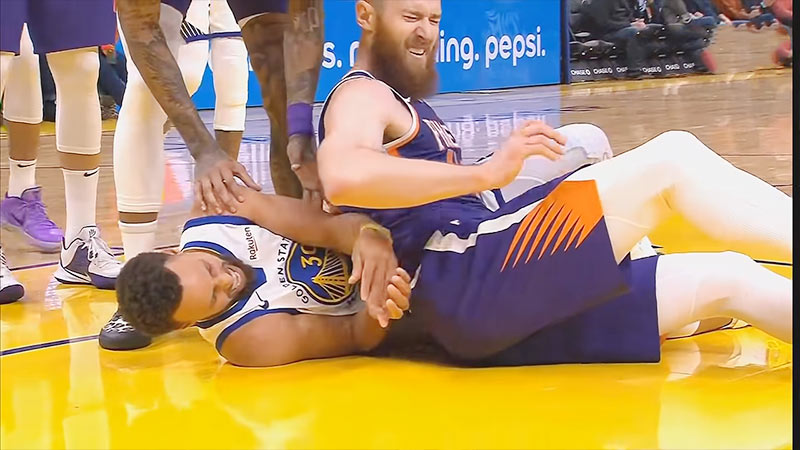
The most significant impact injury of his career occurred in 2019 when Phoenix Suns center Aron Baynes landed directly on Curry’s left hand during a drive to the basket.
This resulted in a broken second metatarsal that required surgery and sidelined him for over four months, effectively ending his 2019-20 season after just a few games. Later, in late 2022, Curry suffered a left shoulder subluxation (partial dislocation) while reaching for a steal.
This injury sidelined him for 11 games but did not require surgery, showcasing his ability to recover from upper body trauma without long-term loss of shooting range.
Lower Body Impacts: The Marcus Smart Incident
In March 2022, Curry suffered a sprained ligament in his left foot after Boston Celtics guard Marcus Smart rolled onto his leg while diving for a loose ball.
This injury was particularly concerning as it occurred just before the postseason, forcing him to miss the final 12 games of the regular season. Despite the severity of the sprain, he returned just in time for the playoffs, leading the Warriors to another championship.
Other notable impacts include a viral tailbone contusion in 2021 after a hard fall backward onto a metal step, which sidelined him for several weeks and required specialized padding upon his return.
Modern Era Challenges: Mechanical Wear-and-Tear
As Curry has moved into his late 30s, the “injury of Curry” has transitioned back toward mechanical issues, though they differ from his early career ankle problems.
These are now largely “wear-and-tear” conditions associated with a heavy workload over thousands of NBA minutes.
The Rise of Tibiofibular and Hamstring Strains
In recent seasons, Curry has dealt with injuries that reflect the strain of maintaining an elite pace at an advanced age.
During the 2022-23 season, he missed 11 games due to tears in his lower leg superior tibiofibular ligaments—a rare injury in basketball that involves the connection between the two bones of the lower leg.
Furthermore, during the 2024-25 postseason, a left hamstring strain during the Western Conference Semifinals limited his availability. These muscle-related issues require precise load management and emphasize the importance of his “new normal” recovery routine.
Maintaining Elite Performance Through Muscle Support
Following his recovery from patellofemoral pain in 2026, Curry revealed that his daily focus has shifted toward the “surrounding muscles” to support his knee joints.
This includes rigorous training for the quadriceps, hamstrings, and calves to act as shock absorbers, reducing the direct impact on the knee’s internal structures.
By focusing on these supporting muscle groups, Curry was able to finish the 2025-26 season playing at full capacity. This proactive approach to mechanical health is the primary reason why, despite over 35 career injuries, he remains an uninjured and active threat for the 2026-27 season.
Essential Insights on Stephen Curry’s Health
What is the injury of Curry right now?
Stephen Curry does not have an active injury. He is currently healthy and uninjured as he prepares for the 2026-27 NBA season. His last major absence was the 27-game stretch in early 2026 for a knee condition.
How many total injuries has Curry suffered?
Over his 17-year career, he has recorded between 35 and 40 different injuries or ailments. While many of these were minor, they have collectively prevented him from ever playing a full 82-game regular season.
Is Curry’s “runner’s knee” a permanent condition?
While runner’s knee is often a chronic mechanical issue, Curry successfully recovered in April 2026. He manages the condition by strengthening the muscles surrounding the knee, which he refers to as his “new normal” for professional maintenance.
Did Curry have surgery on his knees?
No, Curry’s recent knee injury (patellofemoral pain syndrome) did not require surgery. His primary surgical history is related to his right ankle (2011 and 2012) and his left hand (2019).
Resilience as a Competitive Advantage
The “injury of Curry” is not a sign of weakness, but rather a testament to his incredible resilience. Throughout his 17 seasons, he has faced career-threatening ankle instability, broken bones, and mechanical wear, yet he has consistently returned to an elite level of play.
By evolving his training to prioritize hip power and core stability, and by adopting advanced orthopedic support like Zamst braces, he has extended his prime well beyond what many experts predicted in 2012.
As he heads into the 2026-27 season, his status as a healthy, uninjured player is a result of years of disciplined rehabilitation and a sophisticated understanding of his own body’s mechanics.
For the Golden State Warriors, his health remains the most critical factor in their pursuit of another title.