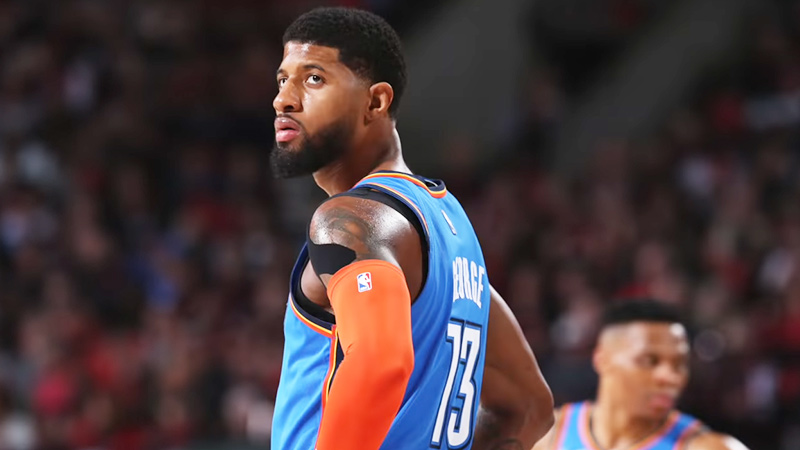
Paul George possesses a maximum recorded vertical leap of 39 inches, an elite metric that defines his “smooth” yet explosive presence on the court.
While this figure sits just below the legendary 40-inch benchmark, it allows the veteran forward to navigate complex aerial maneuvers and finish above the rim with ease.
Because he did not participate in official athletic testing during the 2010 NBA Combine, this specific 39-inch data point originates from specialized team workouts and modern tracking.
Understanding this verticality provides deep insight into how George maintains his status as a premier two-way force.
Understanding the Paul George Vertical Leap Metric
Analyzing the athleticism of an elite wing player requires looking beyond raw numbers to understand how those figures translate to on-court dominance.
The 39-inch vertical attributed to Paul George represents a tier of athleticism that allows for high-level rim protection and offensive creativity.
Breaking Down the 39-Inch Maximum
The recorded 39-inch maximum vertical leap is more than just a highlight-reel statistic; it is a foundational component of George’s elite physical profile.
In the context of the NBA, a 39-inch leap is significantly higher than the average for a small forward, placing him in a category of athletes who can effectively “play above the rim”.
This explosive lift provides the necessary hang-time for George to adjust his shot mid-air, a trait that has become a hallmark of his scoring versatility.
Why Inches Matter for Elite Finishing
In high-traffic situations near the basket, every inch of verticality serves as a tool for overcoming defensive interior pressure. For George, the 39-inch jump ensures that he can rise above rim protectors to convert dunks or high-difficulty layups.
This metric is particularly impressive given his size, as maintaining a near-40-inch leap at nearly 6’9″ creates a defensive mismatch that few opponents can reliably contest.
Paul George Physical Dimensions and Measured Reach
To truly grasp the significance of the Paul George vertical jump, one must examine his full physical profile. Verticality does not exist in a vacuum; it is the combination of height, reach, and wingspan that determines a player’s actual “functional” height during a game.
| Physical Attribute | Measurement |
|---|---|
| Height Without Shoes | 6’7.75″ |
| Height With Shoes | 6’8.75″ |
| Standing Reach | 8’11” |
| Wingspan | 6’11.25″ |
| Maximum Vertical Leap | 39 Inches |
| Maximum Touch Point | ~12’2″ |
This data illustrates that George’s physical presence is enhanced by his nearly 9-foot standing reach, which serves as the launchpad for his 39-inch explosions.
By starting with an 8’11” reach, he is already closer to the rim than many guards with higher vertical leaps, making his total reach more impactful.
Calculating the Paul George Maximum Touch Point
The intersection of a player’s standing reach and their maximum vertical leap determines their peak touch point, a critical metric for rebounding and blocking shots. For Paul George, these variables combine to create a staggering aerial range.
The 12-Foot Reach Threshold
When Paul George executes a maximum vertical jump, his fingers can reach a height of approximately 12 feet, 2 inches. This 12’2″ touch point is significant because the standard NBA rim is positioned at 10 feet
This means George is capable of reaching over two feet above the rim, allowing him to pull down rebounds that are well out of reach for smaller opponents and to contest shots at their highest trajectory.
Head at the Rim: A Visual Perspective
Visualizing George’s athleticism often involves the “Rim Reference” test. At the absolute peak of his jump, Paul George can elevate his entire head to within 2 to 3 inches of the 10-foot rim.
This level of elevation is rare for players of his stature and explains how he is able to complete complex dunks where his eyes are nearly level with the iron. This visual data confirms that his 39-inch leap is functional and consistently applied in live-action scenarios.
The Mystery of the 2010 NBA Draft Combine Stats
One of the more interesting aspects of George’s athletic profile is the lack of centralized data from his entry into the league. Unlike many of his peers, his most famous athletic metrics were not recorded in the traditional Chicago setting.
Why George Skipped Athletic Testing
During the 2010 NBA Draft Combine, Paul George provided his baseline physical measurements, such as height and wingspan, but he did not participate in the athletic jump tests.
This “Combine Skip” is not uncommon for players who have already demonstrated their athleticism during the college season or who wish to showcase their skills in more controlled environments.
As a result, there is no “official” combine log for his standing or maximum vertical leap.
Verification through Team Pre-Draft Workouts
The 39-inch figure that is widely cited today was not fabricated; it was verified through independent team workouts and rigorous sports science tracking.
During the pre-draft process, teams conduct private evaluations where they use advanced technology to measure a prospect’s explosiveness.
It was in these settings that George’s 39-inch leap was first documented, and modern tracking data from NBA games continues to support this high level of verticality.
Career Shift: Impact of the 2014 Leg Injury
Physicality in the NBA is often divided into two eras for Paul George: before and after his significant lower-body injury. This event fundamentally changed how he utilizes his 39-inch vertical on a nightly basis.
Analyzing the Pre-Injury Explosiveness
Before 2014, George’s game was heavily predicated on raw, punishing athleticism. He frequently relied on his vertical leap to drive directly into the paint, often looking to “posterize” elite shot-blockers.
During this stage of his career, his 39-inch leap was his primary weapon, used aggressively to collapse defenses and create high-percentage scoring opportunities through sheer force of will and elevation.
Post-2014: Evolution of the “Smooth” Game
Following a severe right leg fracture during a Team USA showcase in 2014, George had to undergo a lengthy recovery and rehabilitation process.
While tracking data suggests he retained a significant amount of his functional vertical lift, his approach to the game underwent a strategic transformation.
He transitioned into a more perimeter-oriented specialist, prioritizing elite shooting and tactical footwork over high-risk, high-impact jumps in a crowded interior.
Longevity through Precision and Deceleration
The modern version of Paul George uses his verticality more as a “threat” and a tool for “stop-and-go” play. Instead of launching every time he nears the paint, he utilizes precise deceleration and elite shooting mechanics.
This shift has not only preserved his health but has also made him a more difficult player to guard, as defenders must respect both his 39-inch leaping ability and his ability to pull up for a jumper at any moment.
The Hidden Advantage of a 6’11” Wingspan
While the vertical leap gets the most attention, George’s 6’11.25″ wingspan is the silent partner that makes his athleticism truly elite. This reach allows him to impact the game in ways that a vertical jump alone cannot explain.
Wingspan vs. Vertical: The Catching Radius
A player’s wingspan effectively extends their catching and finishing radius beyond their absolute launch point.
For George, this means that even if he doesn’t reach the full 39 inches of his vertical on a specific play, his long arms allow him to secure “high-point” rebounds or catch alley-oops that are technically outside his jump range.
This combination of reach and lift creates a massive “effective” area where George can influence the ball.
Defensive Utility and Verticality
On the defensive end, George’s wingspan and vertical leap combine to make him a nightmare for perimeter players.
He can use his 39-inch lift to contest shots that other defenders couldn’t reach, while his nearly 7-foot wingspan allows him to disrupt passing lanes and poke balls away from ball-handlers.
This dual-threat capability is why he has remained one of the premier two-way wings in professional basketball for over a decade.
FAQ Regarding Paul George’s Athletic Profile
What is Paul George’s exact vertical jump?
Paul George has a maximum recorded vertical leap of 39 inches.
How high can Paul George reach?
Combined with his 8’11” standing reach, his maximum touch point is approximately 12 feet, 2 inches.
Did Paul George lose his vertical after his 2014 injury?
While he retained much of his functional lift, he adapted his playstyle to be more perimeter-focused and less reliant on high-risk explosive jumps.
How does Paul George’s wingspan affect his jump?
His 6’11.25″ wingspan allows him to finish plays and grab rebounds at extensions that exceed his vertical launch point.
Can Paul George put his head at the rim?
Yes, at his peak, his head is only 2 to 3 inches below the standard 10-foot rim.
The Enduring Legacy of Elite Athleticism
The story of the Paul George vertical jump is one of both raw talent and remarkable adaptation. A 39-inch leap is an incredible physical feat, but the way George has integrated that explosiveness into a sophisticated, high-IQ game is what truly sets him apart.
By combining his 8’11” standing reach with his nearly 40-inch bounce, he has created a physical profile that has withstood the test of time and injury.
Today, George remains a testament to how elite athletes can evolve. He no longer needs to jump 39 inches on every play to be effective; instead, he uses that explosive potential as a tactical advantage, blending it with world-class shooting and defensive positioning.
Whether he is rising for a contested three-pointer or elevating for a defensive stop, the verticality of Paul George remains a cornerstone of his Hall of Fame-caliber career.
As he continues to compete at the highest level, his physical metrics serve as a blueprint for how to balance natural explosiveness with long-term professional sustainability.