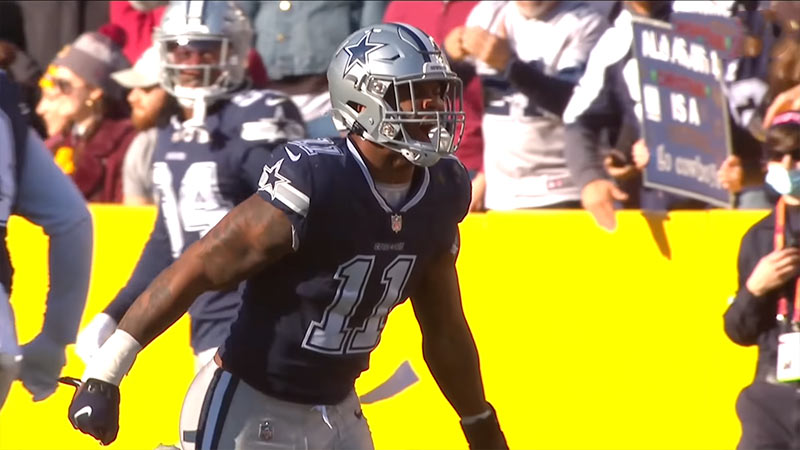
In the modern landscape of professional football, the definition of a defensive playmaker has undergone a radical transformation.
No longer confined to a single role, the premier defenders of the current era must possess a rare synthesis of raw power, explosive burst, and refined technique.
Within the digital simulation of the sport, specifically in the latest iteration of the franchise, Micah Parsons emerges as the definitive blueprint for this new breed of athlete.
This analysis dissects the specific attributes that define his performance, examining how his physical metrics translate into a dominant presence on the virtual gridiron.
The Core Physical Identity
To understand the impact of a player like Micah Parsons, one must first look at the foundational metrics that dictate his movement and interaction with the offensive line.
The following table provides the primary athletic profile for Parsons as documented in the current player database.
| Attribute | Rating | Impact on Performance |
|---|---|---|
| Acceleration | 94 | Dictates the initial burst off the line of scrimmage. |
| Strength | 91 | Determines the ability to overwhelm offensive tackles and shed blocks. |
| Speed | 89 | Defines the top-end velocity for chasing down ball carriers. |
| Agility | 89 | Influences the fluidity of finesse moves and pass-rush maneuvers. |
| Change of Direction | 76 | Governs the speed at which a player can pivot or adjust their path. |
The Engine of Production: 94 Acceleration
The most critical component of Parsons’ athletic profile is his 94 acceleration rating. In the context of a pass rusher, acceleration is often more vital than raw speed.
It represents the “get-off”—the split second between the snap of the ball and the first point of contact.
- Initial Burst: With a 94 rating, Parsons is consistently one of the first players to reach full speed, often catching offensive linemen before they have fully established their pass-set depth.
- Closing Velocity: This acceleration allows him to close the “cushion” between himself and the quarterback with terrifying efficiency. Even when an offensive tackle manages to make contact, Parsons’ ability to re-accelerate after a block shed makes him a constant threat for a secondary sack.
- Gap Penetration: For users who prefer aggressive defensive schemes, this rating ensures that Parsons can exploit “A-gap” blitzes or stunt across the line of scrimmage faster than the offensive logic can react.
Velocity and Range: The 89 Speed Metric
While acceleration wins the first three yards, 89 speed ensures Parsons remains relevant across the entire field.
For a player primarily utilized as a pass rusher, an 89 speed rating is exceptionally high, placing him in a tier where he can realistically track down wide receivers on screen plays or chase mobile quarterbacks to the sideline.
- Sideline-to-Sideline Range: His speed allows him to function as a “spy” against elusive quarterbacks, a role that most defensive ends are too slow to fulfill.
- Recovery Potential: If a play breaks down or a quarterback escapes the pocket, Parsons’ 89 speed allows him to recover from a missed pass-rush attempt and participate in the pursuit from the backside of the play.
The Power Threshold: 91 Strength
A common limitation for “speed rushers” in professional football is a lack of physical density. However, the data indicates that Parsons does not suffer from this imbalance, boasting a 91 strength rating.
This elevated strength metric is what elevates him from a situational specialist to a foundational defensive cornerstone.
- The Bull Rush: A 91 strength rating means Parsons can successfully execute power moves against elite offensive tackles. This forces the opponent to respect both his speed and his power, preventing them from “cheating” toward the outside edge.
- Run Support: Beyond the pass rush, his strength ensures he can hold the point of attack in the run game. He is not easily moved by double teams, allowing him to maintain the integrity of the defensive edge.
- Block Shedding: Strength is a primary modifier in the calculation of how quickly a defender can disengage from a blocker. At 91, Parsons is among the most difficult defenders to “lock up” for an extended duration.
Fluidity vs. Suddenness: The Agility and COD Gap
One of the more nuanced aspects of this athletic profile is the discrepancy between Agility (89) and Change of Direction (76). Understanding this gap is essential for maximizing his efficiency in a competitive environment.
- Agility (89): This rating reflects his ability to perform complex finesse moves, such as the spin or the swim move, with high fluidity. It makes his lateral movement during a pass rush smooth and effective.
- Change of Direction (76): This lower rating suggests a limitation in “suddenness” when forced to completely stop or pivot. While he is incredibly fast and agile in a forward or arcing motion, he may feel slightly “heavier” when trying to react to a sudden cut by a shifty ball carrier in the open field.
- Strategic Implication: To mitigate the 76 Change of Direction, users should focus on using Parsons in “downhill” roles—attacking the quarterback or the line of scrimmage—rather than dropping him deep into zone coverage where he might be forced to change directions repeatedly against quick-cutting slot receivers.
Comparative Tier Analysis
When assessing where Parsons stands within the broader defensive ecosystem, his numbers suggest a “hybrid” archetype that is rarely seen.
- Vs. Traditional Defensive Ends: Most elite ends possess higher strength but lower speed. Parsons’ 89 speed gives him a distinct advantage in pursuit that traditional ends lack.
- Vs. Traditional Linebackers: While most linebackers have higher Change of Direction ratings, very few can match Parsons’ 91 strength and 94 acceleration.
- The “Unicorn” Status: He occupies a unique middle ground, providing the power of a defensive lineman with the explosive burst of a skill-position player.
Strategic Implementation for Competitive Play
To fully leverage these metrics, defensive coordinators (or users) should adopt a multi-faceted approach to his deployment.
- The “Wide-9” Technique: Aligning Parsons outside the tackle allows his 94 acceleration and 89 speed to shine. The extra space gives him time to reach top speed before the tackle can engage.
- A-Gap Blitzing: Utilizing his 91 strength and 94 acceleration in the interior of the line can create immediate pressure that forces the quarterback into early mistakes.
- Manual Control (Usering): Because of his high acceleration and speed, he is a prime candidate for manual control. However, the user must be mindful of the 76 Change of Direction, opting for broad, sweeping pursuit angles rather than tight, jerky movements.
Refining the Defensive Logic: A Global Perspective
The inclusion of such high-tier metrics for a single player reflects a broader trend in sports simulation: the move toward “game-breaking” individuals.
Parsons represents a shift in how defense is played. In previous iterations, defense was a matter of gap discipline. Now, with an athlete possessing 94 acceleration and 91 strength, defense becomes an act of disruption.
His presence on the field dictates the offense’s entire strategy. Opponents are often forced to:
- Keep a tight end or running back in to “chip” him on his way to the quarterback.
- Shift the entire offensive line’s protection toward his side.
- Utilize “quick-game” passing strategies to get the ball out before his 94 acceleration brings him into the backfield.
Final Professional Verdict
Micah Parsons in the current iteration of the game is not merely a high-rated player; he is a strategic asset that requires a specific understanding of physical mechanics.
His 94 acceleration and 91 strength make him an unstoppable force in the trenches, while his 89 speed provides a level of versatility that is almost unmatched at his position.
Despite a modest 76 Change of Direction, his overall profile suggests he is the premier defensive weapon for any roster, capable of single-handedly dismantling offensive game plans through pure physical dominance.
For those looking to build a championship-level defense, the data is clear: Parsons is the gold standard of the modern athletic archetype.
Integrating him effectively requires an understanding of where his burst ends and his momentum begins, but once mastered, he becomes the most impactful player on the field.