Navigating the world of indoor athletics reveals a complex naming convention where terminology dictates everything from the surface beneath a player’s feet to the specific rules of engagement.
When enthusiasts ask what is indoor soccer called, they are often surprised to find that the answer varies significantly based on geographic location and professional governance.
Most commonly identified as Futsal or Arena Soccer, these two pillars represent distinct sporting philosophies rather than mere synonyms.
Understanding this lexicon is essential for organizations and players aiming for high-level technical development and accurate strategic alignment within the global footballing landscape.
The Primary Distinction: Futsal vs. Arena Soccer
The most critical distinction in the indoor game lies between the official, FIFA-recognized version and the wall-based variation popular in North America. These formats utilize different equipment and environments, requiring players to adapt their skill sets accordingly.
| Feature | Futsal | Arena Soccer / Indoor Soccer |
|---|---|---|
| Common Name | Futsal (fútbol sala / futebol de salão) | Arena Soccer, Indoor Soccer, Turf Soccer |
| Surface | Hard court (wood or ceramic) | Synthetic turf (often over ice rinks) |
| Boundaries | Traditional lines (the ball goes out) | Walls or dasher boards (ball stays in play) |
| Ball Type | Size 4, heavier, low-bounce design | Size 5, standard bounce and weight |
| Player Count | 5 vs 5 (including goalkeeper) | Typically 6 vs 6 (including goalkeeper) |
| Official Body | FIFA & AMF | WMF & MASL |
| Primary Goal | Technical precision and ball control | High-speed transitions and physical play |
As evidenced by the table above, Futsal is characterized by its use of a hard court and a specialized low-bounce ball, which forces players to maintain the ball on the ground.
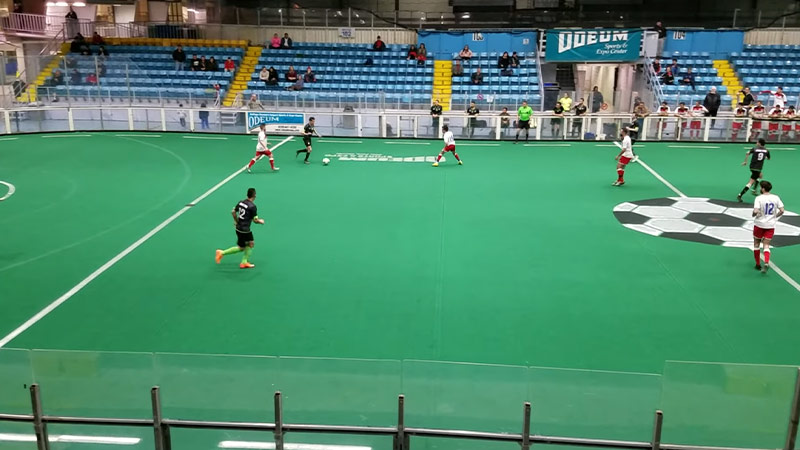
In contrast, Arena Soccer utilizes walls to keep the ball in play, creating a faster, more continuous flow of action that mirrors the intensity of ice hockey more than traditional association football.
Global Regional Nomenclature
Beyond the broad categories of Futsal and Arena Soccer, various regions have adopted localized names that reflect their unique sporting cultures and historical developments. These terms often describe specific player counts or the intended speed of the game.
The British Isles and the Five-a-Side Tradition
In the United Kingdom and much of Europe, the most prevalent term for any small-sided game played indoors is “Five-a-side”.
While this name technically refers to the number of players per team, it has become a catch-all descriptor for amateur and semi-professional indoor matches.
In these regions, the game is frequently played in specialized centers with synthetic turf, often surrounded by netting or boards, blending elements of both Futsal and Arena Soccer.
Mexico and the “Fútbol Rápido” Identity
In Mexico, the sport is predominantly known as Fútbol rápido, which translates directly to “Fast football”. This name is highly accurate, as the Mexican iteration of the game emphasizes rapid transitions and high scoring.
It typically follows the Arena Soccer model, utilizing walls to ensure the ball rarely leaves the field of play. This terminology highlights the tactical priority of the region: speed and offensive efficiency.
Brazilian Variations: Showbol and Society
Brazil, a global powerhouse in both outdoor and indoor football, uses several distinct terms. Futebol de salão remains the traditional name for Futsal, but other variations like Showbol or Futebol Society are also common.
Showbol is a high-entertainment format often featuring legendary retired players, while Society refers to a slightly larger format typically played on synthetic turf with seven or eight players per side. These names signify the depth of the sport’s integration into Brazilian social life.
European Institutional Terms: Spain and Germany
In Spain, the term Fútbol indoor is frequently utilized, particularly when referring to professional leagues that use walled courts. In Germany and other parts of Central Europe, you may hear the term Hallenfußball, which literally means “hall football.”
While the name is simple, it carries a deep tradition of winter indoor tournaments that involve professional outdoor clubs during their off-season.
Technical Specifications Behind the Names
The name applied to an indoor match often dictates the specific technical requirements of the equipment and the court. Using the wrong terminology can lead to significant confusion regarding the type of footwear or ball required for a session.
The Role of the Boundary
One of the most defining factors in naming conventions is the boundary system. In Futsal, the presence of touchlines means that the ball frequently leaves the field of play, requiring a “kick-in” to restart.
This encourages a more tactical, set-piece-heavy approach to the game. In Arena Soccer, the walls act as an additional player, allowing for bank passes and eliminating the need for frequent restarts.
This fundamental difference is why North Americans rarely refer to their walled games as “Futsal,” as the strategy is entirely different.
Surface Mechanics and Footwear
The surface is another primary indicator of what the sport is called in a specific context. Futsal is played on wood or ceramic courts, necessitating “flat” indoor soccer shoes with non-marking rubber soles to provide grip on smooth surfaces.
Arena Soccer and other turf-based variations require “turf shoes” with small rubber studs or “cleats” designed to provide traction on synthetic grass.
Outside of the provided material, it is worth noting that playing on a hard Futsal court with turf shoes can lead to injury, reinforcing the importance of knowing exactly which version of the game is being played.
Governance and Professional Standards
The lexicon of indoor soccer is further reinforced by the international organizations that oversee the sport. These bodies ensure that the rules associated with each name are standardized across the globe.
The FIFA Influence on Futsal
As the primary governing body for world football, FIFA’s adoption of Futsal has made it the “gold standard” for indoor competition.
When an event is billed as a Futsal tournament, it is expected to adhere to FIFA’s Laws of the Game, which include specific court dimensions, four-second restart rules, and accumulated foul counts.
This international standardization has allowed Futsal to grow into a professional sport with its own World Cup and continental championships.
The WMF and the Rise of Minifootball
The World Minifootball Federation (WMF) acts as the umbrella organization for various small-sided formats, including Arena Soccer. They utilize the term “Minifootball” as a standard international term to include everything from 5v5 to 8v8 matches.
In the United States and Mexico, the Major Arena Soccer League (MASL) represents the pinnacle of the walled game, strictly using the “Arena Soccer” branding to market its product as a high-intensity, professional spectacle distinct from the Futsal played in gymnasiums.
Why the Name Matters for Strategic Development
For coaches and players, the distinction between Futsal, Arena Soccer, and Five-a-side is not merely academic. Each format develops different athletic attributes.
Futsal is widely credited with developing the superior technical skills of players like Ronaldinho and Cristiano Ronaldo due to its heavy ball and tight spaces.
Arena Soccer, meanwhile, is lauded for improving a player’s physical conditioning and reaction time due to the lack of breaks in play.
When a development program uses the term “Futsal,” they are promising a specific type of training focused on ball mastery and tactical awareness.
Conversely, an “Indoor Soccer” camp might be more generalized, focusing on the fun and speed of the turf-based game. For elite athletes, choosing the right format—and knowing it by its correct name—is a critical step in their professional pathway.
Enhanced FAQ: Common Nomenclature Queries
What is the most common name for indoor soccer globally?
Globally, Futsal is the most recognized and standardized name for the sport. This is largely due to the administrative support of FIFA and the widespread adoption of the hard-court format in South America and Europe.
Can I call any soccer game played indoors “Futsal”?
Technically, no. While people often use the terms interchangeably, Futsal refers specifically to the 5v5 game played with lines on a hard court using a low-bounce ball. If the game involves walls or a standard ball, it is more accurately called Arena Soccer or Indoor Soccer.
Is “Minifootball” the same as indoor soccer?
Minifootball is a broader category that includes indoor soccer, but it also encompasses outdoor small-sided games played on artificial turf. It is the official term used by the World Minifootball Federation to unify these various formats under one governing body.
Why do North Americans call it Arena Soccer?
The term Arena Soccer is popular in North America because the game is traditionally played in multi-purpose hockey arenas. The name reflects the physical environment—the “arena”—and the use of the dasher boards that are already in place for ice hockey.
What is the difference between Five-a-side and Futsal?
Five-a-side is a general term common in the UK and Europe that refers to the team size. Futsal is a specific, regulated version of five-a-side football that must be played on a hard court without walls.
Conclusion: Mastering the Indoor Lexicon
The answer to what is indoor soccer called is a window into the rich diversity of the global sporting community. From the technical hardwood floors of a FIFA Futsal court to the high-energy turf of a Mexican Fútbol rápido arena, the names we use define the rules we follow and the skills we prioritize.
For the modern player, coach, or fan, mastering this lexicon is the first step toward true global fluency in the world’s most popular sport.
By identifying the differences between Futsal, Arena Soccer, and regional variations like Five-a-side, we can better appreciate the unique nuances each format brings to the pitch.
Whether you are looking for the skill-intensive precision of the low-bounce ball or the relentless speed of a walled game, knowing the correct name ensures you find exactly the type of football you are looking for.
As the sport continues to evolve, these names will remain the cornerstone of our understanding of the indoor game.