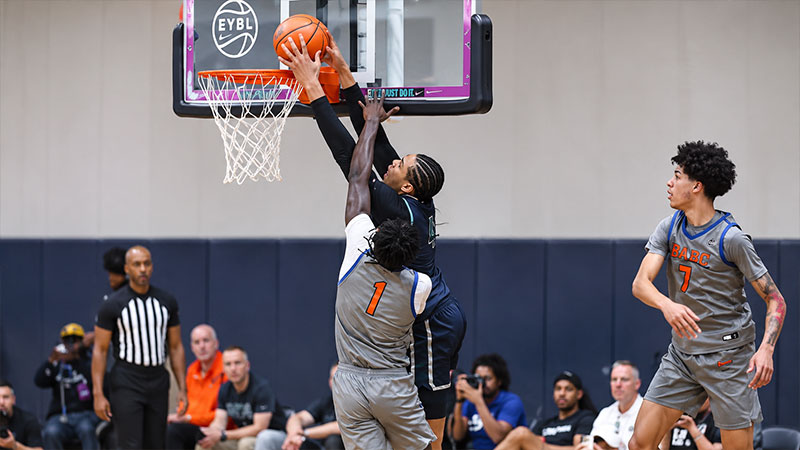
EYBL basketball is the Nike Elite Youth Basketball League, a spring and summer travel league that brings many of the top high school players in the United States together on Nike-sponsored club teams.
If you follow high school basketball or college recruiting, you have likely seen the term in player rankings, scholarship news, and conversations among coaches and parents.
For many young players, the EYBL is a key step on the path to college basketball and, for a few, the NBA. This guide explains what EYBL basketball is, how the league is organized, how the season works, and why it plays such a large role in youth basketball today.
What Does EYBL Stand For?
EYBL stands for Elite Youth Basketball League. Because Nike runs it, most people call it the Nike EYBL.
The league is part of what is known as grassroots or travel basketball, which many people still call AAU basketball. These are club teams that play outside the school season, mostly in the spring and summer.
Unlike high school basketball, where players compete for the school they attend, EYBL teams are independent clubs. Players from different schools, and sometimes different states, come together on one roster.
Each club is sponsored by Nike, which provides shoes, uniforms, and event support, and the clubs play one another in a structured league format with standings.
A Brief History of the Nike EYBL
Before the EYBL, summer basketball was spread across many separate tournaments with no shared schedule or standings. Nike already sponsored many of the strongest club programs and had been running its Peach Jam tournament since the 1990s.
In 2010, the company organized its sponsored teams into one league with a set schedule, a standings table, and a championship event.
The goal was more structure and consistency. Instead of teams choosing which tournaments to enter, they would play each other in regular sessions through the spring. This gave players steady games against strong opponents and gave college coaches a reliable place to evaluate talent.
Since then, the league has added younger age groups and related programs. Today, it is widely viewed as the most established grassroots circuit in the country.
How the EYBL Season Works
Age Divisions
The EYBL is divided by age into three main divisions: 17U, 16U, and 15U. The “U” means “under,” so a 17U team is made up of players 17 or younger, usually high school juniors. The 16U and 15U divisions are for younger players, generally sophomores and freshmen.
The 17U division draws the most attention because those players are closest to choosing a college. The younger divisions still matter, since many players get their first real look from college coaches there.
Regular Season Sessions
The EYBL season runs from spring into early summer. Instead of weekly games like a school team, EYBL teams travel to a series of sessions held in different cities.
At each session, a team plays several games over a weekend, and every result counts toward its record and place in the standings.
Because every team is a Nike-sponsored program with skilled players, the level of play stays high from game to game. There are very few easy matchups, and players face other top prospects almost every time they take the court.
Peach Jam: The Season Finale
The season leads to the Nike EYBL Peach Jam, held each July in North Augusta, South Carolina. Peach Jam is the league’s championship tournament. Teams earn a spot based on how they played during the regular season sessions, so every spring game carries weight.
Peach Jam is one of the most closely watched events in youth basketball. College coaches from across the country attend, and the gyms are often full. Winning it is one of the top achievements for any grassroots program.
Why EYBL Basketball Matters for College Recruiting
The main reason the EYBL carries so much weight is its link to college recruiting. The NCAA sets specific periods when Division I coaches may watch prospects in person, and many of these periods line up with major grassroots events, including EYBL sessions and Peach Jam.
For coaches, the EYBL is an efficient way to see many talented players in one place. Rather than traveling to dozens of high school games, they can watch top prospects compete against each other over a single weekend.
Seeing how a player performs against other high-level players often tells coaches more than watching that player against weaker competition.
For players, a strong showing in the EYBL can lead to scholarship offers, higher national rankings, and more interest from major programs. Many players who had few offers at the start of spring have earned several by the end of summer because of how they played on the circuit.
Well-Known Programs in the EYBL
Many EYBL clubs have been around for years and are known for developing players. Programs that often come up include Mac Irvin Fire from Chicago, Team Takeover from the Washington, D.C. area, Boo Williams from Virginia, the Oakland Soldiers from California, MOKAN Elite from the Kansas City region, Expressions Elite from Massachusetts, and Nike Team Florida.
These programs usually have experienced coaching staffs, organized development plans, and long relationships with college programs.
Their record of sending players to college and the pros helps them attract new talent each year. League membership can change from season to season, so the list of teams in any given year may differ from past years.
Notable Players Who Came Through the EYBL
A large number of current NBA players spent time on the EYBL circuit as teenagers. Players such as Anthony Davis, Jayson Tatum, Zion Williamson, and Cade Cunningham all competed in Nike grassroots basketball before moving on to college and professional careers.
The league has also drawn wider public attention at times. When Bronny James played for Strive for Greatness on the EYBL circuit, his games brought larger crowds and more media coverage than usual for youth basketball.
This track record is a big part of the league’s reputation. When families see so many successful players connected to the EYBL, it supports the view that the league is a strong place to develop and be seen.
EYBL vs. Other Grassroots Circuits
The EYBL is not the only major grassroots league. Under Armour runs the Under Armour Association, often called the UAA, and Adidas runs the 3SSB circuit. Each league has its own sponsored teams, schedule, and championship event.
All three circuits feature talented players and attract college coaches. The EYBL is often seen as the most established because it has run the longest in its current format and has a long list of well-known alumni.
Still, many top prospects play in the UAA and 3SSB every year, and a player’s success depends more on skill and effort than on which shoe company sponsors the team.
Girls EYBL and EYBL Scholastic
Nike has expanded the EYBL name beyond the original boys club league. The Girls EYBL gives top female players a similar setup, with regular sessions during the spring and a season-ending championship. It has become an important recruiting stage for women’s college basketball.
Nike also created the EYBL Scholastic, a league for national high school programs. Unlike the club-based EYBL, this league is made up of school teams, many of them prep schools, that play a national schedule during the winter high school season.
How Teams and Players Get Into the EYBL
Teams cannot simply sign up for the EYBL. A club must be part of Nike’s sponsored network and be selected by Nike to take part. Programs are judged on factors such as their history, the quality of their players, and how well they are run.
For individual players, the path usually means joining one of these Nike-sponsored clubs. Club coaches scout local talent, hold tryouts, and invite players they believe can compete at the EYBL level. Many players start on a club’s younger teams and move up through the age divisions over time.
What Families Should Know Before Joining
Playing in the EYBL can open doors, but it also takes a serious commitment. Teams travel to sessions in different cities, which means weekends away from home and time missed at school. Families should ask each program how travel is arranged and whether any costs fall on them.
Players should also keep academics in focus. College coaches look at grades and test scores alongside talent, and a player who keeps up with schoolwork will have more options.
It is also wise to learn about the coaching staff, ask how the program supports player growth, and make sure the team fits the player’s goals.
Final Thoughts
EYBL basketball is Nike’s Elite Youth Basketball League, a top grassroots circuit that gathers many of the best young players in the country.
Through its age divisions, regular season sessions, and the Peach Jam championship, it offers high-level competition and wide exposure to college coaches.
For players hoping to compete at the next level, the EYBL remains one of the most important stages in youth basketball.