In the high-stakes environment of professional basketball, momentum is a currency. While a thunderous dunk or a deep three-pointer often captures the headlines, few plays possess the transformative power of a steal.
It is a moment of pure defensive intuition that simultaneously strips an opponent of their opportunity and creates an immediate advantage for the defense.
Understanding the nuances of what constitutes a steal is essential for players, coaches, and analysts who seek to master the defensive end of the floor.
A steal in basketball occurs when a defensive player legally takes the ball away from an offensive player, intercepts a pass, or secures a loose ball, directly causing a turnover.
This action is a catalyst; it instantly halts the opponent’s possession and shifts momentum, frequently triggering fast-break scoring opportunities for the defense.
However, the official recording of a steal is governed by specific criteria that separate a clean play from a defensive error.
The Technical Criteria of an Official Steal
For a play to be recorded in the official box score as a steal, it must meet several rigorous standards. These rules ensure that the statistic accurately reflects defensive skill rather than accidental contact or offensive mistakes.
1. The Requirement of Legal Contact
The most fundamental rule of a steal is that the defender must take the ball without committing a personal foul. Basketball is a game of space and contact, but the defensive player must maintain a “legal” position.
If a defender reaches in and hits the dribbler’s arm before touching the ball, the whistle blows, and the play is whistled as a personal foul rather than a steal.
Elite defenders master the art of “all ball” contact, ensuring their hands are precise enough to dislodge the leather without making illegal contact with the opponent’s body.
2. The Nuance of Deflections
One of the more complex aspects of the statistic involves deflections. If a defender intentionally tips or deflects a pass or a dribble away from the offensive player, they have initiated the turnover.
However, the steal is only credited if the defensive team ultimately secures possession of the ball. In these instances, the player who caused the initial deflection—rather than the teammate who simply picks up the loose ball—is officially credited with the steal.
This rewards the player whose active hands and anticipation created the turnover in the first place.
3. The Forced Turnover
By definition, a steal is a forced turnover. It is not merely a missed shot or an unforced error by the offense (such as stepping out of bounds). It requires an active, defensive intervention that removes the ball from the offense’s control.
This distinction is vital for statistical modeling and performance evaluation, as it identifies which defenders are truly disruptive to the opponent’s rhythm.
Three Primary Methods of Execution
While the definition of a steal is straightforward, the execution requires a blend of physical agility and mental foresight. Most steals in the modern game fall into one of three categories.
Intercepting the Passing Lane
This is perhaps the most strategic form of the steal. It requires the defender to read the opposing team’s passing lanes—the invisible lines between the player with the ball and their teammates—and catch the ball mid-air.
To excel at interceptions, a defender must:
- Predict the Offense: Analyze the quarterback-like intentions of the point guard.
- Time the Jump: React the moment the ball leaves the passer’s hands.
- Maintain Balance: Be ready to transition immediately into a fast break once the ball is secured.
Stripping the Ball
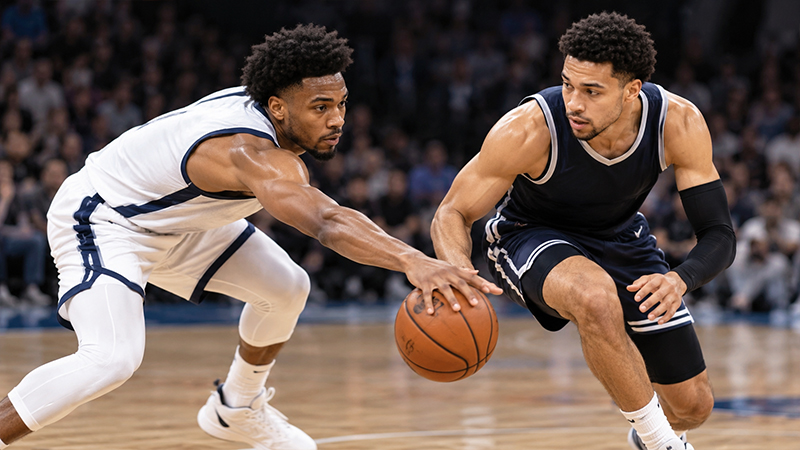
Often called “poking” or “swiping,” this method involves taking the ball away while an offensive player is actively dribbling. This requires incredible hand-eye coordination.
The defender waits for the ball to leave the offensive player’s hand and hit the floor; during that split second when the ball is rising back toward the hand, it is most vulnerable. A quick poke can send the ball rolling into the open court.
The Back-Tap
The back-tap is a specialized “sneak attack” technique. It usually occurs when a defender has been beaten by a dribbler or is trailing the play.
The defender sneaks up behind the offensive player and taps the ball out of their hands toward a waiting teammate. This requires high awareness from the rest of the defensive unit to be in a position to recover the tapped ball.
The Strategic Balance: Defensive IQ vs. Gambling
While steals are a thrilling indicator of quick reflexes and high defensive basketball IQ, they come with inherent risks. In the coaching world, there is a fine line between “aggressive defense” and “gambling.”
The Rewards of High Defensive IQ
A high steal count often correlates with a defender who understands the game’s flow. These players do not just react; they anticipate.
By forcing turnovers, they decrease the number of shots the opponent can take and increase their own team’s scoring efficiency through transition points.
The Dangers of the “Gamble”
Analysts frequently warn that gambling for steals can be a double-edged sword. If a defender “reaches” for a steal and misses, they are often left out of position.
This lunging motion compromises the defender’s balance and “base,” allowing the offensive player to bypass them easily and head toward the basket for a high-percentage shot or a lay-up.
Therefore, elite defensive systems emphasize “containment” over “chasing.” The goal is to remain in a disciplined stance, using active hands to pressure the ball without sacrificing the team’s overall defensive integrity.
The Evolutionary Role of the Steal in Team Strategy
In contemporary basketball, the value of a steal extends beyond the individual stat sheet. It is a cornerstone of modern “pressure” defenses.
Teams that utilize full-court presses or “trapping” schemes rely on the threat of the steal to force the offense into making rushed, poor decisions.
When a team consistently threatens to steal the ball, the offensive players become tentative. They may look at the defender’s hands instead of the basket, or they may rush their passes to avoid a deflection. This psychological pressure can be just as effective as the physical turnover itself.
Professional Development: Improving Your Defensive Hands
For athletes looking to increase their impact on the game, developing “heavy hands” (the ability to physically move the ball) and “quick hands” (the ability to react to movement) is essential. Training often involves:
- Peripheral Vision Drills: Learning to see the ball and the man simultaneously.
- Reaction Training: Using light boards or rapid-fire passing drills to improve hand speed.
- Film Study: Learning the tendencies of opponents—specifically which hand they prefer to dribble with and their favorite passing targets.
Detailed FAQ: Common Questions Regarding Steals
What is the difference between a steal and a block?
A block occurs when a defender touches a shot attempt, preventing it from reaching the basket. A steal occurs during a pass, a dribble, or a loose ball situation. While both are defensive stops, they occur at different stages of the offensive process.
Can a player get a steal if the ball goes out of bounds?
No. For a steal to be recorded, the defensive team must gain possession of the ball. If a defender pokes the ball away and it rolls out of bounds, it is recorded as a “deflection” or “forced turnover” for the team, but the individual defender does not receive a steal in the box score because possession was not secured.
Does a “jump ball” result in a steal?
Generally, if a defender ties up an offensive player and a jump ball is called, a steal is not credited. However, if the defensive team wins the ensuing tip or possession arrow, it results in a team turnover for the offense.
Can you get a steal on an airball?
If an offensive player shoots an airball and a defender catches it before it hits the ground, it is technically recorded as a defensive rebound, not a steal. A steal must involve the disruption of a pass or a dribble.
How do steals impact “Advanced Metrics”?
In modern analytics, “Steal Percentage” (STL%) is used to estimate the number of opponent possessions that end in a steal by a specific player while they are on the floor.
This is often considered a better measure of defensive impact than “total steals” because it accounts for the pace of the game and the minutes played.
Conclusion: The Ultimate Defensive Weapon
The basketball steal is a masterclass in timing, physics, and psychology. It is the definitive way to “take” the game into your own hands.
By understanding the strict rules of legal contact and deflections, players can refine their technique to maximize disruption while minimizing fouls.
Whether it is a perfectly timed interception of a cross-court pass or a gritty back-tap from a trailing defender, the steal remains one of the most exciting and influential plays in sports.
It represents the moment where defense becomes offense, and where a single movement can change the trajectory of a championship game.