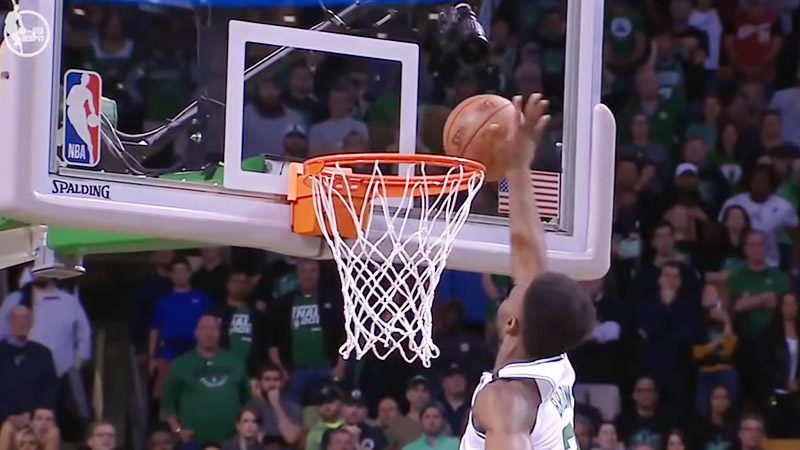
The roar of a packed arena often reaches its peak not just at the final buzzer, but in the split second a player absorbs a heavy blow, regains their balance, and watches the ball tickle the twine.
In that moment, the referee’s whistle creates a brief pause in the chaos, followed by the most electric phrase in the sport: “And-one!”
This isn’t just a scoring play; it is a declaration of physical superiority and mental fortitude. For the casual observer, it’s an extra point.
For the athlete and the strategist, it’s a momentum-shifting event that can dismantle a defensive game plan and ignite a comeback.
Understanding the “and-one” is essential for anyone looking to appreciate the tactical depth and raw emotion of basketball.
The Fundamental Definition: More Than a Basket
At its most basic level, an “and-one” occurs when an offensive player is fouled while in the act of shooting and completes the basket despite the illegal contact.
The term itself is shorthand for the reward: the player gets the points for the made field goal and one additional free throw attempt.
This play is unique because it rewards perseverance. In most fouling situations, the play stops, and the player is awarded free throws to compensate for the missed opportunity.
However, in an and-one scenario, the “basket counts” because the shooter was able to power through the adversity.
The Mathematical Advantage: 3-Point and 4-Point Plays
The “and-one” serves as a primary driver of scoring efficiency. It allows a team to maximize a single possession without needing to reset the offense.
- The Traditional 3-Point Play: When a player is fouled while attempting a standard 2-point shot (like a layup, dunk, or mid-range jumper) and makes it, they earn 2 points plus a chance for a third at the charity stripe. Converting this free throw effectively turns a standard high-percentage shot into a 3-point gain.
- The Rare 4-Point Play: This occurs when a player is fouled while attempting a shot from beyond the arc. If the 3-pointer goes in, they receive 3 points plus “one” additional free throw. Making that final shot results in a 4-point play, one of the rarest and most devastating scoring sequences for a defending team to endure.
The Anatomy of the Call: Conditions and Criteria
An and-one is not granted simply because contact occurred. Specific officiating criteria must be met to trigger this sequence.
The Shooting Motion
For the “and-one” rule to apply, the foul must happen while the player is in the “act of shooting”. If a player is fouled on the floor before they begin their upward motion or gather, the basket will not count even if it goes in, and the ball will simply be taken out of bounds or result in standard free throws if the team is in the bonus.
The referee must determine that the illegal contact was simultaneous with or during the shooting process.
The Requirement of Success
The most critical—and often most frustrating—component of the and-one is that the ball must go into the hoop.
If a player is hammered by a defender, loses their balance, and misses the shot, they are awarded two or three free throws depending on where they were standing, but the “and-one” opportunity is lost.
This is why the play is considered a showcase of skill; it requires the athlete to maintain enough concentration and body control to finish the play while being physically compromised.
The Psychology of the Flex: Why Players Yell “And-One!”
If you’ve spent any time watching a game—from the NBA down to a local pickup run—you’ve heard players shout the phrase before the ball even leaves their hands. This phenomenon is a mix of strategic gamesmanship and raw confidence.
Chastising the Officials
Often, shouting “and-one!” is a player’s “not-so-subtle” way of letting the referee know they believe they were fouled.
It serves as a verbal prompt to ensure the whistle is blown. In high-stakes environments, players use this to highlight contact that an official might have missed from their vantage point.
A Display of Mental Toughness
Yelling the phrase is also a “flex”—a way to demonstrate that the defender’s best attempt to stop the play was insufficient. It signals to the opponent that their physical presence was not enough to deter the score.
Shouting it before the shot even falls is described as a “complex emotional feat”—a combination of being both cocky about the score and aggrieved by the contact. It is a high-energy celebration of overcoming an obstacle.
Strategic Impact: How It Changes the Game
The implications of an and-one extend far beyond the three or four points added to the scoreboard. It has a ripple effect on the entire game’s ecosystem.
Foul Trouble Management
Every and-one involves a personal foul charged to a defender. If a star defensive player accumulates two or three of these “extra” fouls early in the game, they may be forced to the bench to avoid disqualification. This shifts the defensive landscape, often leaving the paint open for more aggressive drives.
Momentum and Morale
Basketball is a game of runs and emotional shifts. An and-one is a “momentum-changing play”. For the offensive team, it is an infusion of energy that validates their physical play.
For the defense, it is demoralizing; they committed a foul (a mistake) and still gave up the points (a failure). The “plus-one” free throw also allows the scoring team to set their defense while the clock is stopped, often leading to a defensive stop on the other end.
Cumulative Scoring Efficiency
In modern analytics, the “True Shooting Percentage” of a player is heavily influenced by their ability to draw and-ones.
Converting these plays means the team is scoring at a higher rate per possession, which is often the difference between a middle-of-the-pack team and a championship contender.
The “And-One” in Life and Culture
The phrase has permeated culture beyond the hardwood. It has become a metaphor for succeeding despite unfair or difficult circumstances.
Imagine being at work and being assigned a project with a particularly difficult or “useless” colleague.
If you manage to land the client or finish the report successfully despite their dead weight, you have essentially completed a professional “and-one”. It is the feeling of succeeding “despite” rather than “because of” your surroundings.
This cultural resonance is why the phrase has such staying power. It represents the universal desire to push through contact—whether physical, professional, or emotional—and still come out on top.
Essential FAQ for the Informed Fan
Does the basket always count if there is a foul?
No. The basket only counts if the official determines the foul occurred during the shooting motion and the ball actually goes into the basket. If the foul happens before the shot begins, the play is dead.
Can you get an “and-one” on a dunk?
Absolutely. Many of the most iconic and one-on-one plays occur at the rim, where a player dunks through heavy contact from a rim protector.
What happens if the player misses the “plus-one” free throw?
The initial points (2 or 3) still stay on the scoreboard. The game simply continues with a rebound attempt if the free throw is missed.
Why is it called “and-one”?
It refers to the scoring: you get the points for the made basket and one additional free throw.
The Skill of Drawing the Contact
Mastering the and-one isn’t just about strength; it’s about craft. Elite players often “hunt” for the and-one by baiting defenders into reaching or jumping prematurely.
By initiating the contact themselves while maintaining a legal shooting path, they force the official to make a call.
This requires:
- Body Control: The ability to absorb a hit in mid-air and still square the shoulders toward the rim.
- Touch: The dexterity to flip the ball toward the hoop with finesse, even when your equilibrium is disrupted.
- Anticipation: Knowing where the defender is going to be and using their momentum against them.
Conclusion: The Ultimate Test of Grit
The and-one is basketball’s ultimate reward for the resilient. It is the intersection of physicality, rulebook technicality, and psychological dominance.
Whether it’s a bruising center finishing through a double-team or a guard hitting a 4-point play at the buzzer, these moments define the competitive spirit of the game.
For fans, recognizing an and-one allows for a deeper appreciation of the athleticism required to thrive under pressure. For players, it remains the ultimate flex—a way to tell the world that no amount of contact can stop the ball from finding the bottom of the net.
Next time you hear that shout in a game, remember: it isn’t just about the points; it’s about the triumph of the will over the obstacle. Just remember the golden rule of the boardroom: keep the “and-one” shouts on the court.