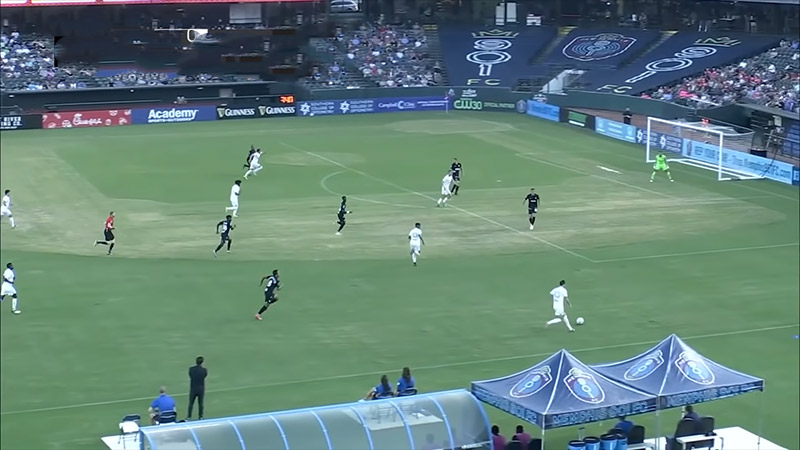
The landscape of the pitch has underwent a radical transformation over the past two decades. What was once a position defined by stay-at-home defending and basic clearances has evolved into perhaps the most tactically complex role in the modern game.
Today, the fullback is the engine of the team—a multifaceted contributor who must defend with the discipline of a center-back, attack with the flair of a winger, and dictate play with the vision of a central midfielder.
Defining the Modern Fullback
In a standard tactical setup, such as a 4-4-2 or 4-3-3 formation, fullbacks are the wide defenders positioned on either side of the central defensive pair.
They are categorized by their side of operation: the Right-Back (RB) and the Left-Back (LB). While their starting position is deep and wide near the touchline, their influence now extends across every blade of grass.
Historically, the term “fullback” finds its roots in rugby, where these players served as the last line of defense. In the early 20th century, tactical pioneers like Walter Camp adapted these roles for American football, initially designing the position for powerful runners.
While the American variant eventually shifted toward a blocking-first role in the NFL, the soccer fullback has taken the opposite path, moving from a static defender to a primary playmaker.
The Three Faces of the Position
To understand the contemporary game, one must recognize that “fullback” is no longer a monolithic term. Coaches now utilize three distinct styles depending on their tactical philosophy.
1. The Traditional Stopper
Twenty years ago, the job description was simple: stay wide, mark the opposing winger, and clear the ball from danger.
These traditional defenders rarely crossed the halfway line and prioritized 1v1 defensive duels above all else. Their primary goal was to neutralize the threat on the flanks and maintain the team’s defensive shape.
2. The Modern Attacking Fullback
The current standard for elite teams involves fullbacks who act as secondary weapons in the final third. These players provide essential width by making overlapping runs past their wingers.
By doing so, they stretch the opposition’s defense, creating space for teammates and delivering high-quality crosses into the penalty area.
Players like Trent Alexander-Arnold have redefined this role, operating effectively as wide playmakers who often lead their teams in assist statistics.
3. The Inverted Fullback
The most recent tactical innovation is the rise of the inverted fullback, a role popularized by coaches like Pep Guardiola.
Instead of staying wide during the attacking phase, these players move inside into central midfield spaces. This shift accomplishes several strategic goals:
- Midfield Superiority: It creates a numerical advantage in the center of the pitch, allowing for better possession control.
- Counter-Pressing: By being centrally located, they can immediately intercept the ball if possession is lost, disrupting the opponent’s transition.
- Tactical Fluidity: This movement can transform a standard 4-3-3 into a 3-2-2-3 structure during build-up play, making the team much harder to track and mark.
Fullback vs. Wing-back: Resolving the Confusion
A frequent point of confusion for fans is the distinction between a fullback and a wing-back. The difference is fundamentally rooted in the team’s formation and the level of defensive risk.
A fullback operates within a defensive line of four. They typically have a winger positioned in front of them to share the offensive load. Their primary mindset remains “defense first,” only joining the attack when it is tactically safe to do so.
Conversely, a wing-back is utilized in formations with three or five at the back (e.g., a 3-5-2). Because there is often no winger in front of them, the wing-back is responsible for controlling the entire sideline alone.
They are more advanced, less defensively-minded, and require even greater levels of stamina to cover the massive distances required.
Essential Skills of the Elite Fullback
Excellence in this position requires a unique blend of physical attributes and tactical intelligence.
- Aerobic Capacity and Stamina: Often referred to as “the engine,” fullbacks cover more distance than almost any other player on the pitch. They must sprint back and forth for 90 minutes, balancing their duties in both halves.
- Explosive Speed: Pace is non-negotiable. It is required to keep up with elite, technically-gifted wingers and to make recovery sprints during defensive transitions.
- Tactical IQ and Awareness: Players must decide in a split second when to push forward and when to “tuck in” closer to the center-backs to close gaps in the defense. A mistake in positioning can expose the entire back line to a through-ball.
- 1v1 Defending and Tackling: Despite the attacking shift, the ability to stop an opponent 1v1 remains a core requirement. This demands excellent timing, aggression, and the ability to prevent crosses or “cutting inside”.
- Technical Proficiency: Modern fullbacks need the ball control of a midfielder. Accurate crossing at full speed, precise short passing in congested spaces, and a strong first touch are essential for maintaining possession under pressure.
Legends and Modern Masters
The evolution of the role can be traced through the players who pioneered new ways of playing the position.
- The Pioneers: Brazil’s Cafu and Roberto Carlos proved that defenders could dominate the entire flank. Cafu, a two-time World Cup winner, combined flawless intelligence with technical prowess, while Roberto Carlos was a dangerous attacking threat in the final third.
- The Defensive Icons: Paolo Maldini and Ashley Cole set the gold standard for 1v1 defending. Maldini’s tactical nous and leadership made him one of the greatest defenders in history, while Cole was famously one of the few players who could consistently neutralize elite wingers like Cristiano Ronaldo.
- The Intellectuals: Philipp Lahm and Javier Zanetti were celebrated for their versatility and positioning. Lahm was an integral part of dominant German and Bayern Munich sides, possessing the intellect to transition seamlessly between fullback and midfield.
- The Modern Vanguard: Today, players like Joao Cancelo and Alphonso Davies continue to push boundaries. Cancelo is known for his positional fluidity and creative distribution from central areas, while Davies utilizes blistering pace to act as a hybrid winger-defender.
Frequently Asked Questions
What does the abbreviation “FB” mean?
“FB” is the standard shorthand for Fullback used on team sheets, tactical diagrams, and in sports media.
Is a fullback a defender or a midfielder?
Technically, they are part of the defensive back line. However, in modern “inverted” or “attacking” roles, they frequently operate in midfield spaces to help control possession.
Has a fullback ever won the Ballon d’Or?
No. Historically, the award has been dominated by forwards and attacking midfielders. While fullbacks are increasingly vital to team success, they rarely grab the same headlines as flashy goal-scorers.
What is “tucking in”?
This is a defensive maneuver where the fullback moves closer to the center-backs when the ball is on the opposite side of the pitch. This narrows the defensive line and prevents opponents from playing dangerous passes through the middle.
Conclusion: The Future of the Flank
The fullback position has moved from the periphery of tactical discussions to the very heart of modern strategy.
They are no longer just “wide defenders”; they are tactical chameleons whose movements dictate the shape and success of a team’s attack and defense.
As the game continues to evolve toward higher levels of possession and fluidity, the importance of these “flank engines” will only continue to grow.
Understanding the nuances of this role is not just for players and coaches—it is essential for any fan wishing to appreciate the sophisticated landscape of football in 2026.