In modern professional football, games are decided by inches, fractions of a second, and the razor-thin margins of human physical capability.
When a receiver stretches their fingertips toward the pylon or a defender lunges to punch a ball free, the human eye on the field is asked to perform near-impossible tasks in real time. To protect the integrity of these monumental moments, the National Football League relies on a sophisticated, multi-layered officiating structure.
At the heart of this system is the automatic booth review—a technical and administrative safeguard designed to ensure that the most critical turning points of a game are decided with absolute accuracy.
For fans, players, and coaches alike, understanding how the booth review operates is essential to understanding the flow of a modern game.
It is not merely a technical pause in the action; it is a highly strategic, precisely timed intervention that influences team momentum, timeout preservation, and ultimately, the final score. This analysis details the exact rules, personnel, physical infrastructure, and strategic chess matches that define the modern automatic booth review.
Defining the NFL Booth Review: The Automatic Officiating Safeguard
At its core, a booth review is an automatic video replay check initiated directly by the replay official stationed high above the field in the stadium’s press box.
Unlike a standard review, which requires a head coach to make a calculated gamble by throwing a red challenge flag onto the field, a booth review requires zero intervention from the sidelines.
The game is stopped, the play is analyzed, and the ruling is verified entirely through the league’s designated officiating chain of command.
This mechanism represents a fundamental shift in how sports officiating balances accuracy with the natural flow of play.
By automating reviews for specific, game-altering moments, the league removes the burden of challenge administration from coaching staffs, ensuring that human error on the field does not permanently compromise the most consequential plays of a matchup.
The division of labor between coaches and replay officials is stark:
- Coaches’ Challenges: Used for standard plays during the first 28 minutes of each half. A coach must risk a valuable team timeout and one of their limited challenges to force a review.
- Booth Reviews: Triggered automatically by the replay official for designated game situations or at any point inside the final two minutes of either half. No timeouts are risked, and no coaching decisions are required.
The Triggers: When Does the Officiating Booth Take Control?
The officiating booth does not have unlimited authority to stop the game at any moment during the first 28 minutes of play.
To keep the game moving, the league has established strict, objective criteria for when the replay official must step in and initiate an automatic review. These automatic review triggers are restricted to three primary categories:
All Scoring Plays
Every single touchdown, field goal, and extra point is automatically subject to a booth review. Whether a play is a spectacular 60-yard pass into the corner of the end zone or a routine one-yard plunge up the middle, the replay official upstairs immediately examines the footage.
They must verify that the ball broke the plane of the goal line in legal possession, that the player’s feet remained in bounds, and that no ground-contact rules were violated before the score was finalized.
All Turnovers
Possession changes are among the most volatile and game-changing events in football. Consequently, every interception, lost fumble, and fourth-down turnover on downs is automatically reviewed by the booth.
The replay official checks to confirm that the ball was completely secured before hitting the ground, or that a runner’s knee was not down prior to the ball being dislodged.
The Two-Minute Window
As soon as the game clock ticks down to the two-minute warning in either the second or fourth quarter, the entire philosophy of replay review changes. After this threshold, coaches are stripped of their ability to challenge plays altogether.
The responsibility of calling reviews shifts entirely to the replay assistant in the booth. During these high-stakes final minutes, any questionable call on the field—whether a sideline catch, a first-down spot, or a pass interference determination—can only be reviewed if the booth chooses to halt the game.
The Tech Grid: The Infrastructure Supporting the Replay Booth
To make split-second officiating decisions on a global stage, the replay booth relies on an incredibly advanced technical infrastructure. The speed and precision of a review are made possible by a dedicated technical loop operating beneath the stadium seats:
[On-Field Cameras]
       │
       ▼ (Fiber-Optic Transmission)
[Press Box Servers & Technicians] ───► [Replay Assistant Evaluation]
       │                                         │
       ▼ (Buzzer Signal Issued)                  ▼ (Decision to Stop Game)
[Referee On-Field Receiver]             [Sideline Shielded Monitors]
Fiber-Optic Video Delivery
To facilitate a rapid review, high-definition signals from every single broadcast camera in the stadium are transmitted instantly via fiber-optic cables directly to the replay booth.
This ensures that the replay official has immediate access to every angle, zoom level, and slow-motion perspective captured by the television network.
Server Storage and Cueing
Once these high-definition feeds arrive in the press box, they are recorded simultaneously on two separate computer servers.
A specialized replay technician is responsible for cueing up these angles in real time. As soon as a play concludes, the technician organizes the best visual perspectives so that the replay official can evaluate the play without delay.
The Officiating Team in the Press Box
The replay booth is not a solo operation. It features a highly specialized team working in perfect synchronization:
- The Replay Assistant: A core member of the officiating crew who evaluates the technical footage and determines if a call warrants a formal stoppage.
- The Video Operator: A technical specialist who physically transfers the most relevant, clear replay angles onto the primary evaluation monitors for the replay assistant.
- The Communicator: An official who keeps their eyes fixed on the field of play, constantly updating the replay assistant on whether the offense is lining up or if play has officially resumed. This role is vital, as the replay assistant must know exactly how much time they have to decide the next snap.
Step-by-Step: The Anatomy of a Booth Review
The transition from a live play to a finalized replay ruling on the field is a highly structured process. It unfolds through several distinct phases:
Step 1: Real-Time Evaluation
As a play concludes, the replay assistant and their video operator immediately begin scanning the live feeds on their monitors.
Because the game does not stop automatically unless a score or turnover has occurred, the replay assistant has only the brief window of time between plays to decide whether to halt the game for a closer look.
Step 2: The Buzzer Notification
If the replay assistant identifies a clear, questionable aspect of the ruling on the field, they must act before the ball is snapped for the next play.
To halt the game, the assistant activates a vibrating buzzer worn on the wrist or belt of the head referee on the field. This physical “buzz” alerts the referee that the booth is taking control of the game clock and that play must stop immediately.
Step 3: Sideline Consultation
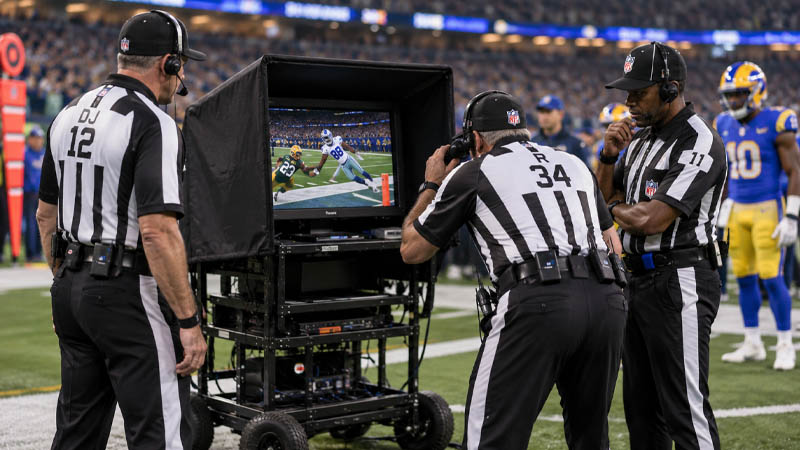
Once the game is stopped, the replay signal selected by the booth is transmitted directly to two shielded monitors located on the sidelines.
In outdoor stadiums where rain, wind, or snow could compromise the equipment or the referee’s ability to view the screen, a third backup monitor is placed in a secure runway near the locker rooms to ensure a clear viewing environment.
The head referee walks over to these monitors, dons a headset, and examines the footage while consulting with the replay official in the booth and league officiating heads.
Step 4: The Announcement
After evaluating the visual evidence, the referee makes a final determination. The referee must choose to either confirm the call (meaning the visual evidence proves the on-field call was correct), let the call stand (meaning there was insufficient visual evidence to change the call either way), or reverse the call (meaning clear visual evidence proved the original ruling was incorrect).
The referee then walks to the center of the field and announces the decision to the stadium and the broadcast audience.
Strategic Impact: Momentum, Offense, and the 40-Second Dilemma
The automatic booth review is not just a tool for accuracy; it is a major variable in the tactical flow of a football game. Coaches, coordinators, and players must constantly adjust their strategies to account for the booth’s presence.
Saving Critical Timeouts
In tight, late-game scenarios, timeouts are a coach’s most valuable currency. Because the replay official handles all reviews inside the two-minute warning, teams are spared from risking their final timeouts on questionable spots or sideline catches.
A coach can preserve their stops for stopping the clock during a two-minute drill or managing a final, game-winning drive, knowing that any legitimate officiating error will be handled automatically by the upstairs official.
The Disruptive Force of Momentum
Even when a call on the field is ultimately upheld, the mere act of initiating a review can have a massive impact on a game’s momentum. A fast-paced, no-huddle offense relies on rhythm, speed, and keeping the opposing defense tired and unorganized.
A sudden booth review stops the clock, giving the defense a chance to rest, catch their breath, and receive adjustments from their coaching staff. Conversely, it can cool off a hot quarterback who was in the middle of a rhythm-driven drive.
The Proposed 40-Second Limit
The interruption of game flow has led to continuous debate among league owners and competition committees. Some franchises have actively campaigned to streamline the process.
For example, the Los Angeles Rams previously proposed a rule change that would institute a strict 40-second limit on initiating a booth review.
The goal of such proposals is to force the replay assistant to make their decision quickly, preventing long, drawn-out delays between plays that frustrate fans and disrupt the natural tempo of the sport.
Historical Evolution: The “Instant Replay Game” of 1989
Today’s highly automated, fiber-optic replay system is the result of decades of experimentation, controversy, and technological improvement.
Few moments better illustrate this evolution than the famous “Instant Replay Game” between the Green Bay Packers and Detroit Lions on November 5, 1989.
Late in the fourth quarter, Packers quarterback Don “Magic” Majkowski appeared to throw a game-winning touchdown. However, officials ruled that he had crossed the line of scrimmage, making the pass illegal and giving Detroit a 14-13 victory.
The replay assistant reviewed the play and overturned the call, determining Majkowski had released the ball behind the line. Green Bay was awarded the touchdown and won 14-13.
NFL vs. NCAA Replay Rules
While college football (NCAA) and professional football (NFL) share a similar passion for replay review, their structural approaches to the booth review contain several key differences that alter the pacing and coaching strategies of their respective games:
| Feature | National Football League (NFL) | College Football (NCAA) |
|---|---|---|
| Booth Review Authority | Restricted to scoring plays, turnovers, and plays inside the final two minutes of each half. | The replay official in the booth has the authority to call for a review of a play at any time during the game. |
| Mandatory Adoption | Universally mandatory across all stadium venues. | Not mandatory; the decision to use replay is left up to individual teams and/or athletic conferences. |
| Coaching Challenge Limits | Coaches can challenge up to two plays per game (earning a third if both of the first two challenges are successful). | Coaches are allowed a maximum of two challenges, but they are only permitted to make a second challenge if their first challenge is successful. |
The NCAA’s model gives the booth coordinator complete, game-long sovereignty over reviews, whereas the NFL seeks to balance the booth’s power by reserving automatic reviews for specific, high-leverage situations or late-game scenarios, relying on coaches to police the rest of the game with their challenge flags.
Conclusion: The Precision Era of Football
The automatic booth review represents a triumph of modern sporting administration, seamlessly blending high-definition camera technology with the human judgment of professional officiating crews.
By establishing clear triggers—such as turnovers, scoring plays, and the final two-minute window—the NFL has created a system that protects the competitive fairness of its most critical plays without completely grinding the game’s natural momentum to a halt.
While no system of replay will ever completely eliminate the passionate debates that make football the most talked-about sport in the world, the booth review remains the ultimate safety net.
It ensures that when the confetti falls and the final whistle blows, the outcome of the game was decided fairly on the field, verified by the eye in the sky.