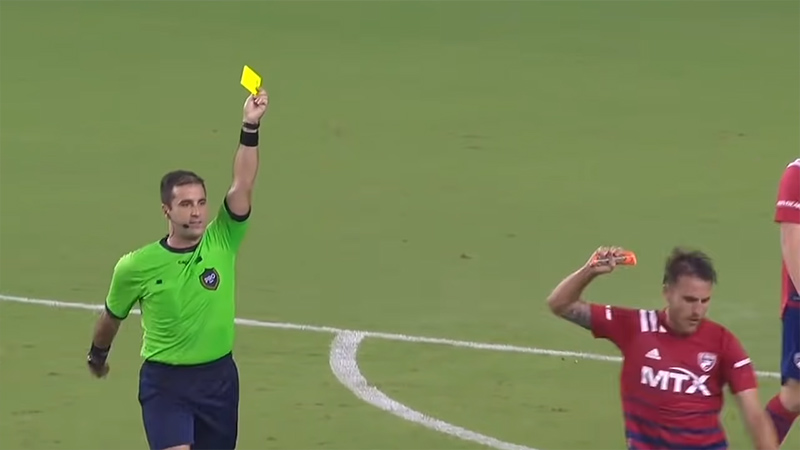
In the high-stakes environment of professional soccer, a yellow card serves as a pivotal disciplinary moment that ripples far beyond a simple foul.
It is an official caution, a formal warning that fundamentally alters a player’s tactical approach for the remainder of the match. While the athlete stays on the pitch, they enter a state of heightened vulnerability where a single misstep can lead to ejection.
Understanding these mechanics is essential for grasping how a booking influences immediate match dynamics, long-term league suspensions, and the overarching strategic decisions made by coaching staffs at the highest levels of competition.
The Official Caution: Decoding the Yellow Card
When a referee brandishes a yellow card, they are initiating a formal disciplinary protocol that is recognized globally. This action is more than symbolic; it triggers a specific sequence of administrative and on-field events that maintain the integrity and safety of the game.
The Administrative “Booking” Process
The term “booked” is synonymous with receiving a yellow card because of the literal administrative requirement involved in the process. When a player is cautioned, the referee must record the details of the infraction in an official notebook.
This record includes the player’s identification number and the specific time the foul occurred. This ensures that the caution is tracked accurately by league officials and governing bodies for the duration of the competition.
Immediate Pitch Impact and Cautionary Play
Once a player has been cautioned, their role on the pitch undergoes an immediate psychological and tactical transformation. They are permitted to continue playing, but they must do so with extreme care.
Any further serious infraction or repeat of a minor offense can lead to an immediate dismissal. This creates a tactical dilemma for defenders and defensive midfielders who must remain aggressive to stop opponents but cannot risk a second foul that would leave their team shorthanded.
On-Field Repercussions and Play Restarts
A booking does not happen in a vacuum; it is the result of an infraction that requires an immediate restart of play. The nature of this restart is dictated by the severity and location of the foul, often granting the opponent a significant tactical advantage.
The Mechanics of Play Restarts
Depending on how and where the foul occurred, the referee will award one of the following to the opposing team:
- Direct Free Kick: Awarded for physical fouls; the ball can be kicked directly into the goal.
- Indirect Free Kick: Awarded for specific technical infractions or dissent.
- Penalty Kick: Awarded if the foul occurs within the offending player’s own penalty area.
The Escalation to a Red Card
The most critical immediate consequence of a yellow card is the looming threat of the “second yellow.” If a player who is already on a caution receives a second yellow card in the same match, it is automatically upgraded to a red card.
This results in the player being sent off—or ejected—from the field. Once a player is ejected, they cannot be replaced by a substitute, forcing their team to finish the match with fewer players.
In professional tiers, this ejection usually carries a mandatory suspension for at least the next scheduled game.
Long-Term Implications: Yellow Card Accumulation
One of the most complex aspects of soccer discipline is how individual bookings follow a player throughout a tournament or league season.
Accumulating too many cautions leads to mandatory suspensions that can sideline key assets during critical competitive windows.
| Competition | Suspension Trigger | Penalty |
|---|---|---|
| Premier League | 5 yellow cards (before match week 19) | 1-match ban |
| Premier League | 10 yellow cards (before match week 32) | 2-match ban |
| UEFA Competitions | 3 yellow cards | 1-match ban |
| World Cup | 2 yellow cards (before the semifinals) | 1-match ban |
The Strategic Burden of Accumulation
For a professional club, managing these accumulation triggers is a core part of season-long strategy. A star player reaching four yellow cards in the Premier League before mid-season becomes a liability, as a fifth card would trigger an automatic one-match ban.
Coaches often have to rotate their squads specifically to avoid having multiple key players suspended at the same time during difficult fixture runs. This administrative reality forces teams to build deeper rosters to compensate for the inevitability of disciplinary absences.
Strategic Nuances: Card Clearing and Fines
Professional organizations often implement specific rules to ensure that the highest levels of competition remain fair and that key players aren’t unfairly penalized for minor historical infractions during the final stages of a major tournament.
The Wipe Rule in Elite Tournaments
To prevent players from missing a prestigious final due to a single booking in a semi-final, many tournaments utilize a “clearing” or “wipe” rule.
In competitions like the UEFA Champions League and the FIFA World Cup, yellow card tallies are typically wiped clean after the quarter-finals.
This ensures that the most talented players are available for the final, provided they do not receive a red card in the semi-final match.
Professional Financial Penalties
The consequences of a yellow card often extend into the financial realm for professional athletes. In leagues such as Major League Soccer (MLS), receiving a yellow card can result in direct financial fines for the player.
These penalties are intended to serve as a deterrent against unsporting behavior and to encourage a higher standard of professional conduct on the pitch.
For a club, frequent bookings can also lead to institutional fines if the team fails to control its players over a specific period.
Disciplinary Triggers: Why Referees Book Players
Referees are instructed to use the yellow card to manage player safety and maintain the flow of the match. Understanding the specific categories of offenses allows players and fans to predict when the referee will likely reach for their pocket.
Common Offenses Leading to a Caution
While physical play is the most common reason for a booking, the laws of the game allow for cautions in several non-physical scenarios:
- Reckless Tackles: Challenges that show a disregard for the safety of an opponent.
- Dissent: Arguing with the referee or showing public disagreement with an official’s decision.
- Delaying the Restart: Often called “time-wasting,” this involves preventing the opponent from taking a quick free kick or throw-in.
- Unsporting Behavior: A broad category that includes actions like “diving” or even removing a shirt during a goal celebration.
The Impact of Unsporting Behavior
Unsporting behavior is a significant focus for officials because it often involves a lack of professional discipline. For example, a player who removes their jersey to celebrate a goal is subject to an automatic yellow card.
While this may seem like a minor emotional outburst, it carries the same weight as a reckless tackle. If that player was already on a caution, their celebration would lead to a second yellow and an immediate ejection, potentially costing their team the game.
Advanced Disciplinary FAQ: Professional Insights
Do yellow cards carry over into different competitions?
Typically, yellow cards are competition-specific. A yellow card received in a domestic league match like the Premier League generally does not count toward a player’s accumulation tally in a separate competition like the FA Cup or the Champions League.
However, the resulting suspensions for red cards—especially those involving violent conduct—can sometimes be applied across different domestic competitions depending on the specific rules of the national football association.
Can a substitute be given a yellow card?
Yes, the referee has the authority to caution any player listed on the official team sheet, including those on the substitutes’ bench.
If a substitute enters the field of play without permission, or if they engage in dissent or unsporting behavior from the sidelines, they can be booked. This card counts toward their personal accumulation tally just as it would if they were currently playing on the pitch.
What happens if a coach receives a yellow card?
In modern professional soccer, referees also have the power to issue yellow and red cards to coaching staff and managers in the technical area. While these do not affect the number of players on the pitch, they serve as formal warnings for behavior.
Just like players, coaches can face accumulation bans if they receive multiple yellow cards over the course of a season, leading to them being barred from the touchline for future matches.
How does the “Second Yellow” affect a team’s substitutions?
When a player is sent off for a second yellow card, their team is reduced by one player and cannot use a substitution to fill that vacancy.
This often forces a manager to use one of their remaining tactical substitutions to bring on a more defensive player—such as a defender or a holding midfielder—to compensate for the loss, often at the expense of an attacking player.
This effectively “costs” the team two players in terms of offensive capability.
Conclusion: The Strategic Weight of a Warning
The yellow card is a fundamental component of soccer’s disciplinary architecture. It serves as a necessary check on player behavior, ensuring that the game remains safe and competitive.
For the individual, it is a test of temperament and tactical discipline. For the team, it is a logistical challenge that requires careful squad management and a deep understanding of league-specific accumulation rules.
In the professional landscape, the margin between victory and defeat is often found in these disciplinary details.
A team that manages its cautions effectively—avoiding “soft” yellows for dissent or celebrations—is a team that keeps its best players on the pitch when they are needed most.
By mastering the mechanics and consequences of the yellow card, one gains a more profound insight into the complex, multi-layered strategy that defines world-class soccer.