The National Football League Draft is often described as an educated guessing game. Billion-dollar franchises spend millions on analytics, scouting departments, and psychological profiling, all in an attempt to minimize risk and identify franchise cornerstones.
Yet, year after year, the draft board delivers anomalies that defy conventional evaluation models.
Few anomalies in recent history are as stark, illustrative, and impactful as the rise of Maxx Crosby.
Drafted as a relatively unheralded prospect from a mid-major program, Crosby has grown from a day-three developmental flyer into a multi-time All-Pro, the defensive heartbeat of his franchise, and one of the most feared edge-rushers in professional football.
To understand his trajectory is to understand how elite work ethic, technical development, and relentless motor can completely blow past the limitations of traditional scouting reports.
The Draft Capital: Where Maxx Crosby Entered the Board
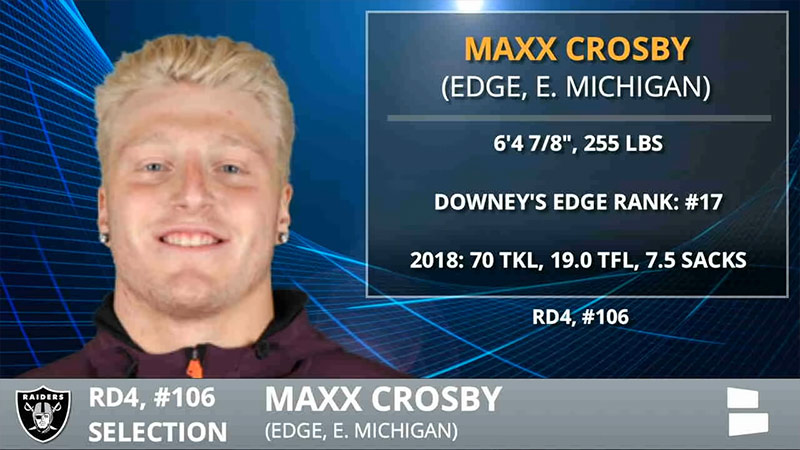
To appreciate the scale of Crosby’s rise, one must look directly at the capital invested in him during the spring of 2019. Maxx Crosby was selected as the 106th overall pick in the fourth round of the 2019 NFL Draft.
He was drafted out of Eastern Michigan University by the Oakland Raiders (who subsequently relocated to become the Las Vegas Raiders).
Coming out of Eastern Michigan, Crosby had put together impressive collegiate tape, but scouts questioned whether his lighter frame (roughly 255 pounds at 6-foot-5) and mid-major competition would translate to the physical trenches of the professional game.
A fourth-round selection carries modest expectations; historically, players selected in this range are projected as rotational contributors, special-teams stalwarts, or developmental depth. They are rarely expected to become the literal face of a defensive unit.
Crosby did not just exceed his draft slot; he completely shattered the concept of day-three draft ceilings.
The 2019 Edge-Rusher Class: A Comparative Study in Return on Investment
The 2019 NFL Draft was universally praised for its defensive line depth. Premium draft capital was spent heavily on edge defenders in the first round, with franchises hoping to land their anchor pass-rushers.
To fully understand Crosby’s value, we must examine how his career has stacked up against the players drafted far ahead of him. The table below illustrates the stark contrast between draft capital and actual on-field production over their careers through the 2025 season:
| Player | Draft Position | Original Team | Career Sacks (Through 2025) | Pro Bowl Selections | All-Pro Honors |
|---|---|---|---|---|---|
| Nick Bosa | Round 1, Pick 2 | San Francisco 49ers | 64.5 | 5 | 1x First-Team |
| Clelin Ferrell | Round 1, Pick 4 | Oakland Raiders | 21.0 | 0 | None |
| Josh Hines-Allen | Round 1, Pick 7 | Jacksonville Jaguars | 50.0+ | 2 | None |
| Brian Burns | Round 1, Pick 16 | Carolina Panthers | 55.0+ | 2 | None |
| Maxx Crosby | Round 4, Pick 106 | Oakland Raiders | 69.5 | 5 | 2x Second-Team |
The Raiders’ Dual-Pick Contrast
The most fascinating subplot of the 2019 draft belongs to the Raiders’ internal decision-making. Holding multiple first-round picks, the Raiders selected Clelin Ferrell, an accomplished edge-rusher out of Clemson, with the 4th overall pick. Ferrell was viewed as a safe, high-floor defensive end who could immediately anchor the edge.
Later in the same draft, with the 106th overall selection, the Raiders took Crosby.
The divergence in their professional careers is one of the most dramatic stories in modern NFL draft history.
While Ferrell struggled to establish himself as a consistent pass-rushing threat, eventually moving on to other rosters such as the San Francisco 49ers, Washington Commanders, and Miami Dolphins, Crosby rapidly established himself as an elite, high-volume defender. Crosby’s 69.5 career sacks are more than triple Ferrell’s career total of 21.0.
Rivaling the Blue-Chip Talents
Even when compared to Nick Bosa—the second overall pick, a former Defensive Player of the Year, and one of the most celebrated edge prospects of the decade—Crosby holds his own. Bosa’s career regular-season sack total stands at 64.5, while Crosby has amassed 69.5 sacks.
While Bosa entered the league with pristine technical polish and pedigree, Crosby built his production through a combination of elite lateral agility, relentless stamina, and a legendary pursuit motor. Crosby doesn’t just win at the snap; he wins on second and third efforts, chasing down quarterbacks long after the initial block has occurred.
Analyzing the Performance Metrics: Why the Production is Sustainable
Crosby’s success is not a product of scheme or occasional flashes; it is built on high-volume, elite-efficiency play. Since entering the league in 2019, he has demonstrated remarkable durability and consistency.
Volume and Snap Share: While many modern NFL defensive coordinators prefer to rotate their edge-rushers to keep them fresh, Crosby has consistently ranked among the league leaders in defensive snap share. He regularly plays over 90% of his team’s defensive snaps, a workload that is virtually unheard of for modern defensive ends. His cardiovascular capacity allows him to maintain his pass-rushing efficiency in the fourth quarter just as effectively as in the first.
Tackles for Loss and Run Defense: Scouts initially feared Crosby would be a pass-rush specialist who might get washed out in the run game due to his lighter frame. Instead, he has turned run defense into a personal trademark. Through the 2025 season, Crosby has amassed 439 total tackles, proving that he is a complete, three-down defender who can set a hard edge and track down ball-carriers from the backside.
Disruption Rates: Pass-rushing success is often judged solely by sack totals, but pressure rate, quarterback hits, and forced fumbles are far more predictive of future success. Crosby has accumulated 11 forced fumbles over his career, showcasing his ability to target the ball and create game-changing turnovers at the point of contact.
The Financial Dimension: The Ultimate Value Proposition
From a roster-building perspective, drafting an elite franchise cornerstone in the fourth round is the equivalent of hitting a financial jackpot.
The Rookie Contract Surplus Value
During his first three seasons in the league, Crosby played on his standard fourth-round rookie contract—a deal that paid him a fraction of what elite edge-rushers command on the open market.
This extreme surplus value allowed the franchise to allocate capital to other areas of the roster while receiving All-Pro caliber production on the field.
Rewarding the Cornerstone
In March of 2022, the Raiders rewarded Crosby’s spectacular development with a three-year, $106.5 million contract extension that included $91.5 million guaranteed.
This contract represented more than just a financial reward; it was an acknowledgment that Crosby had become the undisputed leader and culture-setter for the franchise.
As his production continued to climb, the team consistently updated his financial structure to reflect his elite status.
By the 2025 and 2026 offseasons, he was playing under a multi-year structure reaching up to $155 million, including $98 million in total guarantees.
With his 2027 salary of $29 million recently triggering into fully guaranteed status, Crosby’s contract reflects his status as one of the highest-paid non-quarterbacks in the league.
What makes this investment palatable for the Raiders is his absolute reliability. Even during periods of team transition, coaching changes, and trade inquiries—such as a brief, highly publicized trade discussion that was ultimately voided due to physical check-ups in early 2026—Crosby has remained fiercely loyal to the silver and black, repeatedly stating his desire to win and compete in Las Vegas.
The Psychology of the 106th Pick: The “Mad Maxx” Mentality
Every elite athlete possesses a driving force, but for Crosby, his draft position serves as a perpetual spark.
Coming out of Eastern Michigan, Crosby was overlooked by power-five programs and subsequently ignored by NFL front offices through the first three rounds of the draft.
That slight is not something he has forgotten. He plays with a level of controlled violence and kinetic energy that has earned him the nickname “Mad Maxx.”
His work ethic in the offseason is legendary. He has been open about his personal journey, including his commitment to sobriety and mental health, which he has cited as the true foundation of his sustained physical excellence.
By combining peak physical conditioning with a relentless mental drive, he has transformed his body into a highly efficient, 60-minute disruption machine.
For young players entering the league, Crosby’s career is the gold standard for draft-day defiance. He is living proof that draft pedigree only dictates where you start, not where you finish.
Conclusion: The Lasting Lesson of Draft Evaluation
Maxx Crosby’s journey from the 106th pick to a franchise pillar is a masterclass in scouting and player development. It serves as a reminder that football is not played on paper or decided solely by athletic testing metrics.
While first-round prospects are drafted on potential, players like Crosby succeed because of an unteachable blend of heart, stamina, and technical obsession.
For the Raiders, Crosby represents the single greatest draft-day return on investment in their modern history. For the rest of the NFL, he is a cautionary tale about the dangers of over-indexing on draft capital—and the incredible rewards of finding a player with a legendary chip on his shoulder.