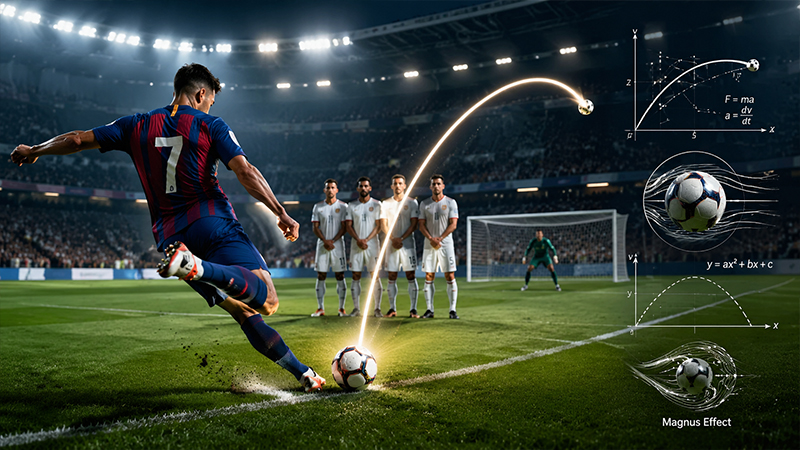
In the world of football, few sights are as mesmerizing as a ball that seems to defy the laws of physics, swerving through the air to find the back of the net.
This phenomenon, known as “the curve” or “bending the ball,” is a high-level technique where a player strikes the ball in a specific manner to cause it to spin and travel in an arc-like trajectory rather than a traditional straight line.
Whether it is a last-minute free kick or a pinpoint cross into the box, the curve is a fundamental tool for elite players to navigate the complexities of a crowded pitch. This guide explores the science, technique, and tactical importance of the curve in modern football.
The Scientific Foundation: The Magnus Effect
To understand the curve, one must first understand the physics behind it. The scientific reason a football curves is known as the Magnus effect.
When a player applies spin to the ball during a strike, it creates a discrepancy in air pressure around the sphere as it moves through the atmosphere.
Specifically, the spinning motion creates high air pressure on one side of the ball and low air pressure on the other.
According to the principles of fluid dynamics, the ball is naturally forced toward the low-pressure side, which results in the signature curved path that leaves spectators and opponents alike in awe.
The Mechanics of the Strike
Achieving a consistent and effective curve is not a matter of luck; it requires precise physical execution and a deep understanding of the ball’s contact points.
1. The Point of Contact A primary requirement for a good curve is hitting the ball off-center. Striking the ball directly in the middle will result in a straight flight path with minimal rotation. By aiming for the side of the ball, the player initiates the necessary spin to trigger the Magnus effect.
2. Inside Curve (“Banana Kick”) One of the most common techniques is the Inside Curve, often referred to in traditional football circles as the “Banana Kick”. In this method, the player strikes the ball with the inside of the foot, aiming for the side of the ball to generate a large, sweeping arc. This technique is favored for its accuracy and the high volume of spin it can generate.
3. Outside Curve Conversely, the Outside Curve requires the player to use the outside of the foot to strike the ball. This causes the ball to rotate in the opposite direction of an inside-foot strike, often catching defenders off guard as the ball bends away from its expected path.
4. The Follow-Through The power and duration of the curve are heavily influenced by what happens after the foot touches the ball. Mastery of this skill requires a sweeping, follow-through motion with the kicking leg. This extended contact and movement ensure that maximum rotational energy is transferred to the ball, sustaining the curve throughout its flight.
Tactical Applications: Why Bend the Ball?
The curve is not merely for aesthetic flair; it serves a primary goal of deceiving the goalkeeper and defenders. By altering the ball’s path, a player makes it incredibly difficult for the opposition to predict the final trajectory of the shot or pass.
Overcoming the “Wall”
One of the most frequent uses of the curve is during free kicks. When a defending team forms a “wall” of players to block the direct path to the goal, an attacking player can use the curve to get the ball over or around the wall.
The ball starts wide of the target or high in the air and then “bends” back into the net, bypassing the stationary defenders entirely.
The Art of the Cross
In open play, the curve is a vital component of successful crossing. A player on the wing can use a curved strike to make the ball arc away from the goalkeeper while simultaneously moving toward their own teammates in the penalty area.
This makes it nearly impossible for the keeper to intercept the ball while providing a perfect “run-on” delivery for a striker.
Clinical Shooting
When aiming for the goal, players use the curve to hit the far corners of the net. By bending the ball, a striker can aim for a spot that is initially out of reach for the goalkeeper, using the arc to tuck the ball inside the post at the last possible second.
The Legacy of the Curve
While many players have mastered this skill, it was famously popularized by legends like David Beckham. His ability to consistently deliver pinpoint accuracy over long distances led to the global cultural phrase “bending it like Beckham”.
Today, “bending it” remains the standard terminology for any player who can manipulate the flight of the ball with such grace and precision.
Advanced Training: Building the Muscle Memory
To reach a level where the curve becomes second nature, players must engage in rigorous, repetitive training.
- Static Ball Drills: Start by placing the ball on a line. Practice striking the side of the ball and watching its rotation. The goal isn’t distance yet, but ensuring the ball spins “tightly” on its axis.
- The Cone Wall: Set up a line of cones to simulate a defensive wall. Practice “whipping” the ball around the side of the cones. This teaches you how much “offset” you need in your aim to account for the ball’s eventual return to the center.
- Varying Distances: The Magnus effect takes time to act on the ball. You will notice that the curve becomes more pronounced the further the ball travels. Practice from 20, 30, and 40 yards to understand how speed and air resistance affect the arc over time.
Equipment Considerations
While the skill lies in the player’s foot, the equipment can play a supporting role.
- Footwear: Modern football boots often feature “strike zones” with rubberized elements or textured surfaces. these are designed to increase friction between the boot and the ball, making it easier to “grip” the surface and generate high RPM (revolutions per minute) spin.
- The Ball: The construction of the football itself matters. Balls with fewer panels or smoother surfaces may move more unpredictably (like the infamous Jabulani), whereas traditionally stitched balls provide a more consistent surface for generating a controlled Magnus effect.
Common Mistakes to Avoid
Many developing players struggle with the curve because of a few common errors:
Lifting the Ball Too Much
If you lean back too far, you will get height but lose the lateral “bend.” Keep your chest over the ball to maintain a controlled, lower trajectory.
Weak Follow-Through
If the leg stops immediately after contact, the spin will be weak. Think of the leg as a whip; the motion should be fluid and continuous.
Too Much Power
Sometimes, striking the ball too hard can actually reduce the curve. The Magnus effect requires the air to flow around the ball; if the ball is moving too fast, it may enter a “knuckle” phase where it wobbles rather than arcs. Finding the balance between speed and spin is the key to a perfect “banana shot.”
The Psychology of the Curve
Beyond physics, there is a psychological element to the curve. For a goalkeeper, a straight shot is easy to track. However, a curved shot forces the keeper to make a split-second recalculation.
Often, you will see goalkeepers remain “rooted” to the spot—this happens because their brain initially registered the ball as going wide, and by the time the curve brought it back on target, it was too late to react.
Conclusion: The Ultimate Expression of Skill
The curve represents the perfect intersection of a player’s physical capability and their understanding of the game’s environment. It turns a simple kick into a work of art.
By mastering the Magnus effect, choosing the right contact point, and applying the technique in tactical situations like free kicks and crosses, you transform yourself from a player who just hits the ball into a player who controls the game.
Whether you are inspired by the legacy of David Beckham or looking to deceive the next goalkeeper you face, the curve is a skill that rewards patience, practice, and a little bit of scientific intuition. Now, get out on the pitch and start bending it.