In the modern era of baseball and softball, high-performance equipment represents a significant financial and emotional investment.
When a player drops several hundred dollars on a top-tier composite bat, every scuff and scratch becomes a source of anxiety.
The heart-stopping moment usually happens in the dugout: you look down after a solid hit and see a line running across the barrel. Is it a home run in the making, or did you just turn your investment into an expensive wall decoration?
The reality is that composite bats are complex, layered machines, and understanding the difference between surface-level cosmetic “drama” and genuine structural failure is vital for any serious player.
Misidentifying damage can lead to unnecessary warranty claims, the loss of replacement rights, and unnecessary time spent on the sidelines.
This guide provides a comprehensive breakdown of what a cracked composite bat actually looks like, how to test for internal failure, and when you should—and shouldn’t—worry.
Understanding the “Good” Damage: Normal Wear and Tear
It is a common misconception that a pristine bat is a high-performing bat. In the world of composites, the opposite is often true.
As a bat is used, the resin and carbon fibers begin to stretch and settle, a process known as “breaking in.” During this phase, the bat may develop visual markers that look like damage but are actually signs of a maturing barrel.
1. The Phenomenon of Spider Webbing and Spiral Marks
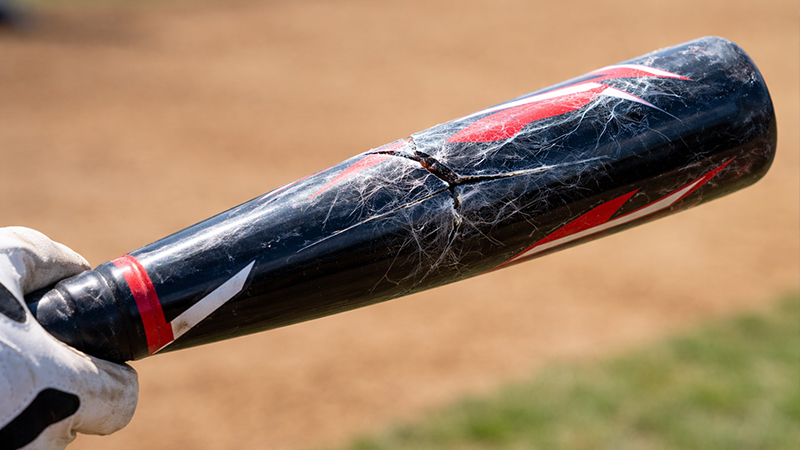
One of the most frequently misidentified “cracks” is spider webbing. These look like small, thin, interconnecting lines that resemble a spider’s web or a series of spiral marks circling the barrel.
While they look alarming, these are typically just clearcoat fractures. The outermost layer of a bat is a protective clear coat over the paint and graphics.
As the composite barrel flexes during impact—creating the famous “trampoline effect”—the rigid clear coat may develop tiny stress fractures because it cannot flex as much as the underlying material.
Key Insight: If you see spider webbing, it often means your bat is reaching its “peak pop”. The barrel is finally soft enough to provide maximum energy transfer to the ball.
2. The Mystery of Paint Seams
Manufacturers apply graphics to bats in various ways, sometimes using wraps or specialized painting processes. Over time, a straight vertical or horizontal line may appear on the barrel.
This is often a paint seam where the graphics meet. These lines are purely cosmetic and have zero impact on the internal integrity of the composite shell.
3. Surface-Level Scuffs and Scratches
Baseball and softball are dirty sports. Bats are dropped in dirt, dragged in bags, and hit by balls traveling at high speeds.
Most surface scratches that do not penetrate the paint are simply battle scars. Unless the mark is deep enough to reveal the raw composite fibers beneath, it is likely just a visual blemish.
The Anatomy of a Broken Bat: Signs of Structural Failure
When a composite bat actually breaks, the damage is fundamentally different in appearance and texture compared to cosmetic wear.
True failure occurs when the internal layers of carbon fiber or resin can no longer hold their shape or provide the necessary tension for the trampoline effect.
1. The “Shark Tooth” or Jagged Crack
Unlike the thin, hair-like lines of spider webbing, a structural crack is often jagged and sharp. These are sometimes referred to as “shark tooth” cracks because they create a zig-zag pattern that interrupts the smooth surface of the barrel.
Visual Check: If the crack looks like it has “teeth” or is uneven, it is likely a sign that the structural shell has failed.
2. Delamination and Layer Separation
Composite bats are made of multiple layers of material bonded together. Structural failure can manifest as splitting or separation of these layers.
If you see the barrel beginning to “peel” or if there are visible gaps where the composite material seems to be lifting away from itself, the bat is structurally compromised.
3. Deep Structural Gouges
A deep gouge is more than just a scratch. It is a depression or cut that penetrates beyond the paint and clearcoat into the structural shell.
If you can see the dark, raw composite material inside the “wound,” the integrity of that specific spot on the barrel is gone. This can lead to a “dead spot” where the bat no longer provides a consistent rebound.
The DIY Bat Inspection: A 3-Step Process
If you have identified a mark on your bat, don’t panic. Use this three-step diagnostic process to determine if you need to retire the bat or keep swinging.
Step 1: The Tactile Test (Feel it Out)
The easiest way to tell a paint crack from a structural crack is with your sense of touch. Run your fingernail or fingertip gently over the mark.
- Cosmetic: If it feels smooth or like a very faint hairline seam, it is likely cosmetic.
- Structural: If your fingernail “catches” on a sharp edge or if the crack feels deep and jagged, it is likely a break.
Step 2: The Sound and Performance Check
Composite bats have a distinct “ping” or “crack” sound when they hit a ball. When a bat suffers structural failure, its acoustic properties change.
- The “Thud” Test: A broken bat will often sound “flat” or “dead” upon impact.
- Performance Monitoring: If you notice a sudden, drastic drop in the distance the ball is traveling, or if the bat feels “vibratory” or “stingy” in your hands even on a solid hit, internal damage is probable.
Step 3: Visual Comparison
Compare the markings on your bat against manufacturer-provided guides or reliable industry images.
Manufacturers often have galleries showing what is considered “normal wear” versus “warranty-eligible damage.” Seeing a side-by-side comparison can offer immediate peace of mind.
The Warranty Dilemma: Why You Should Wait
It is tempting to file a warranty claim the moment you see a mark on an expensive bat. However, they suggest that premature warranty claims can be a costly mistake.
Most high-end bats come with a limited warranty—often a one-time replacement. If you use your replacement right on a bat that only has a cosmetic paint seam, you have “spent” your warranty.
If that replacement bat (or the original, if the claim is denied) breaks for real a month later, you may be left with no recourse and no bat.
Furthermore, the surge in misidentified “breaks” creates a ripple effect in the baseball and softball community.
It leads to extended wait times for players who actually have broken equipment and can lead to increased skepticism from manufacturers during the claim process.
The Golden Rule: If the bat is still performing well and the marks are smooth to the touch, keep playing.
Conclusion: Play On with Confidence
A cracked paint job does not mean a cracked barrel. Understanding the nuances of composite materials allows you to stay focused on your game rather than worrying about every scuff on your gear.
By distinguishing between the beneficial “spider webbing” of a broken-in bat and the jagged failure of a broken shell, you protect both your performance on the field and your financial investment.
If you have performed the tactile and sound tests and are still unsure, the best course of action is to reach out to the manufacturer with high-quality, clear photos. They can often provide a professional assessment before you go through the hassle of a formal claim.
Don’t let “surface-level drama” sideline your season. Educate yourself, trust your equipment, and keep swinging until the performance tells you otherwise.