In June 2003, during a Major League game between the Chicago Cubs and the Tampa Bay Devil Rays, an iconic piece of baseball lore unfolded in real time.
Slugger Sammy Sosa shattered his wooden bat upon making contact with a pitch. When the umpire gathered the splintered pieces from the infield, an unnatural core was revealed: a neat cylinder of cork embedded inside the barrel.
Sosa was instantly ejected from the game, sparking nationwide debate across sports talk radio, scientific journals, and dugout benches.
While altered equipment has surfaced periodically throughout baseball history—with legendary names like Babe Ruth and Sammy Sosa associated with modified lumber—the incident ignited an enduring question: What does a corked bat actually do, and why do players risk their professional reputations to swing one?
                   CORKED BAT CROSS-SECTION
 _______________________________________________________________
|      Handle      |                 Barrel                     |
|__________________|____________________________________________|
                   | <--- 6" Drilled Core Filled with Cork ---> |
                   \____________________________________________/
The Core Debate: Science versus Player Experience
To the casual observer, modifying a bat by replacing dense wood with lightweight material seems like an obvious attempt to transform standard equipment into a home-run weapon. However, placing a modified bat under mechanical scrutiny reveals a profound contradiction.
Physics equations demonstrate that removing mass from the barrel decreases collision power and ball exit velocity. Yet hitters across generations have insisted that altered wood provides a distinct competitive advantage at the plate.
Resolving this tension requires bridging the gap between rigid laboratory physics and the complex biomechanical reality of facing a 90+ mph fastball.
The Physics of Modification: What Actually Happens to Wood
Anatomy of the Alteration
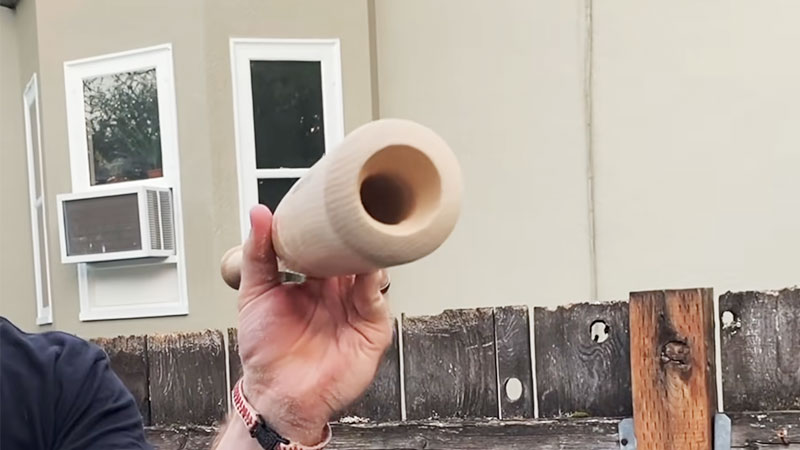
A corked baseball bat is constructed by drilling a hole approximately six inches deep and a half-inch in diameter directly into the top of the barrel end.
The hollow cavity is then packed with lightweight, low-density materials—most commonly cork, sawdust, or compressed rubber balls—and capped over with wood glue and finish to conceal the alteration.
This process alters two key physical properties of the bat:
- Mass Reduction: Removing dense hardwood and substituting it with lighter fill material reduces the bat’s overall weight by approximately 1 to 2 ounces.
- Balance Point Shift: By extracting weight specifically from the barrel end, the bat’s center of gravity shifts closer to the handle and the hitter’s hands. This drastically alters the moment of inertia, making the bat feel lighter to maneuver.
Collision Dynamics and Energy Transfer (F = ma)
The primary scientific argument against corked bats stems from fundamental collision mechanics. In an elastic-inelastic collision between bat and ball, energy transfer is dictated by Newton’s Second Law of Motion (Force = Mass x Acceleration) alongside momentum conservation principles.
| Physics Factor | Solid Wood Bat | Corked Wood Bat |
|---|---|---|
| Barrel Mass | Full Hardwood | Reduced (1–2 oz) |
| Moment of Inertia | Higher | Lower (Hand-Balanced) |
| Collision Absorption | Minimal | Moderate (Energy Loss) |
| Peak Exit Velocity | Optimal Potential | Reduced Power Output |
| Structural Strength | Solid & Uniform | Compromised / Fragile |
Every batter possesses an individualized optimum bat weight where swing speed and barrel mass align to generate maximum exit velocity.
When a bat’s mass drops below this personal threshold, the increased acceleration fails to compensate for the lost mass during impact.
As a result, energy transfer to the baseball declines, yielding lower exit velocities and shorter overall fly-ball distances.
Debunking the Trampoline Effect
A persistent myth suggests that packing cork or rubber inside a bat creates a spring-like “trampoline effect” that propels the ball farther upon contact. Laboratory testing thoroughly refutes this notion.
Unlike hollow aluminum bats—whose thin metal walls flex and store elastic energy—cork embedded inside solid hardwood acts as an energy sink rather than a spring.
Because cork is soft and compressible, it absorbs a portion of the impact energy during contact. This softer collision dampens the force transmitted to the baseball, further reducing hit distance compared to solid wood.
The Human Factor: Why Hitters Value Lighter Swing Mass
                    SWING TIMING & REACTION WINDOW
      Pitch Released                             Ball Reaches Plate
      |-----------------------------------------------------------|
      Standard Bat:  Must commit swing HERE ------------> [  ]
      Corked Bat:    Can wait longer HERE -------> [  ]
Acceleration and Pitch Recognition Window
If corking a bat decreases maximum ball distance, why do professional athletes run the risk of using them? The answer lies not in raw distance, but in reaction time.
At the Major League level, a fastball traveling at 95 miles per hour reaches home plate in roughly 400 milliseconds. A batter has less than 250 milliseconds to process pitch trajectory, spin, and location before deciding whether to swing.
Because removing barrel weight lowers the bat’s moment of inertia, a hitter can accelerate a lighter bat through the zone significantly faster. This increased acceleration allows the batter to hold back their swing for a crucial fraction of a second longer.
That extra split-second grants the hitter vital additional time to distinguish between a straight fastball and a breaking ball before committing their wrists.
Barrel Control and Sweet-Spot Alignment
In competitive hitting, peak power is useless if the ball makes off-center contact with the handle or end-cap. The greatest challenge for elite batters is barrel placement accuracy.
+-----------------------------------------------------------------+
| POWER VS. CONTROL TRADE-OFF                                     |
| Heavy Bat  --> Higher Inertia  --> More Force / Less Precision  |
| Light Bat  --> Lower Inertia  --> Less Force / Higher Accuracy  |
+-----------------------------------------------------------------+
A lighter, hand-balanced bat provides superior barrel control as the wood passes through the strike zone. If a pitch late-breaks or drifts, a hitter swinging a lighter bat can adjust their hands mid-motion to compensate.
By making square contact on the bat’s “sweet spot” more consistently, batters convert potential ground-outs or swing-and-misses into solid hits. For contact hitters or players struggling against high velocity, this added precision far outweighs the loss in raw exit velocity.
The Mental Edge at the Plate
Baseball is a sport famously governed by routine, momentum, and mental state. The psychological advantage of swinging a lighter bat can be profound.
When a hitter steps into the batter’s box convinced that their equipment offers quick hands and effortless barrel speed, their plate approach becomes more aggressive and decisive.
This psychological boost—combined with actual improvements in bat control—explains why veteran players have historically favored altered wood despite scientific proof that it reduces hit distance.
Training and Practice Utility: Overlooked Advantages
What Simplified Experiments Miss
Popular science investigations—including famous television broadcast tests—frequently declare the corked bat myth “busted” by mounting bats into rigid mechanical arm rigs and measuring stationary ball rebound speeds.
While these experiments accurately reflect impact physics, they miss the dynamic human elements of hitting. Mechanical testing rigs cannot replicate late pitch recognition, wrist adjustments mid-swing, or human fatigue over an 162-game season.
Repetitive Strain Prevention and Conditioning
In professional training environments, modified bats serve a functional purpose outside of official competition.
During standard batting practice, players take dozens of full-speed swings daily, placing immense wear and tear on their connective tissue, wrists, shoulders, and rotator cuffs.
Practicing with a lighter, corked bat enables players to train swing mechanics, hand speed, and timing at full tempo while minimizing physical stress on key muscle groups. This reduces wear on the rotator cuff and prevents fatigue over long homestands.
High-Volume Practice for Coaches and Players
Coaches also utilize lightweight or modified bats during defensive drills. When hitting hundreds of grounders and fly balls during daily pre-game workouts, using standard heavy game bats quickly causes arm strain.
Lighter specialty wood—such as Fungo bats or lightweight practice models—allows coaches to conduct high-volume practice sessions without exhaustion.
Summary
Understanding what a corked bat does requires balancing physical collision mechanics against human performance factors:
- The Physics Trade-Off: Corking a bat reduces overall barrel mass and absorbs contact energy, causing a net decrease in raw power and batted ball distance.
- The Biomechanical Benefit: The reduction in swing weight allows hitters to accelerate the bat faster, granting them extra time to read pitches and adjust their barrel to hit the sweet spot.
- The Practical Purpose: In practice settings, lighter equipment helps athletes build swing speed and complete high-rep workouts without taxing their shoulders or rotator cuffs.
- The Regulatory Reality: Major League Baseball strictly bans modified bats to preserve competitive fairness and structural safety. Using an altered bat in competition carries harsh penalties, including immediate ejection and multi-game suspensions.
Ultimately, the corked bat represents one of sports history’s most fascinating paradoxes: a modification that fails as a power-boosting secret weapon, but succeeds as a lesson in human timing, barrel control, and plate perception.