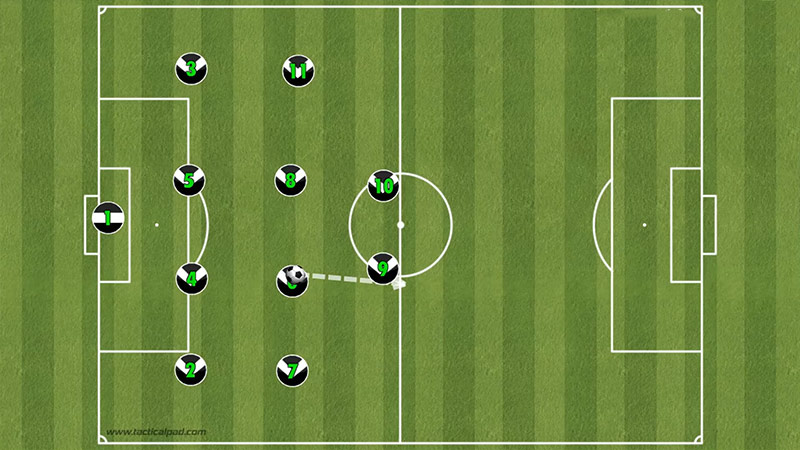
In the intricate world of football tactics, few structures have demonstrated the longevity and resilience of the 4-4-2.
Often regarded as the “traditional” blueprint of modern soccer, this formation has served as the foundation for legendary dynasties and remains a cornerstone for tactical instruction at the highest levels of the sport.
At its core, the 4-4-2 is a study in geometric balance, offering a symmetrical framework that prioritizes defensive stability without sacrificing attacking potency.
For analysts, coaches, and enthusiasts, understanding the 4-4-2 is not merely about identifying players on a pitch; it is about grasping a philosophy of discipline, work ethic, and spatial management.
This guide explores the mechanical nuances, historical origins, and modern adaptations of the formation that shaped the global game.
The Anatomy of a Classic: Defining the 4-4-2 Structure
The 4-4-2 formation is composed of three distinct horizontal lines that span the length and width of the pitch. Excluding the goalkeeper, the setup is divided into four defenders, four midfielders, and two forwards.
The Defensive Foundation: The Back Four
The back line consists of two centre-backs and two full-backs. The centre-backs serve as the primary protectors of the central channel, responsible for clearing crosses and competing against direct central play.
In possession, modern centre-backs are expected to drive into midfield through inside channels or switch the point of attack to wide midfielders.
The full-backs provide essential width, offering delayed support during build-up and overlapping to provide crosses when the wide midfielders tuck inside.
The Engine Room: The Midfield Unit
A flat midfield four features two central players and two wide players. The central midfielders act as the connectors between the defense and the attack, utilizing a wide passing range to dictate tempo.
Depending on the tactical directive, they may operate as deep-lying playmakers or box-to-box runners who support both ends of the pitch.
The wide midfielders (or wingers) are tasked with attacking around the opposition’s defensive line, primarily through crossing or cutting inside to combine with the forwards.
The Spearhead: The Front Two
The attacking line features two centre-forwards. This partnership is designed to provide “height” in the attack, meaning they occupy the opposition’s centre-backs to stretch the defense vertically.
Their roles often vary; one may act as a target man to hold the ball up, while the other looks for penetrative runs or drifts into pockets of space between the lines.
Tactical Execution: Mechanics in Action
The success of a 4-4-2 depends on the seamless transition between phases of play. Its primary strength lies in its balanced structure, which ensures consistent pitch coverage regardless of the ball’s location.
In-Possession Dynamics
When the team has the ball, the 4-4-2 utilizes its width to bypass central congestion. The wide midfielders and overlapping full-backs create 2v1 situations against opposing defenders.
The central midfielders ensure the back line isn’t isolated, providing an “underneath” support option for wide players.
A key advantage in possession is the double threat posed by the two strikers; by constantly occupying both opposing centre-backs, the 4-4-2 makes it difficult for the defense to provide cover elsewhere.
Out-of-Possession Discipline: The “Two Banks of Four”
Defensively, the 4-4-2 is perhaps most famous for creating “two banks of four”. This refers to the two horizontal lines of defenders and midfielders remaining compact and narrow to prevent the opposition from playing through the center.
- The Press: The two forwards are the first line of defense, screening access to the opposition’s defensive midfielders (pivots) and forcing play toward the touchlines.
- Compactness: The midfield unit moves as a block. If the ball is on the right wing, the entire unit shifts right, with the far-side wide midfielder moving inward to cover central spaces.
A Historical Journey: From Rio to Kyiv
The 4-4-2 did not emerge in a vacuum. It was a refined evolution of the more aggressive 4-2-4 formation that dominated the mid-20th century.
The Brazilian national team famously utilized a 4-2-4 during their 1958 World Cup victory, where high-positioned wingers attacked alongside the front two.
Over the following decade, tactical necessity dictated that these wingers drop deeper to support the midfield, leading to the birth of the 4-4-2.
Viktor Maslov, the legendary coach of Dynamo Kyiv, is often credited as the architect of the disciplined 4-4-2. In the late 1960s, Maslov pioneered organized, team-wide pressing.
By pulling his wingers back into the midfield line, he was able to overload opposition midfields that were typically playing with fewer numbers, leading Dynamo Kyiv to three consecutive league titles.
Modern Case Studies: How Elite Coaches Utilize the 4-4-2
While the formation is traditional, its application varies significantly based on the manager’s philosophy.
- Sir Alex Ferguson (Manchester United): Ferguson utilized a fluid 4-4-2 characterized by box-to-box midfielders and attacking wide players. His forwards often rotated, with one dropping deeper to act as a “number 10,” while the team relied on swift counter-attacks to exploit open space.
- Diego Simeone (Atlético Madrid): Simeone’s interpretation is a masterclass in the low block. He prioritizes central compactness and defensive discipline, using the 4-4-2 to control matches by denying space in his own half rather than dominating possession.
- Ralph Hasenhüttl (Southampton): In contrast to Simeone, Hasenhüttl used the shape for aggressive high pressing. His forwards and wide midfielders would jump forward to press the opposition’s back line, aiming to regain possession high up the pitch.
- Sean Dyche (Burnley): Dyche preferred a physical application of the 4-4-2, utilizing aerially strong centre-forwards to disrupt defenders and focusing on defensive duels within a mid or low block.
Strategic Evaluation: Advantages and Vulnerabilities
Why the 4-4-2 Persists (Pros)
- Pitch Coverage: It provides a natural balance across the entire field, making it difficult for full-backs to be “underloaded” (outnumbered) by attackers.
- Counter-Attacking Efficiency: It provides a perfect base for transitions; the team can defend deep and immediately link play to the two strikers who remain high up the pitch.
- Simplicity and Clarity: Roles are generally well-defined, allowing for high levels of organizational discipline.
The Challenges of the System (Cons)
- Central Overloads: Against a three-man midfield (like a 4-3-3), the 4-4-2’s two central midfielders can be outnumbered 3v2, leading to a loss of possession.
- Lack of Staggering: Because the players often sit in flat lines, the formation can be susceptible to “line-breaking” passes. A single accurate pass can sometimes bypass four players at once.
- Physical Demands: The system requires immense stamina and work ethic, especially from the midfielders who must track back to defend while also supporting every attack.
Enhanced FAQ: Understanding the 4-4-2
Q: What is the difference between a “Flat” 4-4-2 and a “Diamond” 4-4-2?
A: A Flat 4-4-2 features a horizontal line of four midfielders. A Diamond 4-4-2 (or 4-1-2-1-2) rearranges that unit into a vertical diamond: one defensive anchor, two central midfielders on the sides, and one attacking midfielder at the tip.
Q: Can a 4-4-2 compete against modern possession-heavy systems?
A: Yes. While it may struggle for possession against a 4-3-3, its defensive compactness makes it an excellent choice for teams that prefer to win through disciplined defending and rapid counter-attacks.
Q: Is the 4-4-2 still used in elite football?
A: Absolutely. While formations like 4-3-3 or 3-4-3 are popular, many top-tier teams still utilize the 4-4-2, either as their primary shape or as a defensive “block” when they lose possession.
Conclusion
The 4-4-2 formation is far more than a relic of football’s past; it is a sophisticated tactical system that offers unparalleled balance and structural integrity.
From the pressing innovations of Viktor Maslov to the defensive fortresses built by Diego Simeone, the 4-4-2 remains a vital tool in a coach’s arsenal.
Whether used to press high or sit deep, its ability to cover the pitch and provide a platform for attacking partnerships ensures that it will remain a staple of the beautiful game for decades to come.