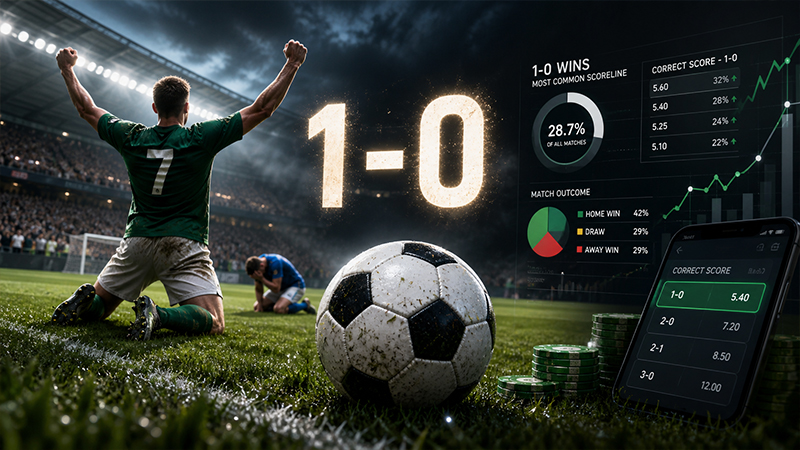
In the world of football, few scorelines carry as much weight, tactical significance, and psychological depth as the narrow 1-0.
To the casual observer, it might seem like a low-scoring or even “boring” affair, but to the seasoned fan, the professional bettor, and the tactical coach, the 1-0 margin represents the pinnacle of discipline and strategic execution.
This guide explores the multifaceted meaning of 1-0 in football, from its literal definition on the scoreboard to its complex role in the betting markets and the mental fortitude it requires from players.
The Literal Definition: The Narrowest Margin of Victory
At its most fundamental level, a 1-0 scoreline in association football signifies that the home team has scored exactly one goal while the visiting team has failed to score, resulting in a narrow victory.
While it is the minimum requirement for a win, it is far from rare. Statistics across major global leagues show that 1-0 is typically the most common minimum-winning margin in the sport.
It represents a “clean sheet” for the winning side—a feat highly prized by defenders and goalkeepers alike.
Key Components of a 1-0 Result:
- The Goal: A single moment of offensive brilliance or a capitalized error.
- The Shutout: A complete defensive performance where the opposition is neutralized.
- The Points: In league play, a 1-0 win yields the same three points as a 5-0 win, making it a highly efficient result.
The “1-0 Mindset”: A Philosophy of Excellence
Beyond the scoreboard, “1-0” has evolved into a metaphorical shorthand for professional discipline. Many elite coaches utilize the term “1-0” as a phrase to describe a mindset of winning one game at a time.
Focusing on the Immediate Task
In high-pressure environments, such as a title race or a relegation battle, looking too far ahead can lead to a loss of focus.
The 1-0 mentality encourages players to focus on accomplishing the immediate next task rather than worrying about the season’s end goal.
Defensive Solidity as a Foundation
A team that embraces the 1-0 philosophy often prioritizes defensive organization. The logic is simple: if the opponent never scores (the “0”), you only need one successful moment to secure the win.
Navigating the Betting Markets: Understanding “1-0” Variations
For sports bettors, “1-0” can mean several different things depending on the specific market chosen. It is one of the most popular outcomes to predict due to its frequency in professional play.
Correct Score Wagers
The most straightforward application is the Correct Score market. In this context, placing a bet on 1-0 means you are predicting the match will end with that exact scoreline. If the game ends 2-0, 1-1, or 0-1, the bet is lost.
Because of the difficulty of predicting an exact score, these bets often offer higher odds than simple win/loss bets.
The European Handicap (1:0)
This is where many beginners get confused. In a European Handicap (1:0), the home team is granted a virtual 1-goal advantage before the opening whistle.
- How it works: If you bet on the home team in a 1:0 handicap market, you win if the real-world match ends in a draw (e.g., 0-0 or 1-1) because your virtual goal makes the “betting score” 1-0 or 2-1 in your favor.
- Purpose: This market is often used to “level the playing field” when a weaker home team is playing a stronger away team.
1st Half Asian Handicap
In more specialized markets, “1-0” refers to time-specific advantages. For example, in the 1st Half Asian Handicap, the 1-0 margin may refer specifically to the advantage a team holds at the half-time whistle.
Tactical Implications (External Insights for Context)
Game Management and “Closing the Shop”
When a team goes 1-0 up, the tactical dynamic of the match shifts instantly. The leading team often shifts to a “low block” or a more conservative defensive posture to protect the lead. This is often referred to as “game management.”
The “Italian School” and Catenaccio
Historically, the 1-0 scoreline was the hallmark of the Italian Catenaccio (door-bolt) system.
The goal was not to outscore the opponent by a large margin, but to score once and then become impenetrable. While modern football has become more attacking, the respect for a “solid 1-0” remains high among tactical purists.
Why 1-0 is Often More Dramatic Than 4-0
While a high-scoring game provides entertainment, a 1-0 match provides tension. In a 1-0 game, every pass, every corner kick, and every refereeing decision can change the outcome entirely.
- The Threat of the Equalizer: The trailing team is always “just one goal away” from a point.
- The Fatigue Factor: Defending a 1-0 lead for 90 minutes is mentally and physically exhausting, often leading to dramatic late-game collapses or heroic goal-line clearances.
- The Heroic Goalscorer: In a 5-0 win, the first goal is often forgotten. In a 1-0 win, the lone goalscorer becomes an instant icon of the match.
Summary Table: The Different Faces of 1-0
| Context | Meaning | |
|---|---|---|
| On the Scoreboard | Home team wins with 1 goal; Away team has 0. | |
| Betting (Correct Score) | Prediction that the exact final score will be 1-0. | |
| European Handicap | A virtual 1-goal head start for the home team. | |
| Coaching Mindset | Focusing on “one game at a time” and the next task. | |
| Half-Time Markets | The specific advantage is held at the 45-minute mark. |
Conclusion: The Beauty of the Minimum Margin
Whether you are a bettor looking at a European Handicap (1:0) to protect against a draw, or a coach instilling a 1-0 mindset to keep your players grounded, this scoreline is the backbone of football.
It is the most common minimum-winning margin for a reason: it represents the perfect balance between offensive efficiency and defensive perfection.
The next time you see a 1-0 scoreline, remember that you aren’t just looking at a low-scoring game—you are looking at a masterclass in focus, tactical discipline, and the fine margins that define the beautiful game.