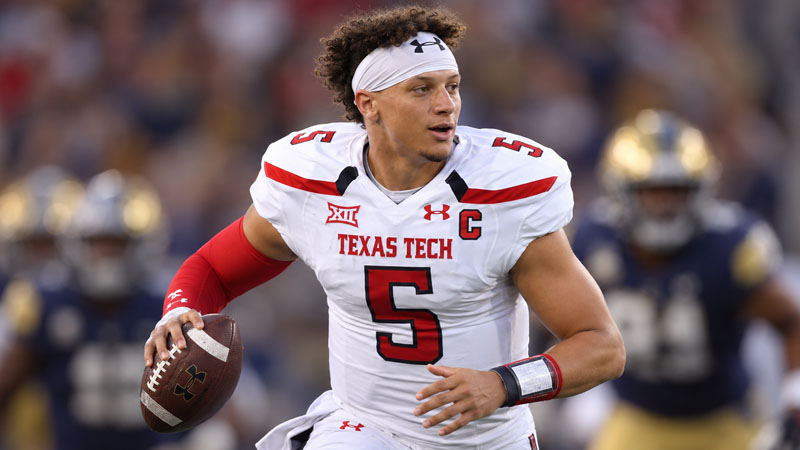
The narrative of Patrick Mahomes is often told through his professional achievements—the championships, the MVP awards, and the game-winning drives.
However, long before he became the face of the National Football League, Mahomes was redefining the boundaries of offensive production in college football.
To fully understand his mechanics, his unorthodox decision-making, and his relentless competitive spirit, one must look back to the high-plains region of West Texas. Patrick Mahomes attended Texas Tech University, where he played quarterback for the Red Raiders.
From 2014 to 2016, Mahomes transformed Texas Tech’s football program into a high-powered offensive powerhouse.
His three-season collegiate tenure was characterized by record-shattering performances, national recognition, and the development of an off-platform passing style that would soon revolutionize the game of football itself.
Why Patrick Mahomes Chose Texas Tech?
Mahomes’ journey to Lubbock began in Tyler, Texas, where he starred in football, baseball, and basketball at Whitehouse High School.
The son of former MLB pitcher Pat Mahomes, he grew up surrounded by baseball but became an elite quarterback, throwing for 4,619 yards and 50 touchdowns while firing a 94-mph fastball as a senior.
Despite his remarkable talent, most recruiting services rated him only a three-star prospect, believing professional baseball was his brighter future. Texas Tech recognized something different and built the perfect environment for his development.
- The Air Raid System: Kliff Kingsbury’s pass-heavy offense emphasized quick decisions, vertical passing, and creativity.
- A Professional Pedigree: Kingsbury encouraged Mahomes’ instincts instead of restricting his improvisational style.
- Dual-Sport Flexibility: Texas Tech allowed him to pitch for the Red Raiders before he committed fully to football.
The Freshman Campaign (2014): Stepping into the Spotlight
Patrick Mahomes entered his freshman season in 2014 as the backup quarterback to sophomore Davis Webb.
Webb, an established starter in Kingsbury’s system, initially commanded the offense. Mahomes used the early months of the season to adapt to the speed of college-level defenses and master the complexities of the playbook.
An injury to Webb late in the season thrust Mahomes into the starting role, and the young freshman immediately showed glimpses of what was to come. Over the final three games of the 2014 season, Mahomes demonstrated a remarkable level of poise and production:
- The Oklahoma Showcase: In his first major test against a ranked Oklahoma team, Mahomes delivered an impressive four-touchdown performance, showing an ability to extend plays outside the pocket.
- The Iowa State Triumph: He followed up with another four-touchdown display against Iowa State, securing his first victory as a starting collegiate quarterback.
- The Baylor Finale: In the final game of the season against No. 5 Baylor, Mahomes put on a historic display. Playing at AT&T Stadium, he threw for a staggering 598 yards and six touchdowns. Although the Red Raiders narrowly lost the shootout, the performance established Mahomes as the undisputed future of Texas Tech football.
By the conclusion of his freshman year, Mahomes had thrown for 1,547 yards and 16 touchdowns in just seven appearances, setting the stage for a spectacular sophomore campaign.
The Sophomore Ascent (2015): Taking Control of the Air Raid
With a full offseason of preparation and undisputed control of the starting quarterback job, Mahomes fully unleashed the capabilities of Texas Tech’s offense in 2015. He became the central engine of a system that routinely scored over 40 points per game.
The 2015 season was a showcase of stamina and statistical dominance. Mahomes led the Big 12 Conference in nearly every major passing category, including completions, attempts, and passing yards.
His ability to manipulate defensive coverages with his eyes, deliver accurate passes from unconventional arm angles, and execute off-platform throws became a weekly highlight.
Key highlights from the 2015 campaign include:
- The UTEP Explosion: In a 69-20 blowout victory, Mahomes threw for 361 yards and four touchdowns while rushing for two additional scores, demonstrating his dual-threat capability.
- The TCU Thriller: Against a highly ranked TCU team, Mahomes threw for 392 yards and two touchdowns in a physical, back-and-forth contest that came down to the final seconds.
- Consistency Across the Board: Mahomes exceeded 350 passing yards in ten different games and eclipsed the 400-yard mark three times.
Mahomes finished his sophomore season with 4,653 passing yards and 36 passing touchdowns, while adding 456 rushing yards and 10 rushing touchdowns.
He led the Big 12 in offensive production and proved that his style of play was both highly effective and incredibly durable.
The Historic Junior Season (2016): National Dominance
The 2016 collegiate season was Patrick Mahomes’ masterpiece. As a junior, he took his production to historic levels, leading the entire country in passing yards and total touchdowns.
He won the prestigious Sammy Baugh Trophy, awarded annually to the nation’s top college passer, and secured second-team All-Big 12 honors.
                      PATRICK MAHOMES II
                   Texas Tech University (QB)
                 2016 NCAA Passing Yardage Leader
                  Sammy Baugh Trophy Recipient
What made Mahomes’ junior season particularly legendary was his sheer physical resilience. For much of the year, he played through a separated shoulder in his non-throwing arm and a fractured wrist, refusing to miss time while carrying the burden of an offense that had to outscore opponents weekly due to defensive struggles.
The Legend of October 22, 2016: Texas Tech vs. Oklahoma
The defining game of Mahomes’ college career occurred on a crisp autumn night in Lubbock against Baker Mayfield and the No. 16 Oklahoma Sooners. The game transcended standard college football, transforming into an offensive duel of historic proportions.
- NCAA Records Set: Mahomes set the NCAA FBS single-game record for total offense with 819 yards. He also tied the NCAA single-game passing record with 734 yards, completing 52 of his 88 pass attempts.
- An Unprecedented Workload: Mahomes accounted for seven total touchdowns (five passing, two rushing). He single-handedly kept the Red Raiders competitive in a game where the two teams combined for an NCAA Division I record 1,708 yards of total offense.
- The Final Score: Despite Mahomes’ superhuman efforts, Texas Tech fell short in a 66-59 defeat. However, the game solidified his status as an elite quarterback prospect capable of executing any throw under any level of pressure.
Mahomes concluded his junior year with 5,052 passing yards and 41 passing touchdowns, becoming one of the few quarterbacks in college football history to eclipse the 5,000-yard mark in a single season.
Patrick Mahomes: Year-by-Year Collegiate Statistics
To appreciate the sheer volume of Mahomes’ production, it is useful to examine his year-by-year statistics at Texas Tech. The following table provides a complete breakdown of his passing data across his three seasons in Lubbock.
| Year | Class | Games | Completions | Attempts | Completion % | Yards | Touchdowns | Interceptions | Passer Rating |
|---|---|---|---|---|---|---|---|---|---|
| 2014 | Freshman | 7 | 105 | 185 | 56.8% | 1,547 | 16 | 4 | 151.2 |
| 2015 | Sophomore | 13 | 364 | 573 | 63.5% | 4,653 | 36 | 15 | 147.2 |
| 2016 | Junior | 12 | 388 | 591 | 65.7% | 5,052 | 41 | 10 | 157.0 |
| Career | Total | 32 | 857 | 1,349 | 63.5% | 11,252 | 93 | 29 | 152.0 |
Tactical Breakdown: The Anatomy of Mahomes’ College Playstyle
Analyzing Mahomes’ performance at Texas Tech reveals several core elements that defined his playstyle and prepared him for professional success:
- Off-Platform Throwing: Unlike traditional quarterbacks who require a perfectly clean pocket and structured footwork, Mahomes excelled at making accurate throws while on the run, falling backward, or leaping in mid-air. This skill was honed during his baseball career, where throwing from different angles is a fundamental requirement.
- Elite Spatial Awareness: In Kingsbury’s open offense, Mahomes displayed an exceptional ability to scan the entire width of the field, processing defensive movements instantly and locating open space.
- Exceptional Arm Strength: Mahomes’ arm talent allowed him to stretch opposing defenses vertically, making 60-yard throws with minimal effort and putting defensive coordinators in difficult tactical positions.
- Play Extension: When defensive pressures broke through Texas Tech’s offensive line, Mahomes used his athletic ability to evade defenders, buying critical seconds for his receivers to find openings downfield.
The Draft and Beyond: Translating College Success to NFL Greatness
While Mahomes’ statistical output at Texas Tech was undeniable, NFL scouts and draft analysts were initially divided on his prospects.
Traditionalists questioned whether his “unorthodox” habits and reliance on the Air Raid system would translate to the structured environment of professional football.
Some labeled him a high-risk, high-reward prospect, expressing concern over his tendency to take big risks and play outside of structure.
However, the Kansas City Chiefs saw Mahomes’ collegiate production not as a product of a system, but as a testament to his rare physical and mental gifts.
Head coach Andy Reid and General Manager Brett Veach engineered a trade to select Mahomes with the 10th overall pick in the 2017 draft.
The transition validated the vision of both Texas Tech and the Kansas City Chiefs:
- The 5,000-Yard Milestone: Mahomes became the first quarterback in football history to throw for over 5,000 yards in a single season in both college (2016) and the NFL (2018).
- System Integration: The modern NFL has increasingly integrated college concepts, including the RPO (Run-Pass Option) and spread alignments that Mahomes mastered at Texas Tech.
- Ring of Honor: In recognition of his unparalleled collegiate achievements, Texas Tech inducted Mahomes into the university’s prestigious Ring of Honor in 2022, cementing his legacy in Lubbock forever.
Conclusion
Patrick Mahomes’ time at Texas Tech University was much more than a prelude to his professional career; it was a transformative era for college football.
In the heart of West Texas, under the guidance of Kliff Kingsbury, Mahomes proved that a quarterback could combine unconventional mechanics, immense physical courage, and historic statistical volume to dominate the game.
His journey from a lightly recruited multi-sport athlete to the national passing leader and Sammy Baugh Trophy winner remains one of the most compelling chapters in Texas Tech history.
Today, as Mahomes continues to build an elite professional legacy, the foundation of his greatness remains firmly rooted in the scarlet and black of the Lubbock plains.