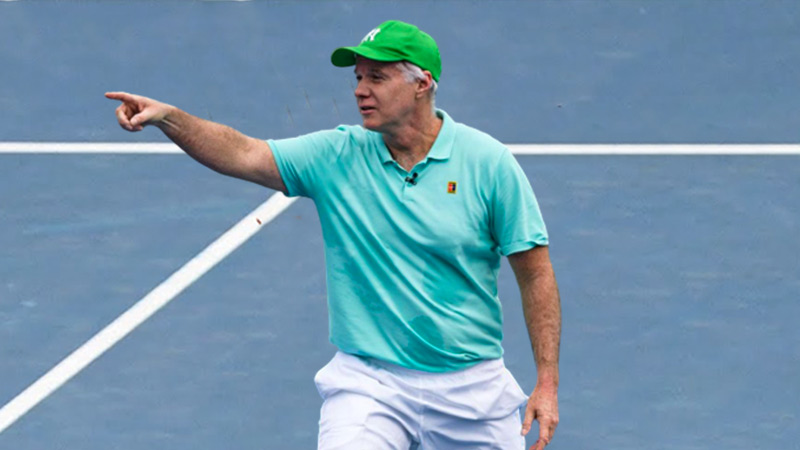
Yes, Patrick McEnroe was an elite professional tennis player, reaching levels of success achieved by only a fraction of athletes globally.
While often compared to his brother John, Patrick’s resume stands on its own merits: he was a Grand Slam champion, capturing the 1989 French Open doubles title, and reached a career-high world ranking of No. 3 in doubles.
In singles, he climbed to world No. 28 and reached the 1991 Australian Open semifinals. Beyond the court, his decade-long tenure as U.S. Davis Cup captain and his role as a premier broadcaster solidify his enduring legacy.
How Good Was Patrick McEnroe’s Professional Record?
To understand the caliber of Patrick McEnroe’s play, one must look at the objective data across his 11-year professional career from 1988 to 1998.
The following table provides a comprehensive snapshot of his performance metrics on the ATP Tour, illustrating his efficiency in both formats of the game.
| Statistic | Singles | Doubles |
|---|---|---|
| Career Record | 140–183 | 288–174 |
| Win Percentage | 43.3% | 62.3% |
| Career Titles | 1 | 16 |
| Highest Ranking | No. 28 (1995) | No. 3 (1993) |
| Grand Slam Record | 27–31 | 55–34 |
| Career Earnings | $3,212,430 (Combined) | Included in total |
The Peak of Doubles Excellence
While many fans focus on singles, McEnroe’s doubles career was truly legendary. Reaching world No. 3 in 1993 was no small feat, as it placed him among the most elite tactical minds in the sport.
Over his career, he secured 16 professional doubles titles, demonstrating a level of consistency that few could match. His 62.3% win rate in doubles is a testament to his ability to read the court and execute high-level strategy alongside various partners.
Singles Achievements on the Global Stage
Patrick McEnroe’s singles career is often underrated because he didn’t collect as many trophies as his brother, yet he was a formidable opponent for any top-tier player. Reaching world No. 28 in 1995 meant he was firmly established within the global elite.
His victory at the 1995 Sydney singles tournament, where he defeated Richard Fromberg, remains a career highlight that proved he could outlast top-tier competitors in a high-pressure final.
Did Patrick McEnroe Ever Win a Major Title?
The ultimate benchmark for “good” in professional tennis is often the Grand Slam trophy, and McEnroe successfully crossed that threshold in 1989.
His success at the majors was not limited to a single format, as he made deep runs that captured the attention of the global tennis community throughout the 1990s.
The 1989 French Open Triumph
The pinnacle of Patrick McEnroe’s on-court career occurred at Roland Garros in 1989. Partnering with fellow American Jim Grabb, McEnroe displayed exceptional clay-court craftsmanship to win the French Open men’s doubles title.
This victory officially made him a Grand Slam champion, a title that forever separates elite professionals from the rest of the pack.
That same year, he underscored his dominance by winning the prestigious Year-End Masters doubles title, a tournament reserved only for the season’s best performers.
Deep Runs in Singles and Mixed Doubles
Beyond his championship win, McEnroe was a consistent threat at the biggest tournaments in the world. He famously reached the semifinals of the 1991 Australian Open, an underdog run that ended only at the hands of the legendary Boris Becker.
Additionally, his versatility was on display in mixed doubles, where he reached the finals of both the 1987 US Open and the 1988 French Open. These performances demonstrate that he was a world-class player across all disciplines of the game.
Comparing the McEnroe Brothers’ On-Court Success
It is impossible to discuss Patrick’s career without acknowledging the shadow of his older brother, John McEnroe.
However, Patrick’s ability to forge his own identity while competing in the same stratosphere as a global icon is a central part of his professional narrative.
Facing John in the 1991 Chicago Finals
One of the most unique moments in tennis history occurred in 1991 when Patrick faced John in the finals of a tournament in Chicago. This was one of the rare instances in the ATP era where two brothers competed for a title.
While John won the match, the event highlighted Patrick’s arrival as a legitimate threat who could go toe-to-toe with the very best, including a multi-time Grand Slam singles champion.
Navigating the Legacy of a Global Icon
Patrick was often overshadowed by John’s transcendent fame, yet he maintained a professional demeanor and a high level of play that earned the deep respect of his peers.
Rather than being deterred by the comparison, Patrick leveraged his deep tactical understanding—a trait shared by both brothers—to maximize his own physical and mental tools.
This tactical intelligence would eventually serve as the foundation for his record-breaking second act in leadership.
How Patrick McEnroe Shaped American Tennis Leadership
After retiring from the professional tour in 1998, McEnroe did not step away from the sport; instead, he transitioned into a leadership role that would leave a lasting mark on the U.S. tennis infrastructure.
His contributions as a captain and administrator are widely considered some of the most influential in modern American tennis history.
The Historic Davis Cup Captaincy
McEnroe served as the captain of the United States Davis Cup team for an unprecedented ten years, from 2000 to 2010. This decade of service makes him the longest-serving captain in the modern era of the sport for the U.S..
His leadership culminated in a major victory in 2007, when he guided the American team to a Davis Cup Championship title, a feat that requires managing both the egos and the physical conditioning of the nation’s top players.
Developing the Next Generation at USTA
Building on his success as captain, McEnroe took on the role of General Manager of the USTA Elite Player Development program from 2008 to 2014.
In this capacity, he was responsible for the architectural planning of how the United States identifies and trains its future stars.
His influence during this period helped shape the developmental paths of numerous athletes, ensuring that his tactical knowledge of the game was passed down to the next generation of American talent.
Why He Is a Defining Voice in Modern Broadcasting
For many modern fans, Patrick McEnroe is best known as the voice of tennis. His transition into the commentary booth was a natural extension of the “tactical understanding” he displayed during his playing days.
He has become an essential part of the viewing experience for the sport’s biggest events.
Translating Tactical Knowledge for Viewers
McEnroe’s career as an analyst for networks like ESPN has been defined by his ability to break down complex strategies for a general audience.
Because he competed at the highest levels of both singles and doubles, he provides a three-dimensional perspective on match dynamics that few other broadcasters can offer.
His analysis often focuses on the “why” behind a player’s shot selection, drawing on his experiences facing icons like Boris Becker and his brother John.
A Staple of Grand Slam Coverage
For over two decades, McEnroe has been a fixture in the coverage of the Australian Open, Wimbledon, and the US Open. His longevity in the booth mirrors his longevity on the court and as a captain, signifying a career built on reliability and expertise.
He is widely regarded as one of the premier television commentators in the world, a role that keeps him at the center of the sport’s most important conversations.
Frequently Asked Questions About Patrick McEnroe
What was Patrick McEnroe’s highest ranking?
In the world of professional tennis, rankings are the ultimate measure of a player’s standing against their peers. Patrick McEnroe reached the absolute peak of the sport in two different categories.
In doubles, he achieved a career-high ranking of world No. 3 on April 12, 1993. In singles, he proved his individual strength by reaching world No. 28 on September 11, 1995. These rankings place him in the top 1% of all players to ever compete professionally.
How much did Patrick McEnroe earn in his career?
Throughout his 11-year stint on the ATP Tour, McEnroe was highly successful from a financial perspective, earning a total of $3,212,430 in prize money.
This figure, which combines his earnings from both singles and doubles, reflects his consistent presence in the deep rounds of major tournaments and his 17 total titles across both formats.
When adjusted for the era in which he played, these earnings signify a very high-level professional career.
Who did he partner with for his Grand Slam title?
Patrick McEnroe won his sole Grand Slam title at the 1989 French Open while playing alongside his American partner, Jim Grabb. The duo’s victory at Roland Garros is the defining on-court achievement of McEnroe’s career.
Beyond this win, he also found success in mixed doubles, reaching Grand Slam finals with partners like Terri Phelps at the 1987 US Open and Mikaela Frimmel at the 1988 French Open.
Final Verdict: The Enduring Value of Patrick McEnroe
When evaluating whether Patrick McEnroe was “good,” the answer is a resounding yes. His career was characterized by a rare trifecta of success: he was a world-class athlete who won a Grand Slam and reached the top three in the world; he was a historic leader who captained his country to a national championship; and he remains a premier analyst who defines how millions of people watch the sport.
His legacy is not merely that of a “brother of a legend,” but of a man who maximized every ounce of his talent and intelligence to influence the game of tennis for over thirty years.
Whether through his 16 doubles titles, his 2007 Davis Cup victory, or his expert commentary on ESPN, Patrick McEnroe has left an indelible mark on the sport that stands entirely on its own.