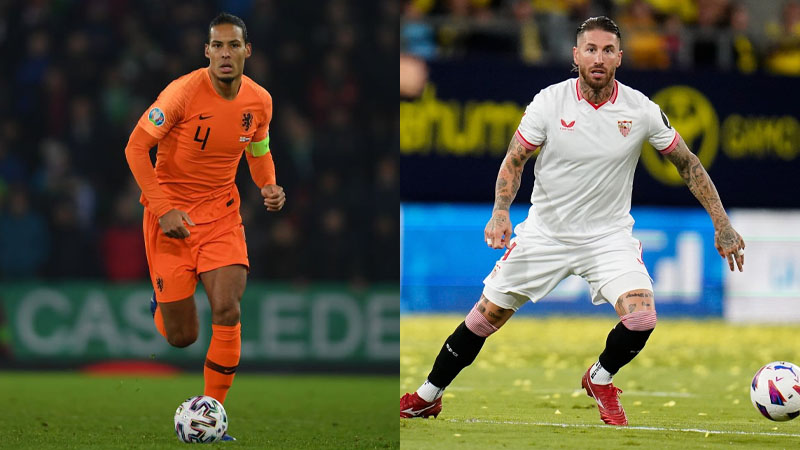
The debate regarding the greatest center-back of the modern era often converges on two specific archetypes: the composed, space-controlling “brick wall” and the aggressive, high-impact “clutch leader”.
Virgil van Dijk and Sergio Ramos represent these distinct philosophies, each redefining what it means to lead a backline at the highest level of European football.
While both players have reached the pinnacle of the sport, their paths, statistical profiles, and tactical applications offer a fascinating study in defensive diversity.
This analysis utilizes verified data to evaluate their careers, physical attributes, and enduring legacies.
Physical and Professional Foundations
Understanding the effectiveness of these two titans begins with their physical profiles. Van Dijk offers an imposing presence, utilizing his height and reach to dominate aerial duels, whereas Ramos relies on a more compact, explosive athleticism that allowed him to transition from a right-back early in his career to a world-class center-back.
| Attribute | Sergio Ramos | Virgil van Dijk |
|---|---|---|
| Date of Birth (Age) | 30/03/1986 (40) | 08/07/1991 (34) |
| Height | 1.84 m | 1.95 m |
| Primary Foot | Right | Right |
| Main Position | Centre-Back | Centre-Back |
| Secondary Position | Right-Back | N/A |
| Citizenship | Spain | Netherlands |
| Youth Academy | Sevilla FC | Willem II |
Career Trajectory and Market Valuation
The financial narratives of both players reflect different eras of the football market. Van Dijk’s move to Liverpool in 2018 for approximately €84.65m marked a shift in how clubs valued transformative defensive talent.
His market value peaked at a staggering €100m, the highest ever recorded for a defender in this data set. Conversely, Ramos maintained a high level of value throughout his decade-plus tenure at Real Madrid, peaking at €50m during a period of lower market inflation.
| Metric | Sergio Ramos | Virgil van Dijk |
|---|---|---|
| Highest Market Value | €50.00m | €100.00m |
| Total Career Appearances | 850 | 639 |
| Total Minutes Played | 73,500 | 56,268 |
| Major Transfer Fee (Peak) | €27.00m (Sevilla to Real Madrid) | €84.65m (Southampton to Liverpool) |
| Current Market Value | €800k (Without Club) | €15.00m (Liverpool) |
Defensive Philosophy: Control vs. Aggression
The most striking difference between the two lies in their tactical execution. Van Dijk is characterized by his “non-tackling” style; he uses immense pace and elite positioning to shepherd attackers away from goal, rarely finding himself forced into a desperate challenge.
Ramos, in contrast, is an “aggressive front-foot defender”. He plays with extreme intensity and is famous for using tactical fouls to disrupt the opposition, which has resulted in a historic disciplinary record.
| Feature | Virgil van Dijk | Sergio Ramos |
|---|---|---|
| Defensive Style | Positional control and composure. | Aggressive, high-intensity, front-foot. |
| Dribbled Past | Globally renowned for how infrequently attackers bypass him. | Relies on tactical fouls and technical recovery. |
| Peak Performance | Recorded highest average match ratings in Europe during his prime. | Renowned for historical defensive impact and clutch moments. |
| Disciplinary Record | Notably low foul and yellow card rate. | Most red cards in European football history. |
Offensive Output: The Scoring Defender
While their primary duty is to prevent goals, both players have been instrumental in the attacking third.
Sergio Ramos is one of the highest-scoring defenders in the history of the sport, frequently serving as a designated penalty taker and a legendary threat during last-minute set pieces.
Van Dijk, while scoring fewer goals overall, is considered an “aerial colossus” and a primary target for set-piece delivery.
| Scoring Metric | Sergio Ramos | Virgil van Dijk |
|---|---|---|
| Total Career Goals | 125 | 66 |
| Total Career Assists | 42 | 28 |
| Champions League Goals | 17 | 5 |
| League Goals (Primary) | 77 (LaLiga) | 31 (Premier League) |
| National Team Goals | 23 (Spain) | 12 (Netherlands) |
Comparative Trophy Hauls and International Success
When measuring legacy through silverware, the scales tilt toward Sergio Ramos. His tenure coincided with the golden eras of both Real Madrid and the Spanish National Team, resulting in an almost unparalleled collection of major honors.
Van Dijk’s impact at Liverpool was transformative, leading the club to its first Premier League title and a Champions League victory, though his overall medal count is smaller.
| Competition | Sergio Ramos | Virgil van Dijk |
|---|---|---|
| FIFA World Cup | 1 | 0 |
| UEFA European Championship | 2 | 0 |
| UEFA Champions League | 4 | 1 |
| Domestic League Titles | 5 (LaLiga), 2 (Ligue 1) | 1 (Premier League), 2 (Scottish Premiership) |
| FIFA Club World Cup | 4 | 1 |
| UEFA Super Cup | 3 | 1 |
Head-to-Head and Teammate Synergy
Despite their long careers at the top of the game, the two have rarely faced each other directly. Records indicate they have met on the pitch only once, with Ramos’s side emerging victorious.
| Head-to-Head Statistics | Data Point |
|---|---|
| Matches Played Against Each Other | 1 |
| Minutes Played in H2H | 90 |
| Winner (Ramos) | 1 Win |
| Winner (Van Dijk) | 0 Wins |
Competitive Analysis: The Expert Perspective
The choice between Van Dijk and Ramos often depends on the specific needs of a tactical system.
- The Van Dijk Case: For organizations seeking a “brick wall” to stabilize a high defensive line, Van Dijk is the gold standard. His ability to control large areas of space through positioning alone reduces the need for high-risk challenges, fostering a calm defensive environment.
- The Ramos Case: For systems that require a high-intensity leader who can influence the psychological state of the game, Ramos is unmatched. His offensive contributions and “clutch” mentality in knockout competitions make him a unique asset who effectively functions as an extra attacker during set pieces.
Frequently Asked Questions (FAQ)
Q: Who is the faster defender?
Virgil van Dijk is widely recognized for his immense pace, which he uses to recover and prevent attackers from dribbling past him. While Ramos was highly mobile, especially in his youth as a right-back, Van Dijk’s recovery speed in a high line is a defining trait of his game.
Q: Why does Ramos have so many red cards compared to Van Dijk?
This is a direct result of their differing philosophies. Ramos utilizes “tactical fouls” and plays with an “extreme intensity” that often crosses the line into disciplinary action.
Van Dijk’s game is built on “positioning” and “composure,” meaning he rarely finds himself in a position where a desperate or aggressive tackle is necessary.
Q: Is Sergio Ramos really one of the highest-scoring defenders ever?
Yes. With 125 total goals at the club level and 23 for his national team, his offensive output is comparable to many midfielders and even some forwards. His role as a penalty taker and his aerial prowess in the box are central to this record.
Q: Who has had the higher market value?
Virgil van Dijk reached a peak market value of €100m in 2024, whereas Sergio Ramos peaked at €50m earlier in his career.
Conclusion: A Conflict of Archetypes
In the final assessment, Virgil van Dijk and Sergio Ramos represent the two poles of modern defensive excellence. Van Dijk is the ultimate practitioner of defensive prevention—a player whose success is measured by the lack of chaos in his vicinity.
Sergio Ramos is the master of defensive intervention—a player who thrives in the chaos, often creating it himself to lead his team to victory through sheer force of will and offensive contribution.
For a Fortune 500-level sporting organization, the “correct” choice would be dictated by the existing squad’s temperament.
Van Dijk brings stability and calm; Ramos brings leadership and a winning mentality that defines eras. Both remain the definitive blueprints for the next generation of defensive talent.