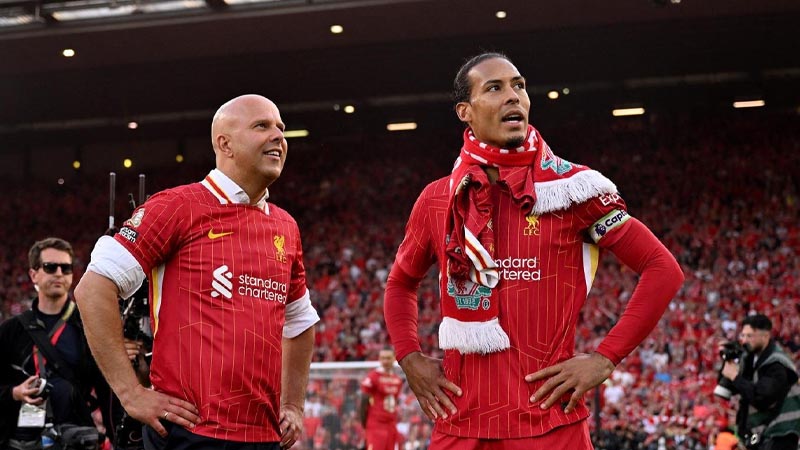
When you watch the towering figure of a world-class defender commanding the pitch, you see more than just an athlete; you see the culmination of a personal history defined by cultural depth and quiet resilience. On the back of his jersey, a single name stands out: Virgil.
This choice is not merely a branding preference or a nod to simplicity. It is a profound statement about his journey, his heritage, and the family dynamics that forged one of the most respected leaders in global football.
To understand the man, one must look toward the figures who shaped him long before he reached the heights of the Premier League.
The story of Virgil’s parents, Ron van Dijk and Hellen Chin Fo Sieeuw, is a narrative of two halves—one of a foundational presence and one of a significant absence.
A Heritage Defined by Global Crossroads
The background of the player often celebrated for his “coolness under pressure” is rooted in a rich, multi-ethnic tapestry.
Born in Breda, Netherlands, his identity is a bridge between European and South American cultures. His father, Ron van Dijk, is Dutch. His mother, Hellen Chin Fo Sieeuw, is Surinamese, specifically of Chinese-Surinamese descent.
This heritage is significant. The Surinamese diaspora in the Netherlands has long contributed to the country’s cultural and athletic excellence, yet Virgil’s specific Chinese-Surinamese roots add a unique layer to his story.
This intersection of cultures often brings a unique perspective on community and perseverance—traits that would later become the hallmark of his defensive style.
The Matriarchal Pillar: Hellen Chin Fo Sieeuw
If there is a singular hero in the biography of this elite athlete, it is undoubtedly his mother, Hellen. Following the separation of his parents during his childhood, Hellen became the primary figure in his life.
In the demanding world of professional sports development, the role of a supportive parent cannot be overstated, but Hellen’s contribution went far beyond logistical support.
She navigated the challenges of raising her children as a single parent, providing a stable foundation during Virgil’s formative years. Her influence was most critical during two pivotal periods:
- Early Football Struggles: The path to the top was not a linear ascent. During the early days of his career, when his potential was questioned and the professional breakthrough seemed distant, Hellen remained his most steadfast advocate.
- The Crisis at Age 19: Perhaps the most defining moment of their bond occurred when he was 19. While a young player at FC Groningen, he suffered a life-threatening illness. (Note: Outside of the provided material, it is widely documented that this was a severe case of appendicitis, peritonitis, and a kidney infection). During this terrifying ordeal, Hellen’s presence was constant. The experience of facing mortality at such a young age, with his mother by his side, forged a “close bond” that remains the cornerstone of his personal life.
The Architecture of Absence: Ron van Dijk
The narrative of his father, Ron, is one of distance. When the future captain was approximately 11 years old, Ron left the family. This departure created a rift that never truly healed.
For a young boy navigating the transition into adolescence while trying to make his mark in the competitive Dutch academy system, the absence of a father figure was a heavy burden.
This estrangement is the direct reason why the world recognizes him as “Virgil” rather than “Van Dijk.” While many players use their surname as a symbol of familial pride and legacy, he chose to distance himself from his father’s name.
By wearing his first name on his kit, he is making a conscious choice to honor the self he became under his mother’s care rather than the name of the man who departed.
The Psychology of the “Virgil” Jersey
In the corporate and professional world, branding is everything. In the world of sports, your name is your brand. For many, the choice to use a first name is viewed as a “Brazilian-style” flair. However, for this defender, it is an act of personal reclamation.
The “strained relationship” with Ron van Dijk meant that the surname no longer represented the values he wished to carry onto the pitch.
Every time he steps out for a major final or a crucial international match, the name on his back serves as a silent tribute to Hellen.
It is a reminder that while his physical stature and talent may be a combination of his parents’ genes, his character, resilience, and ultimate success were nurtured by his mother.
Resilience as a Professional Standard
The journey from a part-time dishwasher in Breda to a Champions League winner is fueled by the lessons learned from his family dynamics.
The ability to remain calm when an opposing striker is bearing down on goal is a direct reflection of the resilience required to survive a broken home and a near-death health crisis.
Professionalism in the face of adversity is his defining trait. By understanding the “massive role” Hellen played in his upbringing, we see that his leadership is not just a learned skill but a lived experience. He leads his team with the same quiet strength his mother used to lead their household.
Frequently Asked Questions about Virgil’s Origins
Why does he only wear “Virgil” on his shirt?
The choice is a result of a strained relationship with his father, Ron van Dijk, who left the family when he was 11. He prefers to honor his first name rather than a surname associated with the man who was absent for much of his life.
What is his ethnic background?
He has a diverse heritage: his father is Dutch, and his mother is of Chinese-Surinamese descent.
How did his mother help his career?
Hellen Fo Sieeuw raised him primarily on her own and provided essential emotional and practical support during his early struggles in football and a major health crisis at the age of 19.
The Legacy of the Name
The story of Virgil’s parents is a reminder that even the most successful figures often carry the weight of personal trials.
His success is not just a victory of talent, but a victory of a family structure that, though broken in one area, was made incredibly strong in another.
As a world-class strategist, I look for the “why” behind the “what.” The “what” is a record-breaking defender.
The “why” is a young man who chose to define himself by the love that stayed rather than the presence that left. That is the true legacy of the name Virgil.