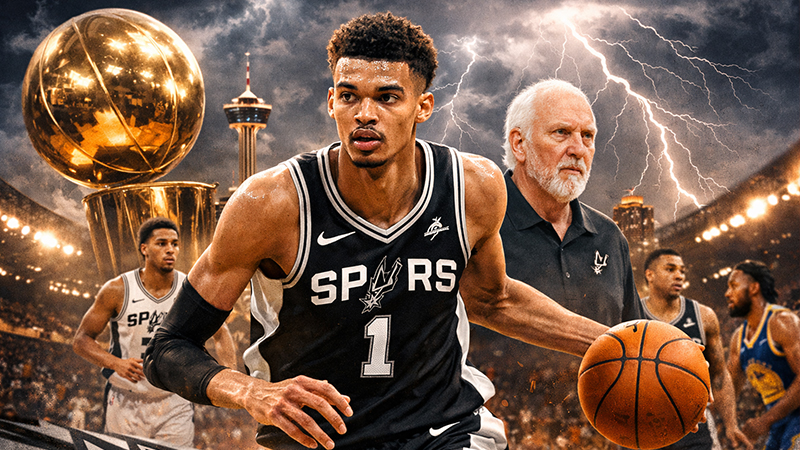
In the professional landscape of the National Basketball Association, there is a long-standing “unwritten law”: teams do not skip steps.
Championship DNA is typically forged through years of playoff heartbreak, veteran leadership, and the slow accumulation of institutional knowledge.
However, as the 2026 season hurtles toward the postseason, the San Antonio Spurs are not just knocking on the door of the elite—they are threatening to tear the door off its hinges.
Led by the generational phenomenon of Victor Wembanyama, the Spurs have moved beyond the “promising young team” label to become a genuine threat to the defending champion Oklahoma City Thunder.
This report analyzes why league executives, scouts, and coaches believe we are witnessing a historic anomaly that could redefine the “rules” of NBA contention.
The Statistical Surge: A Masterclass in Late-Season Momentum
To understand the buzz surrounding San Antonio, one must look at the sheer dominance of their recent stretch.
Since February 1st, the Spurs have posted a staggering 23-2 record. This is not merely a “hot streak”; it is a sustained level of excellence that has placed them within two games of the Oklahoma City Thunder for the top seed in the Western Conference.
Crucially, the Spurs hold the tiebreaker advantage over the Thunder, having secured a 4-1 edge in the season series.
In a Western Conference where home-court advantage can be the difference between a first-round exit and a Finals run, this head-to-head dominance is a critical data point for analysts.
While the Thunder have remained elite, going 15-2 since the All-Star break, they have been unable to shake a Spurs team that seems to have found a higher gear.
The “Wemby” Effect: Psychological Warfare and Defensive Gravity
At the center of this disruption is Victor Wembanyama. NBA insiders are increasingly convinced that Wembanyama is the ultimate “rule-breaker”.
A veteran Eastern Conference scout recently shared a sentiment that is becoming common across the league: Wembanyama’s dominance is as much psychological as it is physical.
- The Nightmare Factor: Scouts observe that by Game 4 of a playoff series, opponents will likely be having “full-on nightmares” about Wembanyama’s length and rim protection. His ability to swat a shot at one end and finish with a dunk at the other—often beating every other player down the floor—is demoralizing for veteran teams.
- The SGA Litmus Test: Perhaps the most telling insight comes from Western Conference coaches regarding how Wembanyama neutralizes elite scorers like Shai Gilgeous-Alexander. Gilgeous-Alexander is famous for his midrange mastery, but Wembanyama’s 8-foot wingspan allows him to defend the jumper and the rim simultaneously. He can remain far enough away to avoid drawing fouls while still effectively contesting the shot. As one coach noted, while SGA has “the answers to the test,” Wembanyama simply “breaks all the rules”.
This unique defensive gravity allows the Spurs to play a style of basketball that most teams with a first-year head coach and young core simply cannot execute.
Challenging the “Experience Gap” Narrative
The primary argument against a Spurs title run is the traditional “experience gap.” Since the 1976-77 NBA-ABA merger, only two teams—the 1977 Portland Trail Blazers and the 2008 Boston Celtics—have gone from missing the playoffs to winning the title the following year.
However, both examples had unique circumstances: the Celtics added Hall of Famers Kevin Garnett and Ray Allen, while the Blazers benefited from the ABA dispersal draft.
The more accurate historical comparison for these Spurs might be the 1994-95 Orlando Magic, led by a young Shaquille O’Neal and Anfernee Hardaway. Like Shaq, Wembanyama is viewed as a “generational” talent capable of bypassing the usual developmental curve.
The Hidden Veteran Presence
While the Spurs are perceived as “young,” league insiders point out that the roster is more prepared for high-stakes basketball than the general public realizes:
- Championship Pedigree: Both Harrison Barnes and Luke Kornet possess championship rings, providing essential locker-room stability.
- Clutch Leadership: De’Aaron Fox has emerged as one of the league’s premier clutch players with existing playoff experience, a vital asset for a team that will inevitably face tight Fourth Quarter scenarios in the postseason.
- Wembanyama’s Temperament: Executives are quick to dismiss the idea that the moment will be “too big” for Wembanyama, citing his preternatural poise.
The Achilles’ Heel: Perimeter Shooting and Tactical Adjustments
Despite the overwhelming optimism, objective analysis requires addressing the Spurs’ primary vulnerability: perimeter shooting. In the high-stakes environment of a seven-game series, flaws that are masked during the regular season are often ruthlessly exploited.
The Spurs’ guard rotation—comprised of De’Aaron Fox, Stephon Castle, and rookie Dylan Harper—consists of three dynamic playmakers who are all below-average three-point shooters.
- Playoff Defensive Schemes: Rival coaches are already planning to “double off” non-shooters, particularly Stephon Castle, to clog the paint and limit Wembanyama’s effectiveness.
- The Depth of Preparation: The transition from the 82-game regular season to the playoffs involves a level of preparation and physical fatigue that cannot be simulated. Whether the Spurs’ young core can navigate these tactical adjustments over two months of post-season play remains the biggest question mark.
The Strategic Landscape of the Western Conference
The Spurs’ path to a title is inextricably linked to the health and seeding of their rivals.
The Thunder Challenge
Oklahoma City remains a formidable obstacle. They are a model of consistency, boasting a 141-37 record over the past two seasons (including playoffs).
Their ability to rely on diverse role players under pressure makes them a difficult “out” for any team, regardless of Wembanyama’s individual brilliance.
The Denver Spoiler
Internal projections within the league suggest that the Denver Nuggets could land the No. 4 seed. This creates a potentially grueling path for the Thunder.
If OKC is forced into a seven-game battle with Denver in the early rounds, the sheer physical toll could leave them vulnerable to a fresher Spurs team in the later stages of the tournament.
Broad League Context: Why the Spurs’ Rise Matters Now
The emergence of the Spurs as a contender coincides with significant shifts in the NBA’s business and regulatory environment.
- The 65-Game Rule: The league’s new participation requirements have been a major talking point, especially following Cade Cunningham’s season-ending injury that disqualified him from awards. Commissioner Adam Silver has noted that the rule is successfully increasing star participation, which elevates the competitive product the Spurs are currently dominating.
- Expansion Buzz: The league is seeing an “ocean of capital” ready to flow in, with expansion to Seattle and Las Vegas virtually assured. The rise of a new “super team” in a traditional market like San Antonio further bolsters the league’s value as it looks to attract billionaires and sovereign wealth funds for new franchises.
- Lottery Reform: While the Spurs built their foundation through the draft, the league is moving toward fundamental changes to the lottery system to curb the “race to the bottom”. The Spurs represent the “success story” of rebuilding, but the NBA is keen to ensure that future teams cannot easily replicate the “tanking” model.
The Eastern Conference Comparison: A Health-Driven Race
While the West is a battle of young titans, the Eastern Conference remains a war of attrition. The Philadelphia 76ers have seen a resurgence with the return of Joel Embiid and Paul George, who combined for 63 points in their first game back together.
Meanwhile, the Cleveland Cavaliers are grappling with defensive inconsistencies (ranking 19th recently) as they wait for Jarrett Allen to return and anchor their frontcourt alongside James Harden.
The contrast is stark: while the East is defined by “if healthy” caveats for veteran-heavy rosters, the West is defined by the explosive arrival of a new era in San Antonio.
Conclusion: Is 2026 the Year History Changes?
History tells us the San Antonio Spurs should not win the 2026 NBA Championship. They are too young, their guards struggle to shoot from deep, and their coach is in his first full season.
However, the consensus among NBA insiders—the people who watch Wembanyama from the sidelines every night—is that history may not apply here. Victor Wembanyama is not just a player; he is a structural shift in the game of basketball. His ability to dominate both ends of the floor and “break the rules” of defensive positioning has given the Spurs a window of contention that has opened years ahead of schedule.
Whether they secure the title this year or not, one thing is certain: the San Antonio Spurs are no longer a “team of the future.” They are the team of the now.
Frequently Asked Questions (FAQ)
Q: How did the Spurs achieve a 23-2 record since February?
A: This surge is attributed to Wembanyama’s generational defensive impact and the elite “clutch” play of De’Aaron Fox, combined with a highly cohesive roster that league executives describe as “very well put together”.
Q: Can the Spurs really beat the OKC Thunder in a seven-game series?
A: While the Thunder have more long-term consistency (141-37 over two seasons), the Spurs won the season series 4-1 and possess the specific defensive tools—namely Wembanyama’s length—to disrupt the Thunder’s primary offensive weapons.
Q: What is the Spurs’ biggest weakness?
A: Their perimeter shooting. Their core guards (Fox, Castle, and Harper) are below-average three-point shooters, which could allow playoff defenses to “clog the paint” and make it harder for Wembanyama to operate.
Q: How does the 65-game rule affect the Spurs?
A: While Wembanyama has remained healthy, the rule has impacted other stars like Detroit’s Cade Cunningham. For the Spurs, the rule’s success in increasing star participation league-wide means their recent wins have come against high-level competition, validating their record.