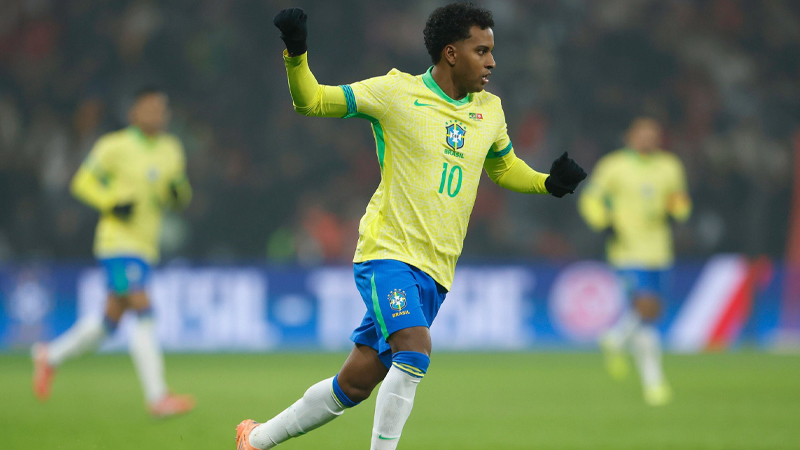
Rodrygo Silva de Goes is one of the most exciting talents in world football today, but his rapid rise at Real Madrid often leaves fans asking questions about Rodrygo’s nationality.
Born in Osasco, Brazil, he is a proud representative of the Brazilian national team, yet he legally holds a Spanish passport. This dual identity is a fascinating intersection of personal heritage and professional strategy.
In October 2022, Rodrygo officially acquired Spanish citizenship, a move that significantly impacted his career and his club’s roster management. Understanding his dual status reveals how modern footballers navigate international law to maximize their global potential.
The Brazilian Origins of Rodrygo Silva de Goes
The story of Rodrygo’s identity begins in South America, where his footballing journey took root long before he became a household name in Europe. His connection to his homeland remains the defining characteristic of his public persona and sporting career.
Birthplace and Early Years in Osasco
Rodrygo was born on January 9, 2001, in Osasco, São Paulo, Brazil. Growing up in the heart of Brazil’s football culture, he was immersed in the traditions of the Seleção from a young age.
Osasco, a city known for its industrious spirit, provided the backdrop for his early development. It was here that his father, Eric Batista de Goes, a former professional footballer himself, helped nurture the talent that would eventually lead Rodrygo to the biggest stages in the world.
His Brazilian roots are not merely a legal fact but the core of his playing style—characterized by flair, agility, and clinical finishing.
Rise through the Santos Academy
Before the world asked about Rodrygo’s nationality in a European context, he was known as the next “Gem” of the Santos FC academy.
Joining the same club that produced Pelé and Neymar, Rodrygo’s Brazilian identity was cemented through his performances in the Campeonato Brasileiro. His time at Santos was instrumental in establishing him as a national icon in the making.
By the time he departed for Spain, he had already become the youngest Brazilian to ever score in the Copa Libertadores, further highlighting his status as a premier representative of Brazilian sporting excellence.
Rodrygo Nationality: Exploring the Dual Citizenship
While his heart and heritage are firmly Brazilian, Rodrygo’s legal status evolved significantly after his move to the Spanish capital. The transition from a foreign “import” to a domestic resident is a common path for elite athletes in La Liga.
| Key Identity Feature | Detail |
|---|---|
| Full Name | Rodrygo Silva de Goes |
| Primary Nationality | Brazilian |
| Secondary Nationality | Spanish |
| Date of Naturalization | October 2022 |
| International Allegiance | Brazil (CBF) |
| Place of Birth | Osasco, São Paulo, Brazil |
| Date of Birth | January 9, 2001 |
The acquisition of Spanish nationality in October 2022 was a milestone that blended his personal life with his professional requirements. Having lived in Madrid since 2019, Rodrygo fulfilled the necessary residency requirements to apply for citizenship.
Under Spanish law, citizens from Ibero-American countries (including Brazil) benefit from a shortened residency requirement—typically two years of legal residence—to qualify for naturalization.
This legal framework allowed Rodrygo to maintain his Brazilian identity while gaining the rights and privileges associated with being a citizen of the European Union.
Why Real Madrid Pushed for Spanish Citizenship
In the high-stakes world of European football, player registration is a complex puzzle. Rodrygo’s nationality became a focal point for Real Madrid’s front office due to strict league regulations regarding squad composition.
The Non-EU Player Restriction in La Liga
The primary professional motivation for Rodrygo obtaining a Spanish passport was to free up a non-EU player spot for his club.
La Liga regulations strictly limit each club to only three players from outside the European Union (or countries without specific Cotonou Agreement status). For a global powerhouse like Real Madrid, these three spots are incredibly valuable.
When Rodrygo first arrived, he, along with teammates Vinícius Júnior and Éder Militão, occupied these limited slots, which restricted the club’s ability to sign other international talents from South America or Asia.
Strategic Benefits for Roster Management
By acquiring Spanish citizenship, Rodrygo ceased to count as a “foreign” player in the eyes of La Liga. This administrative shift provided Real Madrid with immense tactical flexibility in the transfer market.
It allowed the club to pursue other non-EU targets, such as the young sensation Endrick, without having to sell or loan out existing stars.
For Rodrygo, this meant greater job security and a simplified administrative life in Spain, while for the club, it represented a masterstroke in squad planning that ensured they could continue to aggregate the world’s best talent regardless of their origin.
International Career: Choosing the Seleção
Despite his Spanish passport, there was never any doubt about which national team Rodrygo would represent. His sporting allegiance is a testament to the deep-seated pride he feels for his country of birth.
Senior Debut for Brazil in 2019
Rodrygo made his senior debut for the Brazil national team in 2019. This appearance officially “cap-tied” him to Brazil under FIFA regulations at the time, ensuring that his international future lay with the five-time World Cup winners.
For Rodrygo, representing the Seleção is the ultimate honor. He has often spoken about the dream of wearing the yellow jersey, a dream shared by millions of children in Osasco.
His role in the national team has grown from a promising youngster to a vital starter, often playing alongside his club teammates in a synergy that benefits both club and country.
The Role of a Modern Dual Citizen
In the modern era, many players hold multiple passports but remain fiercely loyal to their original sporting nationality.
Rodrygo follows in the footsteps of many Brazilian legends who spent the majority of their careers in Europe, gained local citizenship, but continued to define themselves through their Brazilian heritage.
His dual nationality does not diminish his “Brazilian-ness”; rather, it facilitates his career in Europe, allowing him to focus entirely on his performance on the pitch without the distractions of work permit renewals or foreign-player quotas.
The Legal Process of Spanish Naturalization
Becoming a Spanish citizen is a rigorous process that requires more than just living in the country. For Rodrygo, it involved a commitment to the legal and cultural standards of his second home.
Residency and Integration Requirements
To qualify for citizenship, Rodrygo had to demonstrate a period of continuous legal residency in Spain. As a Brazilian citizen, he benefited from the bilateral agreements between Spain and its former colonies/Portuguese-speaking counterparts, which allow for a fast-track process.
Beyond the time requirement, applicants often must pass exams demonstrating knowledge of the Spanish language (DELE) and the Spanish Constitution and society (CCSE). Rodrygo’s successful naturalization in 2022 suggests a high level of integration into the local culture of Madrid.
The Symbolic Oath of Allegiance
The final step in the process for any new citizen is the swearing of an oath of allegiance to the King of Spain and the Spanish Constitution. This ceremony marks the official transition.
While this is a legal necessity to obtain the passport and the “EU player” status, it also represents a significant personal milestone.
For a young man who moved across the Atlantic at 18, obtaining citizenship is a sign of stability and a successful transition into adulthood in a foreign land.
Frequently Asked Questions About Rodrygo’s Heritage
Can Rodrygo play for the Spanish National Team?
No. Because Rodrygo has already played competitive senior matches for the Brazil national team (having debuted in 2019), he is not eligible to switch his international allegiance to Spain. His Spanish citizenship is purely for legal and professional purposes within the club football system.
When did Rodrygo get his Spanish passport? R
odrygo officially became a Spanish citizen in October 2022. This was part of a coordinated effort by Real Madrid to ensure their key Brazilian stars all obtained EU status around the same time.
What is Rodrygo’s birthplace?
He was born in Osasco, São Paulo, Brazil. He remains a Brazilian citizen by birth and a Spanish citizen by naturalization.
How does his nationality help Real Madrid?
It allows him to be registered as an EU player, which means he does not take up one of the three restricted “non-EU” spots in the squad. This is vital for the club’s ability to sign new players from outside Europe.
Conclusion: A Global Icon with Deep Brazilian Roots
Rodrygo Silva de Goes embodies the archetype of the modern, globalized footballer. While his legal status as a Spanish citizen provides the structural support for a long and successful career in the heart of Europe, his identity remains inextricably linked to Osasco and the Brazilian national team.
The question of Rodrygo’s nationality is not an “either/or” scenario; it is a “both/and” reality. He is a son of Brazil who has found a second home in Spain, using his dual heritage to navigate the complexities of professional sports with the same grace he displays on the pitch.
As he continues to win titles with Real Madrid and lead the line for Brazil, his story serves as a perfect example of how talent, when paired with strategic planning, knows no borders.
For fans and analysts alike, Rodrygo is more than just a player with two passports—he is a bridge between two of the world’s greatest footballing cultures.