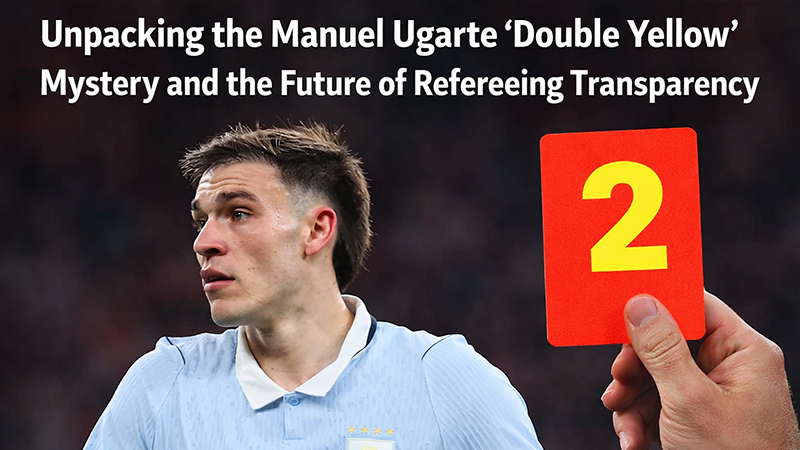
The international friendly between England and Uruguay at Wembley Stadium on March 27, 2026, was billed as a high-stakes tactical chess match between Thomas Tuchel’s evolving England side and a “full gas” Uruguayan squad.
However, what should have been a night centered on Ben White’s dramatic return and Federico Valverde’s clinical equalizer has instead been overshadowed by a refereeing anomaly that is already being cited as future “pub quiz” trivia.
The incident involving Manchester United midfielder Manuel Ugarte—who appeared to receive two yellow cards without being sent off—has ignited a global conversation regarding officiating consistency, VAR intervention protocols, and the need for real-time clarity in the modern game.
As Thomas Tuchel noted in his post-match assessment, it was quite simply a “bad day at the office” for the officiating crew.
The Timeline of Confusion: 71’ to 81’
To understand the magnitude of the tactical and administrative breakdown, we must analyze the two specific flashpoints that left fans, pundits, and players like Harry Maguire in a state of total bewilderment.
The First Flashpoint: The Challenge on Palmer (71st Minute)
In the 71st minute, with the game locked in a physical stalemate, Manuel Ugarte committed what appeared to be a textbook yellow-card offense. His “rash challenge” on England’s Cole Palmer saw the referee reach for his pocket.
To the eyes of those in the stadium and millions watching on television, Ugarte was “seen going into the book”. This moment established the baseline for the remainder of the match: Ugarte was on a tightrope.
The Second Flashpoint: Dissent Following White’s Goal (81st Minute)
England finally broke the deadlock in the 81st minute through Ben White. In the emotional aftermath of the goal, Ugarte was again involved in a confrontation with the referee. Footage from the broadcast showed the referee brandishing a second yellow card toward the midfielder for dissent.
Under International Football Association Board (IFAB) Law 12, the outcome is binary: two yellow cards equal one red card and an immediate dismissal.
Yet, Ugarte remained on the pitch. The confusion was so palpable that Uruguay’s technical staff “hurriedly substituted” Ugarte off in the 87th minute to avoid further risk, replacing him with Brian Rodríguez.
Deconstructing the “Official” Explanation
As the match concluded in a 1-1 draw, the search for answers began. The broadcast team at ITV, led by Mark Pougatch, provided a tentative explanation that only served to highlight the lack of transparency in on-field communications.
According to Pougatch, the “first” yellow card (from the 71st minute) had been rescinded. The narrative shifted to suggest that the card for the foul on Palmer had actually been attributed to José María Giménez for dissent, rather than Ugarte for the tackle.
Harry Maguire summarized the absurdity of the situation: “We’ve been told Ugarte was shown two yellow cards and the second one was rescinded.
Now we’ve been told the first of those yellow cards for Ugarte was actually for Giménez. So rather than two yellow cards, Ugarte got no yellow cards”.
The Tuchel Critique: A Systemic Failure of VAR?
The Ugarte incident was not an isolated error; it was part of a broader officiating performance that Thomas Tuchel described as disappointing.
The England manager pointed to a glaring lack of consistency in how VAR was applied throughout the ninety minutes.
- The Unpunished Challenge on Foden: Phil Foden was forced to limp off following a “rough, studs-up challenge” by Ronald Araújo. Despite the potential for a red card, VAR did not check the tackle.
- The Soft Penalty: In contrast to the Foden incident, VAR intervened late in the game to penalize Ben White for a foul on Federico Viñas, leading to Uruguay’s equalizer. Tuchel expressed surprise that VAR was even functional, stating, “The tackle on Foden not even checked… then suddenly this one is checked”.
High-Performance Analysis: The Strategic Impact
From a strategic standpoint, the failure to dismiss Ugarte altered the final ten minutes of the match. A ten-man Uruguay would have struggled to find the intensity required for Federico Valverde’s injury-time equalizer.
The Ben White Narrative
Beyond the refereeing, the match served as a psychological case study. Ben White, returning to the England fold, was met with boos from a section of the home support—a reaction Tuchel found “disappointing”. Despite the hostile atmosphere, White scored the opener, demonstrating the “mental fortitude” required at the elite level. However, the late penalty incident involving White and Viñas ensured his return was bittersweet.
The “Mini Valverde”
A bright spot for England was the debut of James Garner, whom Tuchel affectionately labeled “our mini Valverde”. This comparison highlights Tuchel’s tactical ambition: he is looking for players who can match the industry and technical proficiency of the world’s best, like Uruguay’s own Federico Valverde.
Enhanced FAQ: Navigating the Controversy
Q: How did Manuel Ugarte stay on the pitch after two yellow cards?
A: The current explanation provided by broadcasters is that the first yellow card, originally thought to be for Ugarte’s foul on Cole Palmer, was actually awarded to José María Giménez for dissent. Therefore, Ugarte technically only had one yellow card at the time of his substitution.
Q: Why didn’t VAR intervene in the Ugarte incident?
A: VAR is currently restricted to “clear and obvious errors” relating to straight red cards, goals, penalties, and mistaken identity. If the referee correctly identified the player he intended to book (Giménez) but the broadcast and players perceived it as Ugarte, VAR may not have seen a reason to intervene unless it was a case of mistaken identity in the awarding of the card itself.
Q: What happened to Phil Foden?
A: Foden suffered a leg injury following a studs-up challenge from Ronald Araújo. The lack of a VAR review on this specific play was a major point of contention for Thomas Tuchel.
Q: Was the late penalty for Uruguay justified?
A: Thomas Tuchel described it as a “very soft penalty,” suggesting that while there was contact between Ben White and Federico Viñas, the striker played for the decision.
Conclusion: The Need for Professional Evolution
The 1-1 draw between England and Uruguay will be remembered less for the football and more for the administrative “glitch” that allowed Manuel Ugarte to escape a red card. For a sport that prides itself on being a global leader in entertainment and precision, “making it up as they go along”—as Ian Wright suggested—is an unacceptable standard.
As we move toward the 2026 World Cup, FIFA and IFAB must prioritize:
- Real-time communication: Referees should have a mechanism to clarify card recipients to the stadium and broadcasters instantly.
- VAR Consistency: The threshold for “checking” a foul must be uniform across all match incidents, from potential red-card tackles to “soft” penalties.
- Trust Signals: Maintaining the integrity of the game requires that officiating is seen to be as professional and data-driven as the players on the pitch.