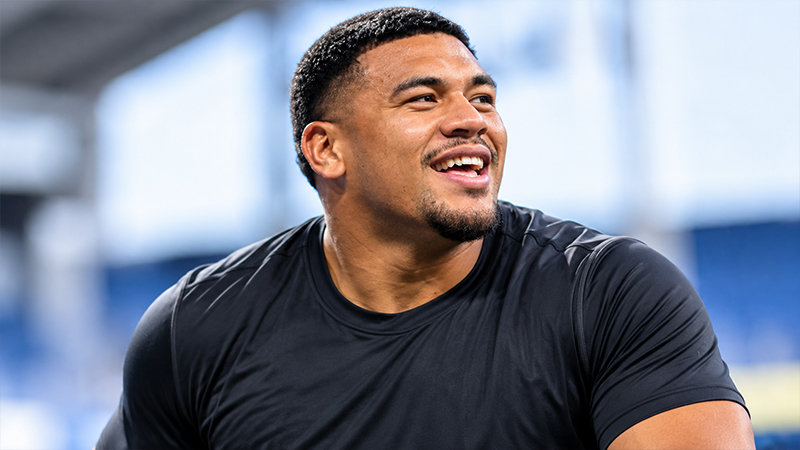
In the modern landscape of professional football, few positions are as critical to the sustained success of a franchise as the offensive tackle.
For the Detroit Lions, the decision to secure Penei Sewell through the end of the decade represents more than just a personnel move; it is a fundamental pillar of their long-term competitive strategy.
As an elite athlete who has consistently logged near-100% snap counts throughout his tenure, Sewell has proven himself to be the bedrock upon which the Lions’ offense is built.
This analysis provides a comprehensive examination of Sewell’s financial trajectory, focusing on his landmark April 2024 extension and the high-level strategic restructure executed in September 2026.
By examining the fiscal mechanics of these agreements, we can better understand how the Lions’ management balances the immediate need for cap flexibility with the long-term goal of retaining generational talent.
The Landmark 2024 Extension: A Benchmark for the Market
In April 2024, the Detroit Lions made a definitive statement regarding their commitment to excellence by signing Penei Sewell to a four-year, $112 million contract extension.
This agreement solidified Sewell’s position as one of the premier offensive linemen in the league, placing him at the time as the third-highest-paid Right Tackle out of 98 ranked players at his position.
The structure of the deal was designed to provide the player with significant security while allowing the organization to manage its cash flow effectively.
With an average annual value (APY) of $28 million, the contract reflected both Sewell’s current performance and his future potential as he entered his prime athletic years.
Penei Sewell Extension Financial Snapshot (April 2024)
| Detail | Financial Value |
|---|---|
| Total Contract Value | $112,000,000 |
| Average Annual Salary (APY) | $28,000,000 |
| Total Guaranteed Money | $85,000,000 |
| Fully Guaranteed at Signing | $42,986,236 |
| Initial Signing Bonus | $15,000,000 |
| Contract Duration | 4 Years (Extension) |
| Contract Expiration | 2029 Season |
| Free Agency Year | 2030 (Unrestricted) |
The Mechanics of Guarantees and Bonuses
A primary factor in any Fortune 500-level negotiation is the allocation of risk. In NFL terms, this is represented by guaranteed money.
Sewell’s agreement featured a robust guarantee package of $85 million, which accounts for approximately 76% of the total contract value.
The initial $42.99 million fully guaranteed at signing included his signing bonus and base salaries for the 2024 and 2025 league years.
Furthermore, the deal utilized a $25 million option bonus in 2025 to spread the cap hit across multiple years, a common strategy for high-value player retention.
This option bonus, due in March 2025, served as a critical trigger for the contract’s long-term stability.
As Sewell moved into the 2026 league year, the Lions front office reached another critical decision point. On the third day of the 2026 league year, his $19.9 million base salary for that season became fully guaranteed, reinforcing his status as an indispensable asset.
The September 2026 Restructure: Tactical Agility
On September 12, 2026, the Detroit Lions executed a strategic restructure of Sewell’s contract. This move was not a reflection of a change in Sewell’s value, but rather a tactical adjustment to the team’s overall salary cap health.
By converting $18.6 million of Sewell’s 2026 base salary into a signing bonus, the Lions were able to achieve significant immediate financial relief.
This conversion allowed the organization to prorate that money over the remaining years of the deal, reducing the 2026 cap charge by $14.88 million.
This specific maneuver is a hallmark of aggressive roster building, often used when a team is preparing to acquire a high-value player or needs to bolster its depth for a championship run.
2026 Contract Restructure Impact
| Metric | Before Restructure | After Restructure | Net Change |
|---|---|---|---|
| 2026 Base Salary | $19,900,000 (Initial) | $1,300,000 | -$18,600,000 |
| 2026 Cap Space Created | $0 | $14,880,000 | +$14,880,000 |
| Future Annual Cap Increase | $0 | $3,720,000 | +$3,720,000 |
| Total 2026 Cap Charge | $28,000,000 (Approx) | $13,120,160 | -53% Reduction |
The “Kick the Can” Strategy: Balancing Today and Tomorrow
While the $14.88 million in immediate savings provided the Lions with flexibility for the 2026 season, such moves come with future obligations. The documentation indicates that the restructure will increase Sewell’s cap numbers in each subsequent contract year by $3.72 million.
This “back-loading” of the cap is a calculated risk. For a player like Sewell, who has maintained an elite level of health and performance—missing only two games across five seasons—the risk of “dead money” in the future is mitigated by his high probability of fulfilling the entire contract.
Projected Annual Cap Charges (Post-Restructure)
| League Year | Age | Cap Number | Cap Percentage (Est) |
|---|---|---|---|
| 2026 | 26 | $13,120,160 | 4.1% |
| 2027 | 27 | $35,720,000 | 10.9% |
| 2028 | 28 | $37,720,000 | 10.7% |
| 2029 | 29 | $30,720,000 | TBD |
| 2030 (Void Year) | 30 | $3,720,000 | TBD |
As shown in the table above, the 2027 and 2028 league years will see Sewell’s cap hit escalate significantly, surpassing $35 million and $37 million, respectively.
This mirrors the financial trajectory of other elite tackles in the NFL, where the highest cap hits are typically reserved for the latter half of the contract.
The Strategic Role of the 2030 Void Year
A notable feature of Sewell’s contract history is the inclusion of a void year in 2030. Technically, Sewell will become an unrestricted free agent in 2030, but the 2030 year exists on the books to facilitate the proration of his signing and restructure bonuses.
The contract is set to void on the fifth day after the Super Bowl following the 2029 season. At that point, the remaining $3.72 million in prorated bonus money will accelerate onto the 2030 cap.
This accounting mechanism is essential for maintaining a competitive roster, as it allows teams to push a portion of the financial burden beyond the player’s active playing years with the team.
Durability as a Return on Investment
From an analytical perspective, the Lions’ willingness to restructure and extend Sewell is deeply rooted in his availability. In an era where player health is a significant variable, Sewell has been a model of consistency.
His snap counts for the 2022, 2023, and early 2026 seasons reached a perfect 100%, demonstrating a level of reliability that front offices value above almost all other traits.
Snap Count Efficiency and Availability
| Season | Games Played | Offensive Snap % | Status |
|---|---|---|---|
| 2021 | 16 | 94.3% | Rookie Foundation |
| 2022 | 17 | 100% | Elite Reliability |
| 2023 | 17 | 100% | Peak Performance |
| 2024 | 17 | 99.9% | Continued Dominance |
| 2025 | 16 | 90.7% | High Efficiency |
| 2026 (Partial) | 2 | 100% | Sustained Excellence |
Broader Roster Implications
The timing of Sewell’s restructure—occurring on the same weekend as a similar move for star wide receiver Amon-Ra St. Brown—suggests a coordinated effort by the Lions to maximize their championship window.
By clearing nearly $15 million in space through Sewell alone, the Lions created the “dry powder” necessary to make significant additions to the roster.
This level of fiscal planning is indicative of an organization that is no longer merely rebuilding but is actively managing its resources to maintain a position of power in the NFC North.
Sewell, at age 26, remains the cornerstone of this plan, providing the physical and financial foundation for everything the Lions hope to achieve over the next four years.
Conclusion
The contract of Penei Sewell is a case study in modern NFL cap management. Through a combination of a high-value extension and a well-timed restructure, the Detroit Lions have secured a top-three player at his position while simultaneously creating the flexibility needed to chase a Super Bowl.
While the future cap numbers in 2027 and 2028 are substantial, they represent the fair market price for a player of Sewell’s caliber and durability.
For the Lions, the investment in the offensive line is the ultimate insurance policy for their offensive success. By the time Sewell reaches the 2030 void year, his tenure in Detroit will likely be viewed as the defining era of the franchise’s resurgence.