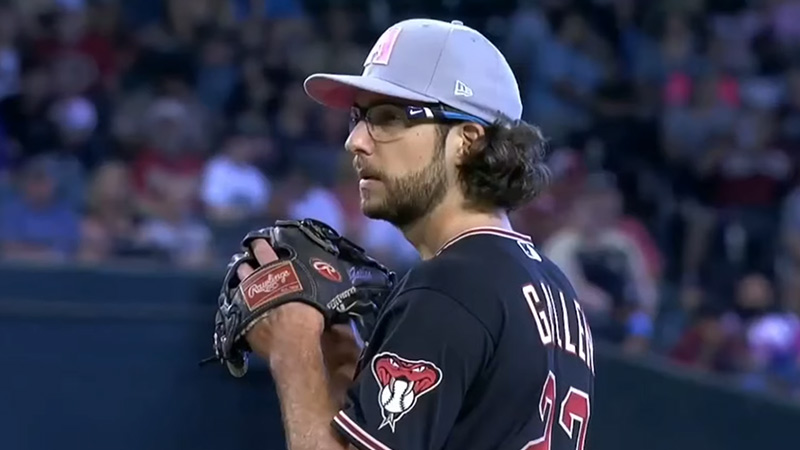
The question of whether Zac Gallen remains a top-tier Major League Baseball ace is one of the most compelling debates in modern sports analytics.
Following a stellar rise that included multiple Cy Young Award top-five finishes, an All-Star starting assignment, and leading the Arizona Diamondbacks to a National League pennant, Gallen has faced intense scrutiny regarding performance fluctuations.
While traditional box scores often present a chaotic picture—marked by occasional run-heavy outings contrasted with moments of sheer dominance—a deep inspection of peripheral indicators, velocity trends, movement profiles, and pitch location reveals a nuanced story.
Gallen has not lost his fundamental craft; rather, he is navigating a classic transition phase driven by heavy inning accumulation, minor mechanical shifts, and evolving opposition game plans.
This deep-dive evaluation breaks down every dimension of Gallen’s profile to determine his true status, future outlook, and actionable value for sports analysts, fantasy managers, and baseball enthusiasts.
Evaluating Zac Gallen’s Status in Modern Baseball
When evaluating starting pitchers in Major League Baseball, the title of “Ace” is reserved for an elite minority.
An ace is not merely a pitcher who posts a solid earned run average; an ace is a rotation stabilizer who consistently silences elite lineups, generates high swing-and-miss rates, suppresses hard contact, and absorbs heavy inning workloads month after month.
       ┌─────────────────────────────────────────────────────────┐
       │             THE MODERN ACE EVALUATION MATRIX            │
       └────────────────────────────┬────────────────────────────┘
                                    │
         ┌──────────────────────────┼──────────────────────────┐
         ▼                          ▼                          ▼
┌─────────────────┐        ┌─────────────────┐        ┌─────────────────┐
│ PITCH QUALITY   │        │   COMMAND &     │        │ DUBILITY &      │
│ - Fastball VAA  │        │   EXECUTION     │        │ WORKLOAD        │
│ - Secondary CSW%│        │ - Zone-Edge %   │        │ - Inning Volume │
│ - Hard-Hit Supp.│        │ - First-Strike %│        │ - High-Stress   │
└─────────────────┘        └─────────────────┘        └─────────────────┘
For several seasons, Zac Gallen met every single criterion on this checklist:
- The Dominance Peak: During his peak runs, Gallen recorded an incredible 44.1 consecutive scoreless innings streak—one of the longest in modern baseball history.
- Cy Young Pedigree: Finished top-five in National League Cy Young voting in consecutive seasons (2022 and 2023), proving his ability to sustain elite production over full 30+ start campaigns.
- Postseason Pedigree: Served as the unquestioned rotation leader during Arizona’s unexpected 2023 pennant run, delivering high-stakes starts on the national stage.
However, recent seasons have introduced noticeable volatility. Outings where Gallen effortlessly navigates seven scoreless innings with nine strikeouts are now occasionally punctuated by high-pitch-count starts where he struggles to finish five innings due to elevated walk counts or early-count hard contact.
To determine if Gallen is undergoing a natural variance period or experiencing a structural decline, we must look beyond basic win-loss records and traditional run averages.
Surface Results vs. Expected Peripherals: The Analytical Gap
In contemporary baseball analysis, judging a pitcher solely by Earned Run Average (ERA) or Wins is akin to judging a company’s health by top-line revenue while ignoring net operating margins. Surface numbers are heavily influenced by defense, luck, ballpark factors, and sequencing.
To isolate Gallen’s true skill level, we evaluate his metrics through the lens of underlying expected peripherals:
Key Pitching Metrics Breakdown
| Metric Category | Traditional Indicator | Expected Peripheral | What the Peripheral Measures | Gallen’s Multi-Year Trend |
|---|---|---|---|---|
| Run Suppression | ERA (Earned Run Average) | xERA / FIP | Strips out defensive play and luck to calculate true run prevention based on strikeouts, walks, and exit velocity. | xERA remains consistently lower than inflated surface ERA periods, signaling strong underlying fundamentals. |
| Strikeout Ability | Strikeout Total (K) | K% & CSW% | Measures strikeout rate per batter faced and Called Strike + Whiff percentage. | Slight regression from peak 30%+ strikeout rates down to 24–26%, indicating fewer non-competitive swing-and-misses. |
| Batted Ball Control | Hits Allowed | Hard-Hit% & Barrel% | Tracks the percentage of exit velocities over 95 mph and optimal launch angles allowed. | Barrel rate suppression remains elite, though ground ball percentage has slightly dipped in favor of fly balls. |
| Luck & Defense | WHIP | BABIP & Strand Rate | Batting Average on Balls In Play and percentage of runners left stranded on base. | Fluctuations in strand rate explain short-term ERA spikes better than pitch quality changes. |
The Finding
When Gallen experiences a stretch of inflated ERA, it is frequently accompanied by a spike in BABIP (Batting Average on Balls In Play) well above his career baseline (.285–.290), alongside a drop in Left-On-Base percentage (LOB%).
When balls in play find holes at an unsustainably high rate, run totals inflate quickly even if a pitcher’s strikeout-to-walk ratios remain healthy. His Expected Fielding Independent Pitching (xFIP) and Skill-Interactive ERA (SIERA) consistently indicate that his core talent level remains anchored firmly in the top 15–20% of all MLB starting pitchers.
Deep-Dive Pitch Metrics and Velocity Profiles
An elite pitcher’s foundation relies on pitch quality—commonly evaluated through velocity, spin rate, vertical/horizontal movement, and tunneling. Gallen’s repertoire is a classic four-pitch mix built around high-level sequencing and movement synergy.
                  ┌─────────────────────────────────────┐
                  │    ZAC GALLEN'S FOUR-PITCH MIX      │
                  └──────────────────┬──────────────────┘
                                     │
         ┌───────────────────────────┼───────────────────────────┐
         ▼                           ▼                           ▼
┌──────────────────┐        ┌──────────────────┐        ┌──────────────────┐
│ Four-Seam Fastball│       │  Knuckle-Curve   │        │ Changeup / Cutter│
│  93.5 - 95.5 mph │        │  80.0 - 82.5 mph │        │  85.0 - 88.5 mph │
│ High Rise & VAA  │        │ Vertical Drop    │        │ Arm-Side Fading  │
└──────────────────┘        └──────────────────┘        └──────────────────┘
1. The Four-Seam Fastball: Velocity and Vertical Approach Angle
- Velocity Tracking: At his peak, Gallen averaged 94.8 to 95.5 mph on his four-seamer, frequently touching 97 mph when needed in critical leverage spots. In recent periods, his average velocity has occasionally hovered between 93.5 and 94.2 mph.
- Vertical Approach Angle (VAA): What makes Gallen’s fastball lethal is not raw speed, but its flat entry angle at the top of the strike zone. This creates an optical illusion of “rising” action, causing batters to swing underneath the pitch.
- The Impact: When his fastball sits at 95 mph with top-of-the-zone precision, hitters cannot adjust in time. When the velocity dips to 93 mph, batters can make foul-ball contact or drive mistakes located over the plate.
2. The Signature Knuckle-Curveball
- Movement Profile: Featuring steep vertical drop and late break, Gallen’s curveball is his premier put-away pitch.
- Whiff Generation: During peak performance windows, his curveball generates a Called Strike + Whiff percentage (CSW%) exceeding 35%. Hitters chase this pitch out of the zone at an extraordinary rate because it tunnels seamlessly with his high fastball.
- Execution Key: If Gallen loses feel for the curveball, he is forced to rely more heavily on horizontal off-speed offerings, making him more predictable in two-strike counts.
3. The Changeup and Cutter Neutralizers
- Changeup: Deployed primarily against left-handed hitters, featuring arm-side fading action that drop off the table. It acts as a primary groundball generator when batters are looking for high heat.
- Cutter / Slider: Used to break inside on lefties or sweep away from righties, serving as a pitch-count reducer to generate early contact in the at-bat.
       FOUR-SEAM HIGH (RISING ACTION) ───┐
                                          ├──► TUNNELING EFFECT (SAME RELEASE POINT)
       KNUCKLE-CURVE LOW (VERTICAL DROP) ─┘
The health of Gallen’s pitch mix relies on tunneling—releasing the fastball and curveball from the exact same arm slot so the batter cannot distinguish between them until the ball is halfway to the plate.
Pitch Location, Command Architecture, and Count Leverage
There is a critical distinction in baseball analytics between Control (the ability to throw strikes) and Command (the ability to hit precise targets on the edges of the strike zone).
Gallen has always been a pitcher reliant on pinpoint command rather than overwhelming 100-mph velocity. When his command is sharp, he operates on the edges of the strike zone (the “shadow zone”), forcing batters into uncomfortable defensive swings.
┌────────────────────────────────────────────────────────┐
│                   STRIKE ZONE MAP                      │
│                                                        │
│     ┌────────────────────────────────────────────┐     │
│     │            SHADOW ZONE (EDGES)             │     │
│     │    ┌──────────────────────────────────┐    │     │
│     │    │                                  │    │     │
│     │    │         HEART OF ZONE            │    │     │
│     │    │     (High Hard-Hit Risk)         │    │     │
│     │    │                                  │    │     │
│     │    └──────────────────────────────────┘    │     │
│     │                                            │     │
│     └────────────────────────────────────────────┘     │
│                                                        │
│                    CHASE ZONE                          │
└────────────────────────────────────────────────────────┘
The Command Breakdown
- Heart-of-the-Zone Rates: During dominant stretches, Gallen keeps his heart-of-the-zone rate below 22%. In starts where he gives up four or more earned runs, that number jumps above 28%. In the modern Major Leagues, even middle-of-the-order hitters smash pitches located over the heart of the plate regardless of pitch type.
- First-Pitch Strike Percentage (F-Strike%): Gallen’s success correlates directly with getting ahead 0-1. When his first-pitch strike rate sits above 65%, his opponent OPS drops below .580. When falling behind 1-0 or 2-0, hitters eliminate his secondary pitches and anchor on his fastball, resulting in higher walk rates and elevated pitch counts.
Fatigue, Workload, and Delivery Mechanics
To fully comprehend Gallen’s trajectory, one must evaluate the physical toll of his recent workloads. Starting pitching in modern baseball is harder on the human body than at any point in history due to maximum-effort delivery demands and extreme pitch design expectations.
Cumulative Inning Load
- 2022 Season: ~184.0 Innings Pitched
- 2023 Season: ~210.0 Regular Season Innings + 33.1 Postseason Innings = ~243.1 Total Innings
- 2024–Present: Continuing to carry a heavy 30+ start workload.
Throwing nearly 245 high-intensity innings in a single calendar year—including high-stress World Series starts—creates physical fatigue that often manifests the following season.
                                    POSTSEASON ACCUMULATION
                                              │
2022: 184.0 IP ──► 2023: 210.0 IP ──► [+33.1 IP OCTOBER] ──► CUMULATIVE FATIGUE RISK
                                              │
                                    MECHANICAL COMPENSATIONS
Mechanical Indicators to Watch
- Release Point Height: When fatigue sets in, a pitcher’s release point often drops by an inch or two as the shoulder and elbow droop. This flattens the vertical approach angle of the fastball, making it far easier for hitters to track and hit.
- Stride Length & Extension: A decrease in extension reduces the “perceived velocity” of his pitches. A 94-mph fastball with 6.5 feet of extension looks like 94 mph to a hitter; that same 94-mph fastball with only 5.8 feet of extension looks like 92 mph, giving batters extra milliseconds to adjust.
- Arm Slot Consistency: Minor arm-slot adjustments can cause the knuckle-curve to pop out of the hand early, signaling to hitters that a breaking ball is coming before it reaches the plate.
Strategic Takeaways for Analysts, Fantasy Managers, and Bettors
Understanding Zac Gallen’s current form provides a massive competitive advantage across multiple decision-making arenas:
For Fantasy Managers: Buy, Hold, or Sell?
- Verdict: BUY LOW / HOLD
- Panic selling Zac Gallen based on short-term high-ERA stretches is a tactical mistake. His underlying strikeout-to-walk ratios and low barrel rates confirm that he maintains top-20 starting pitcher upside. Value him as an elite Fantasy SP2 with mid-season SP1 upside.
For Sports Bettors and Game Analysts
- Home vs. Away Splits: Gallen historically pitches significantly better at home in Chase Field when controlling the environment, despite the hitter-friendly nature of the park.
- Matchup Targeting: Capitalize on matchups against aggressive, high-chase teams (e.g., teams in the top 5 in overall swing rate), where his knuckle-curveball can generate 8+ strikeout performances effortlessly.
Final Verdict
Is Zac Gallen good? The answer is an overwhelming YES. Zac Gallen remains one of the premier starting pitchers in Major League Baseball.
STATUS: High-End Top-15 MLB Rotation Ace
CURRENT PHASE: Transitioning from a Power Ace into a Tactical Location Specialist
CORE STRENGTHS:
- Elite pitch tunneling
- Strong Knuckle-Curve CSW%
- Excellent barrel suppression
WATCH ITEMS:
- Fastball velocity floor: 93.5 MPH
- First-strike percentage
The perception that Gallen has fallen off stems from comparing his regular outings against an impossibly high standard set during his historic 44.1 scoreless inning streak and 2023 Cy Young campaign.
While his profile has evolved from a pure power pitcher into a more strategic location artisan, his pitch design, mental toughness, and elite secondary offerings ensure that he remains a dominant front-line rotation starter for the Arizona Diamondbacks and a force in Major League Baseball for years to come.