For decades, the conversation surrounding the identity of the finest player in the National Football League has been dominated by a singular bias.
When awards are distributed, when national media panels assemble their lists, and when fans debate greatness in sports bars, the focus inevitably defaults to the quarterback.
The logic seems clear: the quarterback touches the ball on every offensive snap, commands the franchise, and exerts the most direct influence over the win-loss column.
Yet, this quarterback-centric framework misses a deeper reality of the sport. Football is not a series of isolated throws; it is a game of physical leverage, structural control, and schematic enablement.
When we strip away positional bias and analyze the league through a pure lens of individual dominance, technical perfection, and unmatched peer respect, a different name consistently emerges.
That name is Trent Williams.
As the cornerstone left tackle for the San Francisco 49ers, Williams has forced coaches, analysts, and fellow players to fundamentally rethink how they define on-field value.
While traditional voting processes and year-end rankings often struggle to place an offensive lineman at the absolute pinnacle of the sport, the tape tells an entirely different story.
This analytical evaluation explores the case for Trent Williams as the premier player in the NFL.
We will dissect his physical and technical blueprint, examine his historic longevity, analyze the complex debate over positional value, and resolve why the league’s most dominant force remains its most challenging ranking puzzle.
1. The Anatomy of Unrivaled Dominance
To understand why Trent Williams belongs at the top of any ranking of elite gridiron talent, one must look past the standard box score and examine what teammates, opponents, and coaches observe on a weekly basis.
In a league defined by razor-thin margins of athletic capability, Williams operates in an entirely different stratosphere.
The Peer Assessment: A Class of One
In professional football, there is no higher praise than the unprompted admiration of those who share the huddle. Teammates who witness his preparation and execution daily offer the most compelling testimonies.
Tight end George Kittle, himself an elite blocker and dynamic pass-catcher, has famously and repeatedly stated that Williams is in a tier completely of his own.
This is not mere locker-room hyperbole; it is a sentiment echoed across the league. Defensive ends who must prepare to face him often describe the experience as a unique physical challenge.
Unlike standard matchups where a pass rusher can exploit a specific technical flaw or physical limitation, Williams presents no obvious avenue of attack.
The Fusion of Size, Speed, and Technical Precision
The foundation of this peer respect lies in a rare combination of physical traits and intellectual mastery. Historically, offensive linemen have been classified into distinct categories:
- The Massive Wall: Players who use sheer bulk and length to anchor against power rushers but struggle when forced to move in open space.
- The Athletic Technician: Agile linemen who excel in zone-blocking schemes and screen passes but can be overpowered by elite bull-rushers.
Williams completely obliterates this traditional taxonomy. He possesses the immense size and anchor of a classic power tackle, yet he moves with the fluid lateral agility and explosive speed of a tight end.
This hybrid athletic profile allows him to execute blocks that are schematically impossible for almost any other offensive lineman in football.
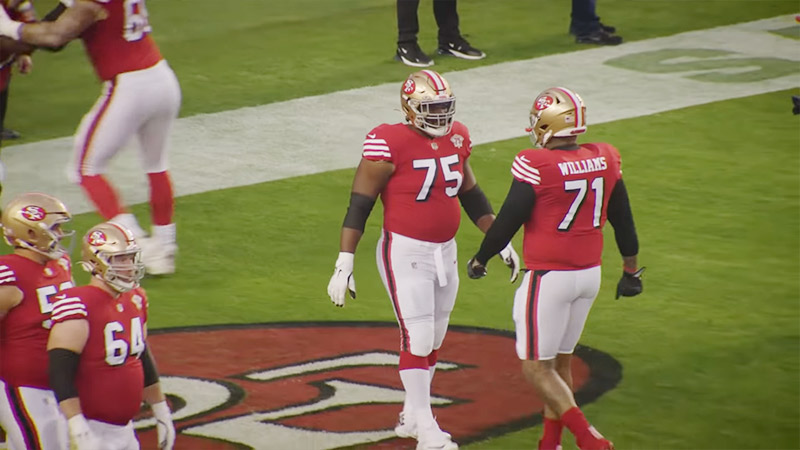
In the run game, Williams is frequently used as a pulling blocker—a role typically reserved for lighter guards.
Watching a player of his dimensions sprint to the perimeter, locate defensive backs in space, and cleanly eliminate them from the play is one of the most remarkable sights in modern sports.
In pass protection, his footwork is so precise and his recovery speed so exceptional that even the league’s fastest edge-rushers find their speed-rushes easily neutralized.
2. Defying Time: The Longevity Anomaly
The NFL is a league designed for rapid physical depreciation. The average career length of an offensive lineman is notoriously short, as the constant high-impact collisions in the trenches take a massive cumulative toll on the joints, spine, and muscles.
Most linemen see their physical skills decline sharply as they enter their early thirties, leading to swift retirements.
Trent Williams, however, continues to defy the biological clock in unprecedented fashion.
The 16-Season Milestone
Williams is currently entering his 16th NFL season. To survive in the trenches for a decade is an impressive achievement; to do so for a decade and a half while maintaining an elite standard of play is nearly miraculous.
At nearly 40 years old, he remains the undisputed anchor of one of the league’s most sophisticated and physically demanding offenses.
| Metric / Aspect | Trent Williams | Typical Veteran Offensive Lineman |
|---|---|---|
| Seasons Active | 16 Seasons | 6–8 Seasons |
| Age | Nearly 40 Years Old | Low-to-Mid 30s (at retirement) |
| All-Pro Selections | Multiple First-Team Honors | Rare / Zero |
| Pro Bowl Berths | 12 Selections | 1–3 Selections |
| Performance Curve | Maintaining Peak Elite Status | Steady Physical Decline |
The Cumulative Toll of the Trenches
Every single offensive play requires a left tackle to absorb and redirect the kinetic energy of defensive linemen who are younger, faster, and highly explosive.
The fact that Williams not only survives these encounters but consistently dominates them at his age speaks to an extraordinary level of physical conditioning, mental resilience, and technical efficiency.
As players age, they must rely increasingly on positioning and intelligence to compensate for any minor loss in raw physical speed.
Because Williams started his career with such an abundance of athletic ability, his natural physical baseline—even when slightly modified by age—remains superior to the vast majority of young tackles entering the league today. When combined with his decades of accumulated football intelligence, he becomes virtually unassailable.
3. The Positional Value Paradigm: Tackles vs. Quarterbacks
If Williams is widely recognized as a peerless talent, why is he not the consensus, undisputed number-one overall player in every single league ranking? The answer does not lie in his performance, but rather in the philosophical debate surrounding positional value.
The Quarterback Monopoly
The primary argument against ranking an offensive tackle as the league’s ultimate player is simple: direct impact per play.
- Quarterbacks like Patrick Mahomes make critical decisions, handle the ball, and directly dictate the outcome of every single offensive snap. They can single-handedly rescue a broken play, convert a third-and-long with an improvised run, or orchestrate a game-winning drive in the final two minutes.
- Pass Rushers like Nick Bosa or Myles Garrett have the ability to instantly alter a game by forcing a strip-sack, generating a safety, or disrupting a quarterback’s rhythm on crucial downs.
By contrast, a left tackle can play a flawless game—executing every block perfectly—and still watch his team lose if the quarterback misreads the coverage or the running back fumbles.
Because a tackle’s contribution is primarily preventative (preventing sacks, preventing tackles for loss) rather than active, traditional evaluation frameworks often treat their contributions as secondary.
The Unseen Enabler of Franchise Assets
This traditional view, however, overlooks a fundamental structural truth: elite quarterback play is a downstream product of elite offensive line play.
A franchise can possess the most talented passer in the world, but if that quarterback is subjected to constant pressure from his blindside, the entire offensive structure collapses.
A defender rushing from the left side of the offensive line attacks the quarterback from an angle he cannot see while preparing to throw.
A failure at left tackle leads to blindside hits, increased turnover risks, and physical injuries that can derail an entire franchise.
By completely securing the left side of the line, Williams does more than block an individual defender.
He provides his coaching staff with the schematic freedom to design deep-developing passing plays without needing to keep extra tight ends or running backs in to help protect.
He allows his quarterback to play with calm pocket presence, secure in the knowledge that his blindside is entirely protected. In essence, Williams is the ultimate insurance policy and force multiplier for every other player on the offense.
4. Resolving the Ranking Disconnect
The tension between Williams’ obvious physical dominance and his actual placement on league-wide lists is best illustrated by his position on the NFL Top 100 Players of 2026.
The Mid-List Paradox
On this highly publicized list, which is voted on by the players themselves, Williams was ranked at No. 40. To the casual observer, ranking 40th out of several hundred active NFL players seems like a glowing endorsement.
However, when evaluated against his true stature as a player who has earned 12 Pro Bowl selections and multiple All-Pro honors, this ranking reveals a clear systemic bias.
The players who vote on these lists are highly aware of Williams’ greatness, yet when forced to rank their peers across all positions, they naturally gravitate toward:
- High-Production Skill Positions: Wide receivers with 1,500-yard seasons, running backs with double-digit touchdowns, and quarterbacks with 4,000 passing yards.
- Impact Defenders: Cornerbacks who lock down half the field and edge-rushers with dominant sack totals.
- Younger Positional Peers: Rising stars who represent the future of their respective positions.
Because a left tackle does not accumulate traditional individual statistics—there are no fantasy football points awarded for a perfectly executed double-team block or a clean pass-protection rep—it is easy for their day-to-day excellence to be underrepresented in cumulative voting charts.
Yet, if you were to ask any of the quarterbacks or coaches who participate in those votes whom they would draft first to protect their franchise’s future, Williams would consistently rank far higher than his official list placement suggests.
5. The Structural Impact on the San Francisco 49ers
To fully appreciate Williams’ value, one must analyze his specific role within the San Francisco 49ers’ offensive system.
Head coach Kyle Shanahan is widely regarded as one of the most innovative offensive minds in football, known for a complex, outside-zone running scheme that requires precise coordination and athletic movement from every player on the field.
The Catalyst for the Outside Zone
In a standard outside-zone running play, the offensive line moves laterally in unison, attempting to stretch the defense horizontally before creating vertical creases for the running back.
For this scheme to succeed, the tackle on the play-side must be able to reach and seal off the outside defensive end—a highly athletic defender who is trying to maintain outside leverage.
Williams is the only tackle in the league who can consistently execute this difficult block without requiring assistance from a tight end. His ability to single-handedly control the edge allows the offense to:
- Create Numbers Advantages: By using Williams to solo-block elite edge defenders, the offense can deploy its tight ends and fullbacks as lead blockers in the second level of the defense, creating massive numbers advantages against linebackers and defensive backs.
- Disguise Formations: The coaching staff does not need to telegraph their run plays by shifting extra blockers to Williams’ side of the formation. They can run with equal effectiveness to either side, keeping opposing defenses entirely off-balance.
The Security Blanket for Brock Purdy
For a young quarterback operating in a high-stakes environment, peace of mind is invaluable.
The presence of Williams on the left side ensures that the pocket remains clean from the blindside, allowing the quarterback to focus his eyes downfield, go through his progressions, and deliver the ball on time.
When Williams has been forced to miss games due to injury, the drop-off in offensive efficiency has historically been stark.
The running game loses its horizontal stretch, the passing game is forced to rely on quicker, shorter throws, and the quarterback is subjected to significantly more physical pressure.
This stark contrast in team performance is perhaps the most definitive evidence of his status as the team’s most indispensable asset.
Conclusion: Recognizing True Greatness
The debate over who is the “best player in the NFL” will always be subjective, heavily influenced by individual biases, highlight-reel plays, and team success.
If the definition of greatness is strictly tied to who has the most direct control over the ball, then an elite quarterback will always claim the crown.
But if greatness is defined as the absolute mastery of one’s position, unmatched physical dominance over opponents, and the ability to elevate the performance of an entire franchise, then Trent Williams has a claim that is as strong as any player in the history of the sport.
For sixteen years, across hundreds of games and thousands of snaps, Williams has stood as an impenetrable wall on the blindside and a devastating force in the run game.
He has redefined what is athletically possible for an offensive lineman and set a benchmark for longevity that may never be matched.
Rather than letting positional bias obscure our evaluation, we should recognize Williams for what he truly is: a historic, generational athlete playing at the absolute peak of his powers, and a strong contender for the title of the most dominant player on the planet.