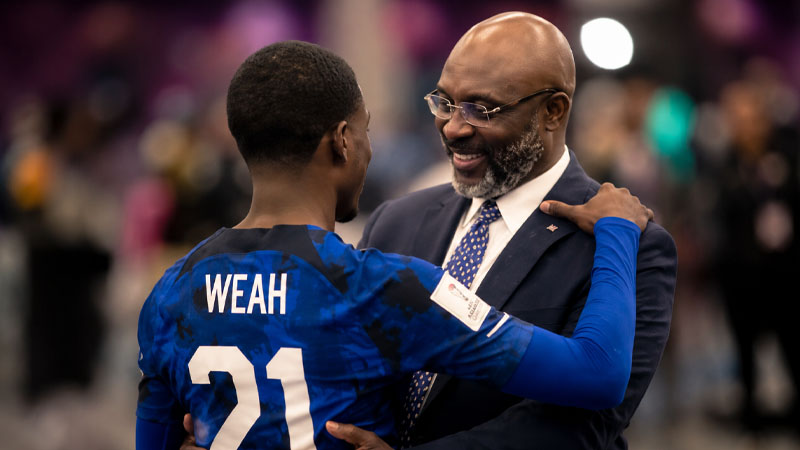
The world of international sports rarely witnesses a lineage as impactful and diverse as that of the Weah family. To answer the most pressing question for soccer enthusiasts: Yes, Timothy Weah is the biological son of George Weah.
This connection is not merely a shared surname but a bridge between two distinct eras of football excellence and two different continents.
While George Weah remains a legendary figure in African and European football history, Timothy has carved out his own prestigious path as a standout player for the United States Men’s National Team (USMNT).
Defining the Relationship: Timothy and George Weah
The relationship between Timothy and George Weah represents a unique cross-generational narrative that links the streets of Monrovia to the pitches of Brooklyn and the grandest stadiums in Europe.
This bond is characterized by a shared athletic prowess, yet it is defined by the vastly different national identities and professional environments each man has navigated during his career.
A Biological Bond with Professional Weight
Timothy was born in Brooklyn, New York, while his father was already established as a global sporting icon.
Growing up as the son of a man who reached the absolute pinnacle of the sport provided Timothy with a unique perspective on the dedication required to succeed at the highest levels of professional soccer.
Despite the immense pressure that often accompanies a famous sporting name, Timothy has frequently spoken about the support and lack of pressure from his father, allowing him to develop his own identity on the field.
The Symbolism of the Weah Name in Global Sport
The “Weah” name carries a weight that transcends goals and assists. It symbolizes a rise from humble beginnings to global leadership, both in athletics and governance.
For George, the name is synonymous with the pride of Liberia and the first African breakthrough in European individual awards.
For Timothy, the name represents the modern, multicultural face of American soccer, demonstrating how the children of global icons are shaping the future of the sport in the United States.
George Weah: The African Icon and Political Leader
George Weah’s career remains the gold standard for African players aspiring to play in Europe’s elite leagues. His journey from the Liberian Premier League to some of the most storied clubs in the world is a testament to his extraordinary talent and resilience.
Beyond the pitch, his transition into the highest level of civil service as the President of Liberia has solidified his status as a truly historical figure.
Achieving Global Dominance in European Football
George Weah’s footballing peak in the mid-1990s is legendary. While playing for elite clubs such as AC Milan and Paris Saint-Germain (PSG), he displayed a combination of speed, power, and technical skill that was ahead of its time.
His most significant individual achievement came in 1995, when he became the first—and to this day, the only—African player to win the Ballon d’Or.
This achievement was a watershed moment for African football, proving that players from the continent could not only compete with but also surpass the best in the world.
A Historic Political Career in Liberia
Following his retirement from professional football, George Weah did not step away from the public eye. Instead, he dedicated himself to the service of his home country.
His political journey culminated in his election as the President of Liberia, a role he held from 2018 to 2024.
This transition from “King George” on the football field to President of a nation is almost unprecedented in modern history, highlighting his deep commitment to his roots and his desire to impact his country’s future beyond the realm of sports.
Timothy Weah: The Modern Face of American Soccer
While he shares his father’s athletic DNA, Timothy Weah has chosen a path that is uniquely his own.
Born in the United States, his decision to represent the USMNT rather than Liberia or France (where he also held eligibility) was a pivotal moment for American soccer.
His career has been marked by a steady rise through elite European academies and a significant role in the resurgence of the U.S. national team on the global stage.
| Aspect | Timothy Weah Details |
|---|---|
| Birthplace | Brooklyn, New York, USA |
| National Team | United States Men’s National Soccer Team (USMNT) |
| Current Club | Olympique de Marseille (French Ligue 1) |
| Primary Position | Winger / Forward |
| Major Achievement | Scored in the 2022 FIFA World Cup |
| Youth Academy | Paris Saint-Germain (PSG) |
Timothy’s development at the PSG academy—a club where his father also excelled—provided him with a world-class foundation.
However, his move to clubs like Lille and eventually Olympique de Marseille shows a player willing to move out of his father’s shadow to prove his worth in one of the world’s most physical and competitive leagues.
Comparing the Two National Team Eras
One of the most fascinating aspects of the Weah family legacy is the contrast in their international experiences.
While George Weah is widely considered one of the greatest players to never play in a FIFA World Cup, Timothy achieved this milestone early in his career, fulfilling a family dream that had remained elusive for decades.
The Significance of the 2022 World Cup
The 2022 FIFA World Cup in Qatar was a definitive moment for the Weah legacy. Representing the United States, Timothy did more than just participate; he became a vital part of the team’s offense.
By scoring a goal for the United States in the tournament, Timothy achieved a massive family milestone that his father never had the opportunity to reach with Liberia.
George Weah was famously in the stands to witness his son score, a moment that many saw as the symbolic completion of the family’s footballing journey.
Tactical Differences in Their Styles of Play
Analyzing their playstyles reveals both similarities and differences. George was a powerful, direct center-forward known for solo runs that could dismantle entire defenses—most famously his coast-to-coast goal for AC Milan against Verona.
In contrast, Timothy often operates as a winger or a wing-back, utilizing his blistering pace and tactical discipline to stretch defenses and provide service from the flanks.
While Timothy may not possess the raw, dominant physicality of his father in his prime, his versatility and modern tactical awareness make him a perfect fit for the high-pressing systems favored by the USMNT and Marseille.
The Cultural Impact of the Weah Name
The story of the Weah family is more than just a sports biography; it is a narrative about the African diaspora and the global nature of modern identity.
The family’s ability to maintain a deep connection to Liberia while successfully integrating into the cultural and sporting fabrics of Europe and the United States provides a roadmap for modern international families.
Representing the African Diaspora
Timothy Weah’s choice to play for the United States is often discussed in the context of the African diaspora. While he is American by birth, his heritage remains central to his public persona.
He represents a generation of athletes who navigate multiple identities with ease, honoring their parents’ origins while fully embracing the country of their birth.
This duality has made him a relatable figure for many young fans in the U.S. who share similar immigrant or multi-national backgrounds.
Leadership On and Off the Pitch
Leadership is a recurring theme in the Weah household. From George’s captaincy of the Liberian national team and his presidency to Timothy’s emerging role as a senior leader within a young USMNT squad, the family emphasizes the importance of responsibility.
Timothy often displays a level of maturity and poise in interviews that belies his age, often attributed to the guidance of his father and his mother, Clar Weah, who has also been a prominent figure in Liberian social initiatives.
Frequently Asked Questions
Is Timothy Weah as good as his father was?
Comparing players across different eras and positions is difficult. George Weah is a Ballon d’Or winner and one of the greatest of all time.
Timothy is a high-level modern professional who has achieved international success his father could not. Both are elite, but George’s individual accolades set a nearly impossible bar.
Why did Timothy Weah choose to play for the U.S. instead of Liberia?
Timothy was born and raised in the United States. He has stated that he feels a deep connection to the U.S. and wanted to help grow the sport in his home country.
While he remains proud of his Liberian heritage, the U.S. offered a clearer path to major international tournaments like the World Cup.
What club does Timothy Weah play for now?
As of the most recent updates, Timothy Weah plays for Olympique de Marseille in France’s Ligue 1. He previously had successful stints at Lille and Paris Saint-Germain.
Did George Weah ever coach his son?
While George has likely provided mentorship and advice throughout Timothy’s life, he has never served as his formal coach in a professional or organized youth capacity.
Their relationship has remained focused on the father-son dynamic rather than a player-coach relationship.
Conclusion: A Dynasty That Continues to Evolve
The Weah dynasty is a remarkable chronicle of talent, ambition, and national pride.
From George Weah’s historic rise to the top of European football and the presidency of Liberia to Timothy Weah’s emergence as a key figure in the future of American soccer, the family has left an indelible mark on the sport.
Timothy’s goal in the 2022 World Cup served as a poignant reminder that while he carries his father’s name, he is busy writing his own history.
As he continues his career in Ligue 1 and prepares for future international challenges, the legacy of the Weah name is in capable hands, ensuring that this footballing royalty will be celebrated for generations to come.