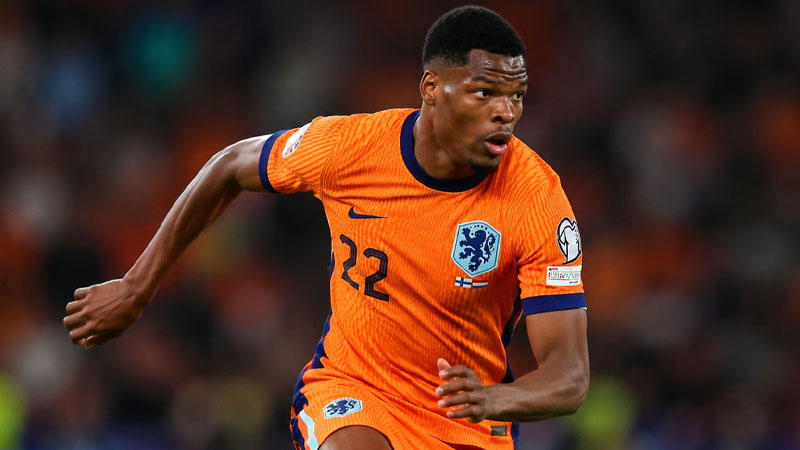
Denzel Dumfries has defied conventional footballing wisdom to become one of the most effective wing-backs in the modern game.
His recent high-profile €20 million transfer to Real Madrid, following a career-defining stint at Inter Milan, serves as the ultimate validation of his unique profile.
While critics often point to his lack of technical elegance compared to peers like João Cancelo, his statistical output and physical dominance tell a different story of elite-level success.
From his humble beginnings in non-league football to starring on the global stage at the 2026 FIFA World Cup, Dumfries represents the pinnacle of specialized athletic excellence in modern tactics.
From Non-League to Real Madrid: The Meteoric Rise
The journey of Denzel Dumfries is frequently cited as one of the most inspiring “late bloomer” narratives in European football.
Unlike many of his peers who were refined in prestigious academies from a young age, Dumfries was still playing for the amateur side Barendrecht just a decade before reaching the summit of the sport.
This non-traditional path has instilled in him a relentless work ethic and a “god-like” mentality that many observers believe is his greatest asset on the pitch.
The Amateur Beginnings at Barendrecht
The narrative of Dumfries playing at the Barendrecht stadium just ten years ago is now a part of Dutch football folklore.
His transition from amateur levels to Sparta Rotterdam in 2014 marked the beginning of a steady, vertical climb through the ranks of professional football.
Even during his early days at Sparta, some scouts noted his potential to quickly reach the national team due to his raw physical gifts and determination.
This period was foundational, allowing him to develop the “target-man” physicality that would later make him a nightmare for elite European defenders.
Dominating the Eredivisie and Serie A
After establishing himself at Sparta, Dumfries made significant jumps to Heerenveen and then PSV Eindhoven, where his offensive output from the right-back position began to draw international attention.
His move to Inter Milan in 2021 was the turning point that refined his game within a world-class tactical system.
At Inter, he matured into a 3-5-2 specialist, contributing to a Serie A title and multiple domestic cups while proving he could perform in the highest-pressure environments, including the Champions League.
This consistent growth culminated in the 2026 announcement that Real Madrid had triggered his release clause to secure his services until 2030.
Statistical Breakdown: A Career of Unrivaled Output
To understand how good Denzel Dumfries truly is, one must look past aesthetic “clumsiness” and focus on the cold, hard data of his contributions.
As of June 2026, he has accumulated over 430 career appearances, logging a remarkable 50+ goals and 65+ assists from defensive positions.
These numbers are largely unheard of for traditional fullbacks and rival the output of many dedicated wingers. His 2024/2025 campaign stands as a testament to his peak efficiency, where he recorded 16 total goal contributions across 44 appearances.
Career Milestones and Performance Data
The following data highlights his productivity across different stages of his career and his impact on the international stage.
| Competition / Team | Period / Season | Appearances | Goals | Assists | Key Achievements |
|---|---|---|---|---|---|
| Sparta Rotterdam | 2014–2017 | 72 | 2 | 4 | Eerste Divisie Title |
| PSV Eindhoven | 2018–2021 | 124 | 16 | 20 | Consistent UCL Threat |
| Inter Milan | 2021–2026 | ~200 | 22 | 24 | Serie A, 2x Coppa Italia |
| Netherlands (Intl) | 2018–2026 | 60+ | 8 | 17 | Indispensable Starter |
| Peak Season | 2024/2025 | 44 | 11 | 5 | 16 Goal Contributions |
| World Cup 2026 | Ongoing | 2 | 0 | 2 | Masterclass vs Sweden |
Tactical Analysis: The Ultimate Wing-Back “Cheat Code”
Dumfries is often described as a “specialist” rather than a generalist, meaning his effectiveness is heavily tied to the tactical system in which he operates.
He is not a player you ask to play a conservative, stay-at-home defensive role; rather, he is a weapon intended to unbalance the opposition through sheer force and verticality.
His 6’2″ frame and aerial prowess allow him to function as a back-post target man, a tactic that has become a staple for both Inter Milan and the Dutch national team.
The 3-5-2 Specialist vs. The Back-Four Fullback
There is a consensus among tactical analysts and fans alike that Dumfries reaches his world-class potential primarily within a five-man defensive structure.
In a 3-5-2 or 5-3-2, his defensive responsibilities are mitigated by a covering center-back, allowing him to occupy high positions that exploit his offensive instincts.
Some critics argue that in a traditional back-four, his defensive positioning can be suspect, as he often leaves vast pockets of space behind him during his frequent forays forward.
However, when used as a wing-back, he is arguably among the top five players in the world in his position.
Physical Dominance as a Tactical Weapon
Standing at 188 cm (6’2″), Dumfries possesses physical traits that set him apart from the average right-back.
He uses his immense power to muscle opponents off the ball and dominate aerial duels, frequently outleaping smaller left-backs at the far post to score or provide headed assists.
This physicality also makes him an elite counter-attacking threat; his long strides and relentless stamina allow him to transition from defense to attack at a pace that few can match.
Managers like Ronald Koeman have built entire tactical frameworks around this ability, utilizing his power to break deadlocks against teams that sit in a deep block.
Big-Game Mentality and the 2026 World Cup Impact
One of the most defining characteristics of Dumfries is his ability to elevate his performance on the grandest stages.
He has repeatedly silenced doubters who questioned his technical level by delivering match-winning performances in the Champions League and international tournaments.
His “big-game” reputation was further solidified during the ongoing 2026 FIFA World Cup, where he helped orchestrate a dominant 5-1 victory over Sweden with two crucial assists.
The Netherlands’ Strategic Weapon
For the Dutch national team, Dumfries has been a consistent performer for years, often being their most reliable threat in major tournaments. Even when the team struggles for rhythm, his high-intensity mentality drives the group forward.
There was significant debate during previous championships regarding whether Jeremie Frimpong or Dumfries should start at right-back, but Dumfries’ superior physicality and experience in a wing-back role often made him the preferred choice for knockout football.
His presence gives the “Oranje” a personality and character that technical ability alone cannot provide.
Clutch Performances on the Global Stage
Dumfries’ impact is perhaps best illustrated by his “otherworldly” performances against top-tier opposition like Barcelona in the Champions League.
His ability to exploit an offside trap and run into open space has made him a specific nightmare for teams that play a high defensive line.
While some suggest he needs space to be effective, his track record of delivering in semi-finals and finals suggests a psychological resilience that transcends tactical limitations.
This mentality is exactly why elite clubs like Real Madrid were willing to trigger his release clause even as he entered his 30s.
Addressing the Technical Paradox: Power vs. Finesse
A frequent point of discussion among football enthusiasts is the apparent “clumsiness” of Dumfries’ technique. Compared to a player like Trent Alexander-Arnold, Dumfries can look heavy-handed—or rather, “heavy-footed”—in his short passing and dribbling.
However, focusing solely on technical finesse misses the broader impact he has on a match. He masters certain aspects of the game at a world-class level, making him a “specialist” whose strengths far outweigh his aesthetic shortcomings.
- Elite Offense: Functions more like a traditional winger, providing consistent goal-scoring and assist threats from deep.
- Physical Dominance: Uses his 6’2″ frame to act as a target-man on set pieces and crosses.
- Work Rate: Possesses an unyielding stamina that allows him to influence both ends of the pitch for 90 minutes.
- Technical Refinement: His first touch and short-range passing can be inconsistent, leading to occasional turnovers.
- Defensive Positioning: His offensive focus can leave gaps behind him, requiring specific tactical coverage from teammates.
- Tackling Finesse: Relies more on strength and body positioning than clean sliding challenges, which can result in fouls.
The Final Verdict: Ranking Dumfries Among the Greats
When discussing where Dumfries stands in the hierarchy of modern right-backs, it is essential to distinguish between a “right-back” and a “wing-back.”
While players like Achraf Hakimi or Jules Koundé might offer more defensive stability or creative passing in a back four, few can match Dumfries’ raw goal-threat and physical presence as a wing-back.
Some fans even argue he is the best Dutch right-back of the 21st century, surpassing modern rivals and potentially rivaling historical legends like Berry van Aerle.
Comparison with Modern Rivals
Comparing Dumfries to players like Trent Alexander-Arnold or Jeremie Frimpong highlights the diversity of the modern fullback role.
Alexander-Arnold is a playmaker stationed on the right, whereas Dumfries is a physical force intended to finish or create direct goal-scoring opportunities in the box.
While he might not be the “number one” right-back in the world—a title often reserved for Hakimi—he is undisputed in the top tier of specialists who can transform a team’s attacking dynamic.
Is He the Best Dutch Right-Back Ever?
The debate over whether Dumfries is the greatest Dutch right-back in history is ongoing. His supporters point to his consistent performance for the national team and his success in Serie A and the Champions League.
While legends like Berry van Aerle are respected for their longevity and defensive reliability, Dumfries’ offensive numbers are objectively superior.
Whether or not he holds the “all-time” crown, he has undoubtedly been the most impactful player in that position for the Netherlands in the last two decades.
Frequently Asked Questions (FAQ)
Is Denzel Dumfries world-class?
Yes, particularly when deployed as a wing-back in a 3-5-2 or 5-3-2 system. His physical traits and goal contributions place him in the elite bracket for his specific role.
Why did Real Madrid sign Denzel Dumfries?
Real Madrid activated his €20 million release clause to secure a physically dominant, big-game performer who provides a unique offensive dimension from the right flank.
Is he better than Jeremie Frimpong?
This depends on the system. Frimpong is often seen as more technically gifted in tight spaces, while Dumfries offers superior aerial ability, physical presence, and experience in high-stakes international tournaments.
How many goals has Denzel Dumfries scored in his career?
As of mid-2026, he has scored over 50 career goals across his club and international matches, a remarkably high tally for a defensive-minded player.
Can Denzel Dumfries play in a back-four defense?
While he can play there, his strengths are best utilized when he has the freedom to move forward. In a back-four, he requires more tactical discipline and can sometimes be caught out of position.
Conclusion
Denzel Dumfries is a testament to the power of specialization and mentality in professional football.
He has proven that elite success does not always require the most refined technical touch if it is replaced by world-class physicality, intelligence in the final third, and an unyielding will to win.
His move to Real Madrid marks the final step in a journey that began in the amateur leagues and has seen him become one of the most feared wing-backs in Europe.
For any manager looking for a tactical “cheat code” to break down stubborn defenses, Dumfries remains one of the most valuable assets in the world of football.