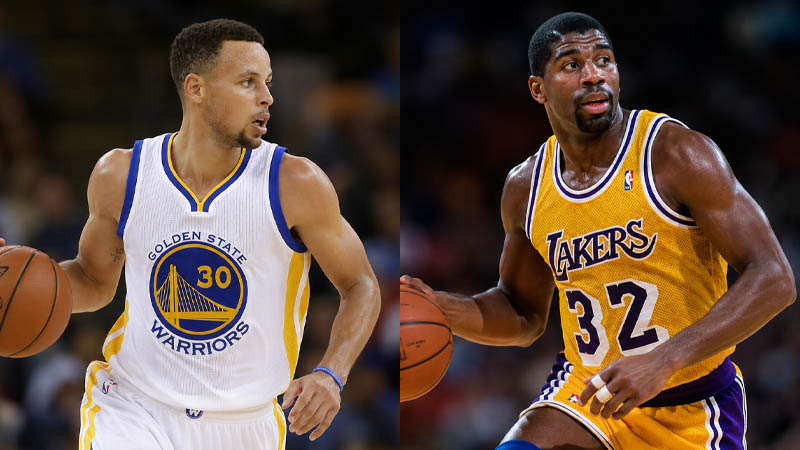
The debate over the greatest point guard in NBA history often centers on two icons: Earvin “Magic” Johnson and Stephen Curry. Magic defined the 1980s with his “Showtime” Lakers, utilizing unmatched size and vision to orchestrate an elite offense.
Conversely, Stephen Curry revolutionized the modern era, using unprecedented shooting range to bend defensive schemes to their breaking point.
While Magic holds the traditional edge in championships and playmaking metrics, Curry’s individual offensive dominance and “gravity” have forced fans to rethink the position’s ceiling.
This analytical deep dive explores their careers, stats, and legacies to determine who truly reigns supreme.
Career Accolades: The Standard of Greatness
When evaluating the “greatest” of all time, the trophy case is often the primary metric for success. Magic Johnson’s resume remains the historical benchmark for postseason achievement and leadership.
| Achievement | Magic Johnson | Stephen Curry |
|---|---|---|
| NBA Championships | 5 | 4 |
| MVP Awards | 3 | 2 |
| Finals MVP Awards | 3 | 1 |
| All-NBA Selections | 10 | 11 |
| All-Star Selections | 12 | 12 |
The Championship Gap
Magic Johnson currently holds the advantage in the most critical category: championships. With five NBA titles compared to Curry’s four, Magic’s ability to lead his team to the summit remains a significant pillar of his argument.
Magic reached the NBA Finals an incredible nine times in just thirteen seasons, establishing an instant winning culture from the moment he entered the league as a rookie.
Individual Honors and MVP Pedigree
Magic also leads in the count of major individual awards, possessing three regular-season MVPs and three Finals MVPs. However, Stephen Curry’s accolades carry unique weight.
Curry holds the distinction of being the only player in NBA history to win the regular-season MVP award by a completely unanimous vote, a feat achieved during his historic 2016 campaign.
While Magic has more total Finals MVPs, Curry’s impact on winning is often viewed through the lens of offensive transformation rather than just individual trophies.
The Case for Magic Johnson: A Playmaking Masterclass
Magic Johnson is widely regarded as the “gold standard” for the traditional point guard position. At 6-foot-9, he possessed elite size that allowed him to see over defenses and control the game’s tempo with unparalleled precision.
Historical Distribution and Vision
Magic’s primary claim to greatness is his playmaking mastery. He holds the highest career assist average in NBA history, recording 11.2 assists per game throughout his regular-season career.
His vision allowed the Lakers to run a fast-break offense that became the envy of the league, earning the moniker “Showtime.”
Unmatched Positional Versatility
Because of his physical profile, Magic was far more than just a passer. He was an elite rebounder, averaging 7.2 rebounds per game, and a constant triple-double threat.
His versatility was famously showcased during his rookie season when he started at center in the NBA Finals, demonstrating an ability to fill any role required for his team to succeed.
Defensive Presence and Longevity
While Curry is often criticized for his defensive limitations, Magic utilized his length to disrupt passing lanes. He led the league in steals twice and maintained a career average of 1.9 steals per game.
Magic’s career was unfortunately shortened to thirteen seasons, yet his total impact during that window remains one of the most concentrated periods of dominance in sports history.
The Case for Stephen Curry: Redefining Offensive Gravity
If Magic is the ultimate floor general, Stephen Curry is the ultimate offensive weapon. Curry revolutionized how modern basketball is played through his long-range shooting, moving the game’s focus from the paint to the perimeter.
Elite Scoring and Shooting Efficiency
Curry scores at a significantly higher volume than Magic, maintaining a career average of 24.8 points per game compared to Magic’s 19.5. He achieved this while maintaining historic efficiency, becoming a leader of the exclusive 50-40-90 shooting club.
His career 3-point percentage of 42.2% is vastly superior to Magic’s 30.3%, highlighting the shift in how the point guard position contributes to scoring in the modern era.
The Phenomenon of Off-Ball Gravity
Perhaps Curry’s greatest contribution is his “gravity.” Unlike traditional playmakers who require the ball to dominate, Curry’s relentless movement without the ball completely breaks opposing defensive schemes.
Defenders are forced to shadow him far beyond the three-point line, which opens up the floor for his teammates and creates high-value opportunities even when Curry doesn’t touch the ball.
Statistical Dominance in the Modern Era
Curry has played more seasons (17) and more total games (1,069) than Magic, allowing him to amass a much higher total point count of 26,528. His prowess at the free-throw line is also statistically superior, with a career percentage of 91.2% compared to Magic’s 84.8%.
Statistical Deep Dive: Regular Season Performance
When comparing the two stars side-by-side in the regular season, the data reveals two vastly different styles of play. Magic excels in the “all-around” categories, while Curry dominates in scoring and shooting metrics.
| Metric (Career Avg) | Stephen Curry | Magic Johnson |
|---|---|---|
| Points Per Game | 24.8 | 19.5 |
| Rebounds Per Game | 4.7 | 7.2 |
| Assists Per Game | 6.3 | 11.2 |
| Steals Per Game | 1.5 | 1.9 |
| Field Goal % | .471 | .520 |
| 3-Point % | .422 | .303 |
The Playmaking vs. Scoring Trade-off
The numbers confirm that Magic was nearly twice as productive as a facilitator, averaging 11.2 assists per game to Curry’s 6.3.
Conversely, Curry is the more potent scorer, with his best season seeing him average 32.0 points per game, whereas Magic’s peak scoring season reached 23.9 points.
This statistical split defines the core of the debate: do you prefer the player who sets the table or the player who finishes the play?
Rebounding and Defensive Totals
Magic’s size advantage is reflected clearly in the rebounding totals. He finished his career with 6,559 total rebounds, while Curry currently sits at 4,973.
Defensively, Magic also holds the edge in total steals (1,724 to 1,602) and total blocks (374 to 282), suggesting that despite the different eras, Magic’s physical presence was more disruptive on the defensive end.
Postseason Analysis: Who Rises to the Occasion?
The playoffs are where legacies are truly forged. Both players have been exceptional in high-stakes environments, but their statistical profiles shift slightly when the pressure intensifies.
Postseason Scoring Power
Curry’s scoring actually increases in the postseason, where he averages 26.8 points per game. This illustrates his ability to carry an offensive load against elite, focused defenses.
Magic Johnson’s scoring remains consistent with his regular-season average at 19.5 points per game, as he continues to prioritize distribution. Curry has also accumulated more total playoff points (4,147) than Magic (3,701), despite playing in fewer playoff games.
Playoff Orchestration and Efficiency
Magic Johnson’s assist average rises to 12.3 per game in the playoffs, further cementing his status as the greatest postseason floor general.
In terms of shooting efficiency during the playoffs, Curry maintains his perimeter dominance with a 39.7% three-point average, while Magic’s career playoff average from deep was just 24.1%.
However, Magic was more efficient from the field overall, shooting 50.6% compared to Curry’s 45.4% in the postseason.
Total Playoff Impact
Magic’s total playoff rebounds (1,465) and assists (2,346) are significantly higher than Curry’s (828 and 953), highlighting his role as a triple-double threat in the chase for a championship.
Magic played in 190 playoff games compared to Curry’s 155, giving him more opportunities to build his postseason legend.
FAQ: Addressing the Greatest Point Guard Debate
Who is the better defender, Magic or Curry?
Statistically, Magic Johnson has the edge in steals and blocks per game, as well as total career numbers in those categories. His 6-foot-9 frame allowed him to guard multiple positions more effectively than Curry, who is often hidden on the opposing team’s weakest offensive player.
Does Curry’s unanimous MVP make him better?
It is a strong argument for his peak dominance. Winning a unanimous MVP indicates that, for at least one season, there was no doubt who the most impactful player in the league was. However, Magic’s consistency in winning three MVPs over a decade is equally impressive.
How does “gravity” affect the stats?
“Gravity” is a metric that doesn’t show up in a traditional box score. While Magic’s assists are a direct measure of his impact, Curry’s ability to draw two defenders away from the basket creates “hockey assists” or open lanes that aren’t credited to him, yet are vital to his team’s success.
Who had the better peak?
Magic’s peak involved reaching the Finals nearly every year he was healthy. Curry’s peak involved the 73-win season and the greatest shooting display in history. The choice depends on whether you value team orchestration or individual offensive explosion.
Conclusion: The Final Verdict on the PG GOAT
Choosing between Stephen Curry and Magic Johnson requires defining what a point guard should be. If the role is defined by traditional orchestration, passing, and managing the game’s tempo, Magic Johnson remains unmatched.
His five championships, three Finals MVPs, and record-setting assist averages make him the ultimate floor general.
However, if the criteria for “better” focuses on individual offensive force, perimeter spacing, and the ability to revolutionize the sport, Stephen Curry has a compelling case. He is the greatest shooter to ever live, and his “gravity” has fundamentally changed how teams defend.
Ultimately, Magic holds the edge in career accolades and traditional point guard duties, while Curry reigns supreme as the most dominant offensive engine to ever play the position.