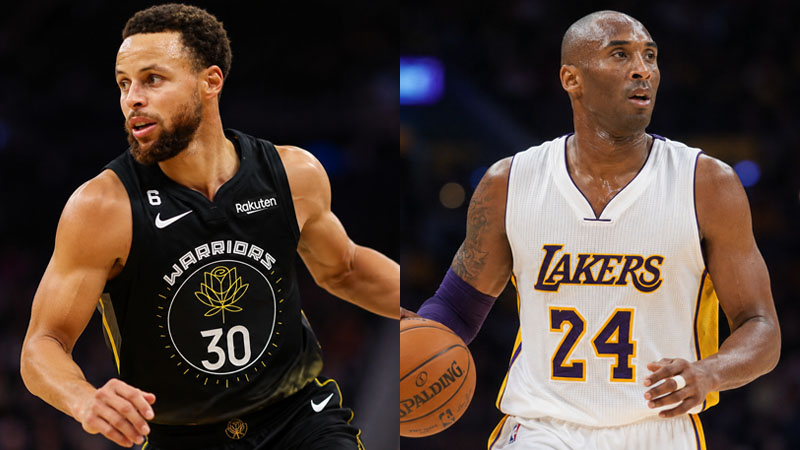
The debate between Kobe Bryant and Stephen Curry is more than a comparison of two legends; it is a clash between two distinct basketball philosophies.
On one side, you have the “Mamba Mentality”—a symbol of physical two-way dominance and individual scoring prowess that defined the post-Jordan era.
On the other, you have the greatest shooter in history, a player whose “gravity” and efficiency sparked an offensive revolution that fundamentally changed how the game is played globally.
Deciding who is better requires weighing traditional accolades and defensive excellence against history-defining metrics and team-wide impact.
The Resume Comparison: Accolades and Hardware
To understand the scope of this debate, we must first look at the raw data. Both players possess resumes that place them firmly in the pantheon of the sport’s greatest icons. However, the nature of their achievements varies significantly, reflecting their different roles and eras.
| Category | Kobe Bryant | Stephen Curry |
|---|---|---|
| NBA Championships | 5 (2000, 2001, 2002, 2009, 2010) | 4 (2015, 2017, 2018, 2022) |
| Finals MVPs | 2 | 1 |
| Regular Season MVPs | 1 (2008) | 2 (2015, 2016 – Unanimous) |
| All-NBA Selections | 15 (11x First Team) | 11 (4x First Team) |
| All-Defensive Selections | 12 (9x First Team) | 0 |
| Scoring Titles | 2 | 2 |
| Career PPG | 25.0 | 24.8 |
| Career FG% / 3PT% | 44.7% / 32.9% | 47.3% / 42.5% |
The data shows a clear divide: Bryant leads in total hardware and defensive recognition, while Curry maintains a significant edge in shooting efficiency and advanced impact metrics.
The Case for Kobe Bryant: The Ultimate Two-Way Competitor
Kobe Bryant’s legacy is built on the foundation of being a complete, two-way force. For nearly two decades, he was not only the most feared scorer in the league but also one of its most tenacious defenders. This dual-threat capability is the primary argument for those who rank him above Curry.
Elite Perimeter Defense and Versatility
One of the most glaring statistical differences between the two is on the defensive end. Bryant’s 12 All-Defensive selections tie him for the second-most in NBA history. He was a lockdown “point-of-attack” defender who could neutralize the opposing team’s best player.
In contrast, Curry has zero All-Defensive selections and has often been “hidden” on the defensive end to preserve his energy for offense.
For traditionalists, a player who dominates both sides of the ball is inherently more valuable than a specialist, even if that specialist is the greatest shooter ever.
Mastery of the Physical Era
Bryant played a significant portion of his career in a slower, more physical era where hand-checking was prevalent and the lane was often clogged. His ability to create a high-quality shot out of nothing against double and triple teams remains legendary.
While Curry’s efficiency is higher, proponents of Bryant argue that Kobe’s scoring volume and his ability to carry an offense during the “dead ball” era of the early 2000s required a level of individual shot-making that Curry rarely has to replicate in the modern, space-oriented NBA.
Unmatched Peak Longevity
Bryant’s ability to maintain a top-tier superstar presence for twenty years is nearly unrivaled. His 15 All-NBA honors (including 11 First Team selections) demonstrate a level of consistent excellence across multiple generations of players.
He successfully bridged the gap from the Shaq era to a second championship window with Pau Gasol, proving he could win as both a secondary force and the undisputed lead option.
The Case for Stephen Curry: The Offensive Revolution
While Bryant represents the pinnacle of the traditional shooting guard, Stephen Curry represents a paradigm shift. He didn’t just play the game; he changed the geometry of the court. His impact is often measured not just by his own stats, but by how he elevates his teammates.
Efficiency That Defies Logic
Stephen Curry is significantly more efficient than Bryant. While their career scoring averages are remarkably similar (25.0 vs 24.8), the way they arrive at those numbers is vastly different.
Curry’s shooting percentages from 2-point range, 3-point range, and the free-throw line all eclipse Bryant’s.
According to advanced metrics like TS Added (true shooting points added above league average), Curry’s 2016 season ranks as one of the best in history, while Bryant’s best seasons fall significantly behind in terms of cumulative efficiency.
The Power of Offensive Gravity
Curry’s greatest weapon isn’t just his shot; it’s his “gravity.” Because he is a threat to score from 35 feet, defenses are forced to track him the moment he crosses half-court.
This “warps” the floor, creating massive lanes and open opportunities for his teammates—even when Curry doesn’t have the ball.
This off-ball impact is a key reason why many modern analysts prefer Curry; he makes the game easier for everyone else on the floor in a way that Bryant’s isolation-heavy style rarely did.
Historical Team Success
Curry led a dynasty that achieved the greatest regular-season record in NBA history (73-9) and secured the league’s only unanimous MVP award.
Analysts point out that Curry’s impact on winning is often more pronounced in advanced stats like RAPM (Regularized Adjusted Plus-Minus).
For example, during the 2016 season, the Warriors performed like a lottery team when Curry was off the floor but were historically dominant when he was on it. This suggests that Curry’s presence alone is enough to transform a roster’s ceiling.
The Generational Divide and Scouting the “Eye Test”
The debate between these two often falls along generational lines. For those who grew up in the 2000s, Bryant was the gold standard—the “next Jordan” who personified the grind and the competitive fire of the game.
The 2000s Perspective: Individual Heroics
To fans of the 2000s, Kobe was the ultimate “hooper.” He was the player you wanted taking the final shot, regardless of the degree of difficulty.
His legacy is tied to the “eye test”—the visible intensity, the footwork, and the mid-range mastery that seemed to defy the defense. To this group, the “analytics” used to boost Curry feel like an incomplete way of measuring a player’s true “greatness” or heart.
The Modern Era: Impact Over Aesthetics
Younger fans and data-driven analysts argue that the “eye test” is often biased toward difficult shots rather than effective ones.
They contend that Curry’s ability to win 73 games and four titles while being the primary engine of the offense is more impressive than Bryant’s defensive accolades.
From this perspective, Curry’s revolution of the three-point shot makes him a more influential historical figure than Bryant, who was seen by some as a highly refined version of Michael Jordan rather than a new archetype entirely.
Tactical Hypotheticals: The Shaq Factor
One of the most intriguing “what-if” scenarios in NBA history involves how Curry would have fared with a teammate like Shaquille O’Neal. Some fans believe that Curry and Shaq would have been an even more lethal combination than Kobe and Shaq.
The logic is that Curry’s outside shooting would have provided Shaq with unprecedented space in the paint, while Shaq’s dominance inside would have prevented teams from double-teaming Curry on the perimeter.
Furthermore, some suggest that Curry’s more selfless, “team-first” personality might have avoided the ego clashes that eventually led to the breakup of the Kobe-Shaq Lakers.
If Curry could have won more with Shaq than Kobe did, does that make him the better player? It is a question that fuels endless debate but remains impossible to answer definitively.
Enhanced FAQ: Settling the Score
Who is statistically better, Kobe or Steph?
It depends on the metric. Kobe has more total points and significantly more defensive accolades (12 All-Defensive teams vs 0 for Curry). However, Curry is much more efficient, with higher shooting percentages and superior advanced metrics like TS Added and RAPM.
Does Kobe Bryant’s defense make him better?
For many, yes. Being an elite defender for over a decade is a massive structural advantage. However, Curry’s supporters argue that his offensive “gravity” is so game-breaking that it outweighs the defensive gap.
Who changed the game of basketball more?
Stephen Curry is widely credited with the “three-point revolution.” He changed how the game is coached and played at every level. Kobe influenced a generation through his “Mamba Mentality” and work ethic, but Curry changed the actual mechanics of the sport.
Why do some people rank Curry higher than Kobe?
Modern analysts often point to Curry’s role as the leader of a 73-win team, his unanimous MVP, and his superior ability to make teammates better through floor spacing and playmaking.
Final Thoughts: A Philosophical Choice
Ultimately, choosing between Kobe Bryant and Stephen Curry is a matter of basketball philosophy.
If you value a player who can dominate the game on both ends of the floor, who relishes physical confrontation, and who possesses the longevity to remain a superstar for twenty years, Kobe Bryant is your choice. He is the personification of individual greatness and competitive will.
If you prioritize a player who maximizes his team’s offensive ceiling, who provides the most efficient scoring in history, and who “warps” the entire court just by stepping onto it, Stephen Curry holds the upper hand. He is the engine of the most successful modern dynasty and the greatest shooter to ever live.
Both are anomalies. Both are legends. Whether you prefer the “Mamba” or “Chef Curry,” their impact on the game of basketball is indelible and beyond reproach.