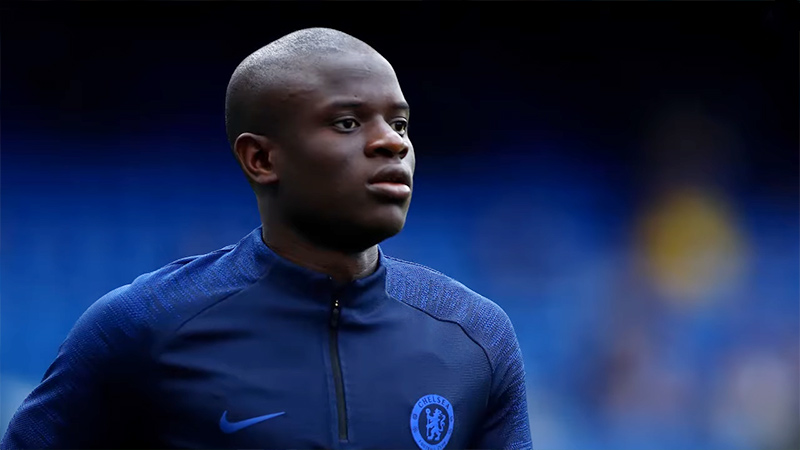
In the complex landscape of elite football, few players have challenged traditional positional theory as profoundly as N’Golo Kanté.
For over a decade, fans, analysts, and gamers have grappled with a singular question that defines the evolution of the sport: Is N’Golo Kanté truly a Central Defensive Midfielder (CDM)?
While the official paperwork and digital databases offer a straightforward answer, the reality on the pitch is far more nuanced.
To understand Kanté is to understand the shift from static positional play to dynamic, space-oriented roles. This analysis deconstructs the tactical profile of a player who redefined the engine room of world-class teams.
The Official Designation: A Foundation in Data
If you look at the primary databases that govern footballing intelligence, the answer seems settled. On football profile platforms such as Transfermarkt, Kanté is officially classified as a Central Defensive Midfielder.
This designation is mirrored in the digital realm; in EA SPORTS FC 26, his base card is primarily listed as a CDM with an 85 overall rating.
However, these labels are often more about organizational convenience than tactical reality. While he possesses the world-class defensive metrics required of the role—specifically in interceptions and successful tackles—his heat maps tell a different story.
He is not a player who stays in a designated zone; he is a player who governs the entire field.
Beyond the Anchor: The Myth of the Stationary Pivot
The most common misconception regarding the CDM position is the “lone pivot” or “anchor” role. Traditionally, a CDM is expected to sit directly in front of the center-backs, acting as a shield and a primary distributor from deep.
Tactical experts emphasize that Kanté is rarely a traditional, stationary anchor. He lacks the physical profile of a classic “destroyer” who wins aerial duels and occupies a fixed space.
Instead, his defensive utility comes from movement. He does not wait for the opposition to reach him; he hunts the ball across the middle third.
By refusing to sit strictly in front of the center-backs, Kanté creates a defensive presence that is proactive rather than reactive. He relies on anticipation rather than just physical imposition, allowing him to snuff out danger before it enters the final third.
The Engine Room: The Box-to-Box Evolution
If Kanté is not a traditional CDM, what is he? Analysts increasingly categorize him as a “Box-to-Box Engine”. His legendary stamina is not merely a physical attribute; it is a tactical weapon that allows him to roam the pitch relentlessly.
His role encompasses three distinct phases of play:
- The Press: Utilizing his mobility to disrupt the opponent’s build-up.
- The Interception: Reading passing lanes to regain possession in central areas.
- The Transition: Instantly driving the ball forward into the attacking third once possession is secured.
This third phase is where the “CDM” label truly fails to capture his impact. A traditional holding player often recycles possession to a more creative teammate. Kanté, however, frequently initiates the attack himself, using his “Rapid” movement to bypass midfields and put his team on the front foot.
The Synergy of the Double Pivot
A critical look at Kanté’s most successful periods—winning the Premier League with Leicester City and Chelsea, and the World Cup with France—reveals a consistent tactical pattern. He has almost always operated within a double pivot.
He has historically thrived when paired with a more traditional holding midfielder who provides the structural discipline he needs to roam. Notable partners include:
- Nemanja Matić: Provided the height and defensive stability at Chelsea.
- Jorginho: Offered the metronomic passing and positional discipline that allowed Kanté to press higher.
- Paul Pogba: For the French national team, Pogba’s physical presence and long-range passing complemented Kanté’s high-intensity coverage.
In this setup, Kanté is freed from the burden of being the “lone pivot.” The presence of a dedicated holding partner unlocks his ability to act as a disruptive force, knowing the space behind him is protected. This partnership is the “cheat code” for his efficiency; without a disciplined partner, his roaming nature can occasionally leave gaps in the defensive line.
Digital Intelligence: Kanté in EA SPORTS FC 26
For the gaming community, understanding Kanté’s role is essential for team chemistry and tactical success. His profile in EA SPORTS FC 26 perfectly captures the duality of his real-world style.
Key Performance Indicators
- Overall Rating: 85.
- Primary Position: CDM (with CM capabilities).
- PlayStyle – Relentless: This reflects his real-world ability to maintain high intensity for the full 90 minutes, allowing him to press without exhausting his stamina reserves mid-match.
- PlayStyle – Rapid: This emphasizes his acceleration when transitioning from defense to attack, a core component of his “Box-to-Box” utility.
Tactical Familiarity
The game categorizes his role familiarity into three distinct types: Box Crasher, Holding, and Playmaker. This variety confirms that he is not a one-dimensional player. While he can play the “Holding” role, he is arguably more effective as a “Box Crasher” or “Playmaker,” where his mobility and transition skills are maximized.
Strategic Implementation: How to Use the Engine
To get the most out of a player like Kanté—whether on a tactical whiteboard or a gaming console—one must lean into his versatility.
1. Avoid the Lone Pivot Setup
Using him as a single defensive midfielder can be risky. His instinct is to move toward the ball, which can leave the central defense exposed if there isn’t a secondary midfielder to cover the vacated space.
2. Maximize the Transition
The moment he wins the ball is the moment the opposition is most vulnerable. Because he possesses “Rapid” traits, he can move the ball into the final third before the opposing defense can reorganize.
3. The Pressing Trigger
He should be the “trigger” for a team’s press. His ability to intercept passes means he can be positioned slightly higher up the pitch to disrupt the opponent’s initial build-up play, rather than waiting for them to reach the defensive third.
The Final Verdict: A Hybrid for the Modern Era
Is N’Golo Kanté a CDM? Technically, yes. But practically, he is a Central Defensive Hybrid. He takes the defensive responsibilities of a CDM and marries them to the physical output and transition speed of a world-class Box-to-Box midfielder.
He represents a shift in footballing philosophy where “positions” are being replaced by “roles.” He is not defined by where he starts on the pitch, but by the influence he exerts over every blade of grass.
For any team looking to dominate the middle of the park, the Kanté model—a high-stamina, high-intellect engine operating within a supportive double pivot—remains the gold standard of modern tactical design.
Common Queries Regarding Tactical Roles
Does Kanté work as a lone defensive midfielder?
While he has the skill to play there, it is not his optimal role. He is most effective in a double pivot where he has the freedom to roam and intercept while a partner maintains the defensive shape.
What makes him different from a player like Rodri or Busquets?
Players like Rodri or Busquets are “controllers.” They sit deep, dictate the tempo, and hold their position. Kanté is a “disruptor.” He uses movement and stamina to break play and drive forward.
What are his best roles in EA SPORTS FC 26?
He is highly familiar with the Box Crasher, Holding, and Playmaker roles. For maximum impact, using him as a Box-to-Box CM allows his “Relentless” and “Rapid” PlayStyles to shine.