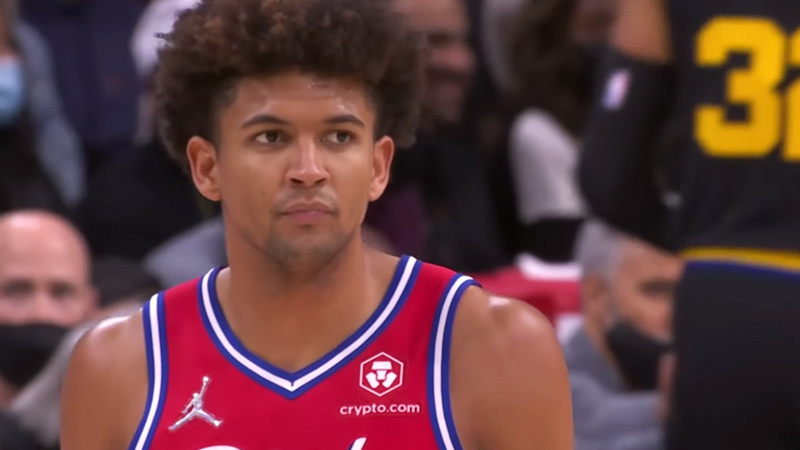
Matisse Thybulle remains one of the most polarizing figures in modern basketball, serving as a litmus test for how fans and analysts value defensive specialization.
Known for his elite instincts, he has carved out a niche as a high-impact disruptor capable of changing the trajectory of a game without scoring a single point.
However, as the NBA shifts toward versatile, multi-dimensional wings, the question of whether Thybulle is truly “good” becomes increasingly complex.
Across 377 regular-season games, his career has been a study in extremes—world-class defensive metrics contrasted with significant offensive limitations and recurring durability concerns.
The Master of Defensive Disruption
Matisse Thybulle is not merely a good defender; he is a generational defensive playmaker whose presence on the court alters how opposing offenses operate.
Over his six-season tenure in the NBA, he has established himself as an elite specialist, earning two NBA All-Defensive Second Team selections in 2021 and 2022.
His value is primarily rooted in his ability to generate “stocks”—the combination of steals and blocks—at a rate rarely seen among perimeter players.
The “Free Safety” Defensive Archetype
Scouts and coaches frequently praise Thybulle for his unique “roamer” instincts. Unlike traditional lockdown defenders who stay attached to their man’s hip, Thybulle often operates like a free safety on a football field.
He possesses an uncanny ability to read passing lanes and anticipate movements before they happen. One of his signature moves involves trailing a ball-handler over a screen and blocking their three-point attempt from behind—a feat that requires exceptional timing and length.
This “roaming” style allows him to act as a secondary rim protector despite his position as a wing, effectively shrinking the court for the opposition.
Elite Statistical Impact and Metrics
The data heavily supports the eye test regarding Thybulle’s defensive prowess. Throughout his career, which includes stints with the Philadelphia 76ers and the Portland Trail Blazers, he has maintained impressive defensive averages:
- Steals Per Game: 1.6
- Blocks Per Game: 0.8
- Advanced Analytics: Advanced defensive models such as Defensive EPM, RAPTOR, and LEBRON consistently rank him among the top 10 defensive players in the entire league when he is active.
These numbers are particularly striking given his career average of only 21.0 minutes per game. On a per-minute basis, his ability to disrupt the ball is nearly peerless among active NBA guards and forwards.
The Offensive Barrier to Stardom
While his defensive floor is incredibly high, Matisse Thybulle’s ceiling is restricted by a severely limited offensive repertoire. In the modern NBA, a “one-way player” often becomes a liability during high-stakes playoff basketball, where opposing coaches are adept at exploiting a team’s weakest link.
Thybulle’s offensive profile is characterized by low volume and inconsistent efficiency, which often leads to his team playing “four-on-five” on the offensive end.
The Challenge of Spacing and Gravity
One of the most significant issues teams face when playing Thybulle is his lack of “gravity.” Because he is not perceived as a consistent scoring threat, opposing defenses often “ignore” him.
This tactical choice allows defenders to sag off him and provide help-side pressure or double-team his star teammates, such as Joel Embiid during his time in Philadelphia or Damian Lillard during his early days in Portland.
His career scoring average of 5.0 points per game reflects a player who rarely seeks his own shot and lacks the ball-handling skills to create opportunities for others.
The Quest for a Reliable Jump Shot
For Thybulle to be considered a premier “3-and-D” player, the “3” component must be reliable. His career three-point average sits at 34.9%, which is slightly below the league average.
However, there have been flashes of improvement. For instance, in the 2025-26 season, he shot a career-high 39.8% from deep across 30 games.
| Shooting Metric | Career Average | 2025-26 Season Peak |
|---|---|---|
| Field Goal % | 43.8% | 43.3% |
| 3-Point % | 34.9% | 39.8% |
| Free Throw % | 68.3% | N/A |
| Effective FG% | 54.3% | N/A |
Despite these peaks, his inability to maintain high-level efficiency over a full season prevents him from keeping defenses honest. Without a consistent perimeter threat, his defensive contributions are sometimes negated by the offensive stagnation he causes.
A Quantitative Analysis of a Six-Year Career
To determine if Matisse Thybulle is “good,” one must look at the totality of his contributions across different environments. His transition from a contender like the 76ers to a rebuilding or developing squad like the Trail Blazers has provided a clear picture of his statistical floor and ceiling.
Since entering the league in 2019, his role has fluctuated between a specialized bench spark and a defensive starter.
Detailed Career Statistics Breakdown
His statistical output has remained remarkably consistent in terms of defensive disruption, even as his minutes and team context changed. In the 2022-23 season, following a trade to Portland, he started all 22 games he played for the Blazers, showing he could handle an increased workload when healthy.
Year-by-Year Performance Overview:
- 2019–20 (PHI): 4.7 PPG, 1.4 SPG, 0.7 BPG (65 Games)
- 2020–21 (PHI): 3.9 PPG, 1.6 SPG, 1.1 BPG (65 Games)
- 2021–22 (PHI): 5.7 PPG, 1.7 SPG, 1.1 BPG (66 Games)
- 2022–23 (PHI/POR): 4.1 PPG, 1.2 SPG, 0.5 BPG (71 Games)
- 2023–24 (POR): 5.4 PPG, 1.7 SPG, 0.7 BPG (65 Games)
- 2024–25 (POR): 7.5 PPG, 2.2 SPG, 0.6 BPG (15 Games)
- 2025–26 (POR): 5.8 PPG, 2.0 SPG, 0.5 BPG (30 Games)
The 2024-25 season saw him reach a career-high in points (7.5) and steals (2.2) per game, albeit in a very small sample size of 15 games due to injury. This suggests that when his body holds up, his impact on the stat sheet can be profound.
The Impact of Health and Durability
A critical factor in evaluating Thybulle’s current value is his recent struggle to remain on the court. For a player whose game relies so heavily on lateral quickness, anticipation, and high-energy movement, physical health is paramount. Unfortunately, the last two seasons have seen a sharp decline in his availability.
Recent Injury History and Limitations
In the 2024-25 season, Thybulle appeared in only 15 games, followed by just 30 games in the 2025-26 season. These absences have been attributed to a variety of lingering issues, including:
- Foot and Ankle Injuries: These are particularly detrimental to a defensive specialist who needs to navigate screens and keep pace with elite guards.
- Thumb Issues: Hand injuries can significantly affect shooting touch and the ability to poke the ball away for steals.
The lack of durability has prevented him from establishing a rhythm, particularly on the offensive end where consistency is already a struggle. For the Portland Trail Blazers, this inconsistency has made it difficult to integrate him as a permanent fixture in their long-term rotation.
Availability as a Component of “Goodness”
In professional sports, the “best ability is availability.” While Thybulle’s per-minute defensive impact remains elite, his inability to stay healthy over the past two years has lowered his overall value to the team.
A defensive stopper is only effective if they are available to guard the opponent’s best player during critical stretches of the season.
Is Matisse Thybulle Good? The Final Verdict
The answer to whether Matisse Thybulle is “good” depends entirely on the context of the team and the role he is asked to play. He is not a star, and he is likely not a primary starter on a championship-contending team due to the offensive compromises a coach must make to keep him on the floor.
The Specialist’s Role
If the question is whether he is an excellent defensive specialist, the answer is an unequivocal yes. For a team that needs a “stopper” to come off the bench and neutralize an elite scorer for 15–20 minutes, Thybulle is one of the best options in the league.
His ability to generate turnovers translates to easy transition points, which can help mask some of his individual offensive flaws.
The Realistic Outlook
However, his trajectory suggests he is a high-level role player rather than a foundational piece. His career averages of 5.0 points, 2.0 rebounds, and 1.1 assists indicate a player who does not contribute significantly to the flow of an offense.
When combined with his recent health struggles, the “goodness” of Matisse Thybulle is currently defined by intermittent brilliance rather than sustained excellence.
Frequently Asked Questions
What makes Matisse Thybulle an elite defender?
Thybulle is considered elite due to his exceptional “stock” (steals + blocks) production and his “free safety” approach to defense. He excels at off-ball roaming, jumping passing lanes, and blocking shots from behind, which is rare for a perimeter player.
Why are his offensive stats so low?
Thybulle has a career average of only 5.0 points per game. This is primarily because he lacks the ability to create his own shot and is often ignored by defenses, who prefer to focus their attention on more dangerous scoring threats.
How has he performed since joining the Portland Trail Blazers?
Since joining Portland during the 2022-23 season, he has shown flashes of improved three-point shooting, hitting nearly 40% in his most recent 30-game stretch. However, his time there has been marred by injuries, limiting him to only 45 games over the last two seasons.
Is he still a valuable asset in fantasy basketball?
In leagues that reward defensive categories like steals and blocks, Thybulle remains a high-value specialist. However, his lack of scoring and recent injury history make him a risky pick for overall utility.
Conclusion
Matisse Thybulle represents the ultimate defensive specialist in the modern NBA. While he possesses world-class defensive instincts and the ability to disrupt even the most sophisticated offenses, his limited scoring and recent health issues prevent him from reaching the upper echelon of NBA wings.
For a championship contender, he is a luxury—a specialized tool to be deployed in specific matchups. For the Portland Trail Blazers, he remains a veteran defensive presence whose future will depend on his ability to stay healthy and maintain the perimeter shooting improvements seen in his recent limited action.
Ultimately, he is “good” at his specific craft, but his value remains tied to how well a team can hide his offensive deficiencies.